
Dynamic vs Static Test Prioritization in CI Pipelines
 |
Modern software developers ship code faster than ever before. Continuous Integration and Continuous Delivery (CI/CD) practices have transformed software development. Instead of deploying application versions a few times a year, with CI/CD, organizations deploy changes multiple times a day. However, who doesn’t know that maintaining fast and reliable test feedback is becoming too complex with increasing development velocity?
One of the biggest bottlenecks here is that of test execution time in CI pipelines. When there are thousands of automated test cases to be executed after every code change, the situation becomes impractical.
Engineering teams address this challenge by using an approach called Test Prioritization. This is the process of determining which tests should be executed first to maximize defect detection while minimizing feedback time.
| Key Takeaways: |
|---|
|
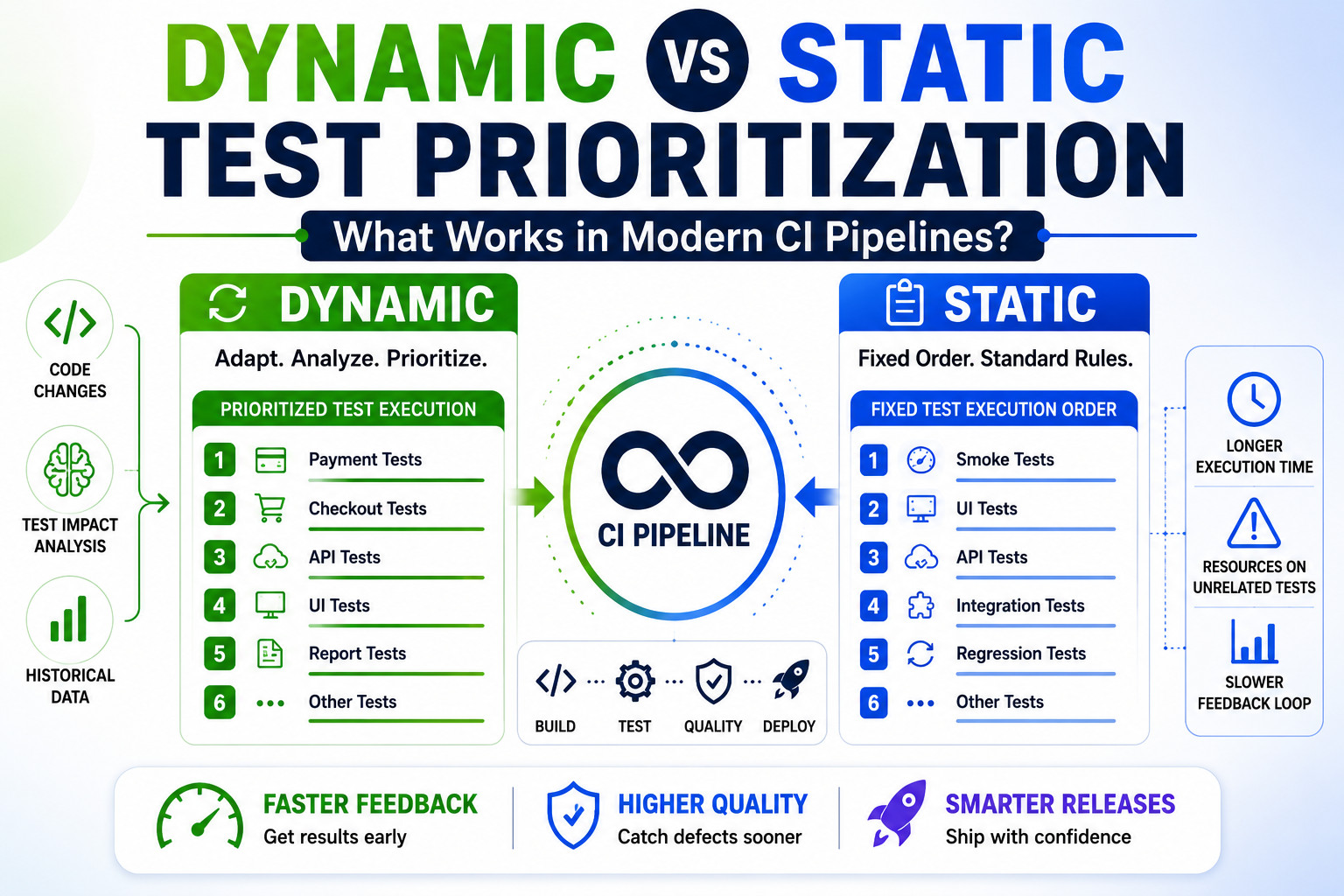
This article explores the strengths, weaknesses, and practical applications of both approaches and examines which strategy works best in modern CI environments.
What is Test Prioritization?
Test prioritization, also known as Test Case Prioritization (TCP) is the process of ordering (arranging) test cases so that the most valuable tests execute earlier in the pipeline.
Thus, instead of running test cases randomly or simply in the order they exist, test prioritization ensures that tests with higher risk, most critical functionality, or greatest business impact are executed first. The primary goal here is to identify failures as quickly as possible, reduce developer wait times and prevent defective code from progressing through the deployment process.
- Detecting defects early
- Reducing pipeline execution time
- Improving developer productivity
- Optimizing resource utilization
- Adapting to changing codebases
- Protecting core business features from breaking
The main challenge in test prioritization is to decide which tests are most important for a given code change. This necessitates the diversion of the test prioritization approach into two approaches: static and dynamic prioritization.
Read: Test Case Prioritization in Agile: 2026 Strategy Guide.
What is Static Test Prioritization?
Static test prioritization is a test prioritization approach in which test cases to run earlier are arranged based on the code’s structure, history, or documentation, without actually running the software. It essentially relies on predefined rules, historical assumptions, or manually assigned priority (order).
Static prioritization is used to find important bugs quickly when time or money is limited.
- Business criticality
- Test suite category
- Risk assessment
- Historical importance
- Manual tagging
- Feature ownership
For example, a team may decide that the smoke test suite should run first, followed by regression tests. Teams may also assign priorities such as P1 (critical), P2 (high), P3 (medium), and P4 (low) for each test case. Then the test cases are run in the order of their priority.
With static prioritization, the execution order remains mostly unchanged regardless of the specific code changes introduced.
Example of Static Prioritization
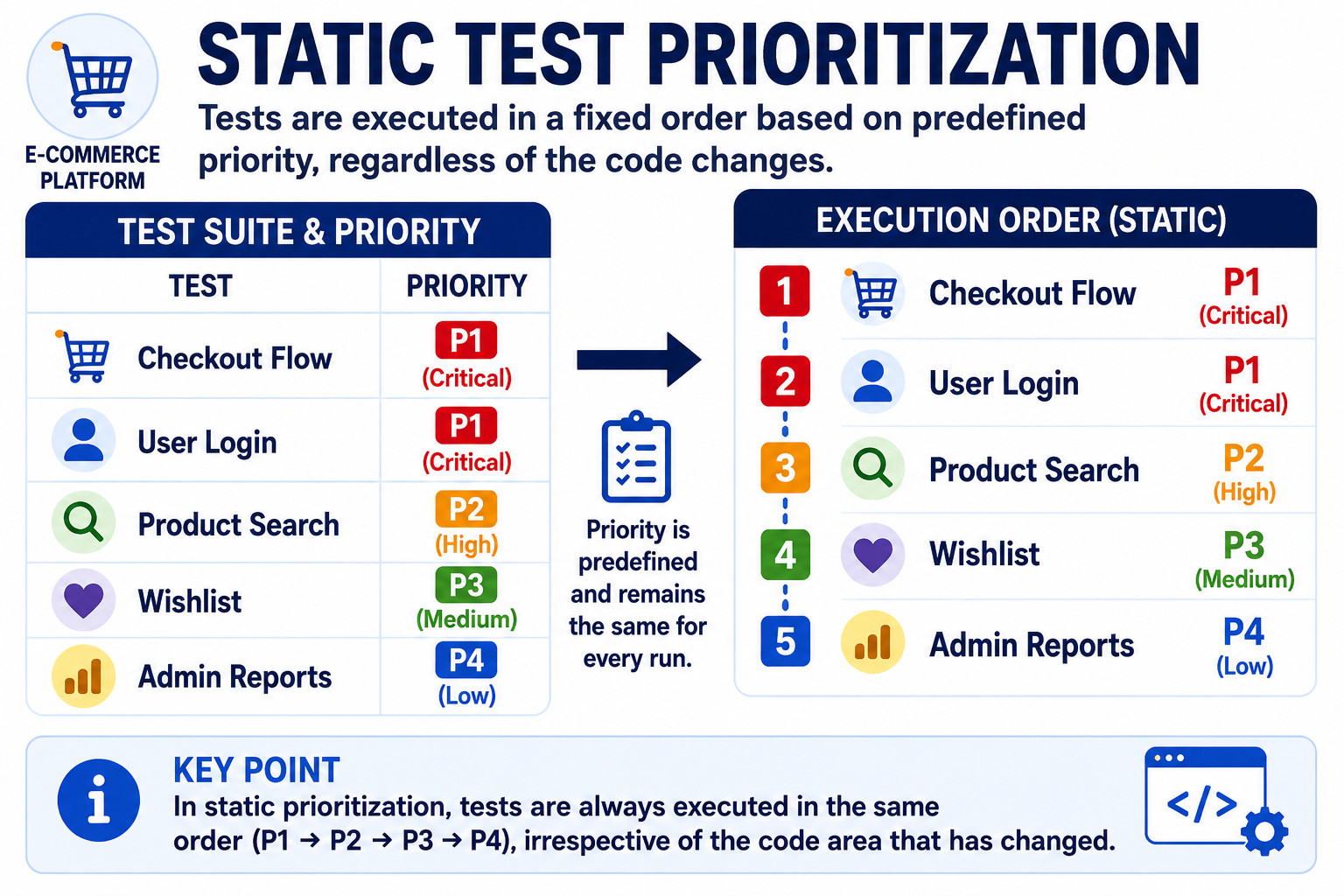
To demonstrate static prioritization, consider an e-commerce platform with the following tests:
| Test | Priority |
|---|---|
| Checkout Flow | P1 |
| User Login | P1 |
| Product Search | P2 |
| Wishlist | P3 |
| Admin Reports | P4 |
In static prioritization, every CI run executes tests in this predefined order. Even if the latest commit affects checkout functionality or reporting features, the order remains unchanged. The pictorial representation of static prioritization is shown below:
Advantages of Static Test Prioritization
- Simplicity: The process is easy to implement and understand. You don’t require sophisticated tooling or analytics; you can establish the rules yourselves. For example, you can decide to run smoke tests first, then execute API tests followed by UI tests, and prioritize critical business workflows.
- Faster Bug Detection: You can find defects early in the design and documentation phase before execution.
- Cost Efficiency: Static prioritization reduces expensive reworking by stopping issues from reaching later stages.
- Quicker Execution: Prioritized critical tests are executed first to catch major faults rapidly.
- Improved Quality: It identifies code standard violations and improves overall maintainability.
- Resource Optimization: Static prioritization conserves compute resources and valuable time by avoiding redundant test runs.
Limitations of Static Test Prioritization
- No Execution Context: Static prioritization cannot identify issues such as runtime memory leaks, hardware interaction faults, or environment-specific crashes.
- Static Analysis Flaws: There is a possibility of automated tools generating false positives, forcing teams to waste time reviewing non-issues.
- Stale Historical Data: This approach heavily relies on past error data. Due to this, new code changes often introduce unpredictable, unprecedented bugs.
- Missed Complex Logic: Static prioritization finds it difficult to catch complex architectural flaws, authentication problems, and subtle data-flow bugs.
- Granularity Issues: If broken down to tiny, individual test methods instead of using whole classes, prioritization scores often become less accurate and effective.
- Blind to Dynamic Changes: This method does not account for data that only changes while the application is running, leaving data-driven paths unchecked.
What is Dynamic Test Prioritization?
Dynamic test prioritization is a test prioritization strategy in which the tests to be executed are continuously reordered in real-time.
This adjustment is done based on recent code changes, immediate feedback, and past execution history. Dynamic test prioritization aims at catching critical bugs early in the development cycle.
- Changed code files
- Code coverage data
- Historical test failures
- Dependency graphs
- Runtime behavior
- Machine learning predictions
- Recent defect patterns
Depending on the specific code changes, the prioritization changes for every CI run.
Example of Dynamic Prioritization
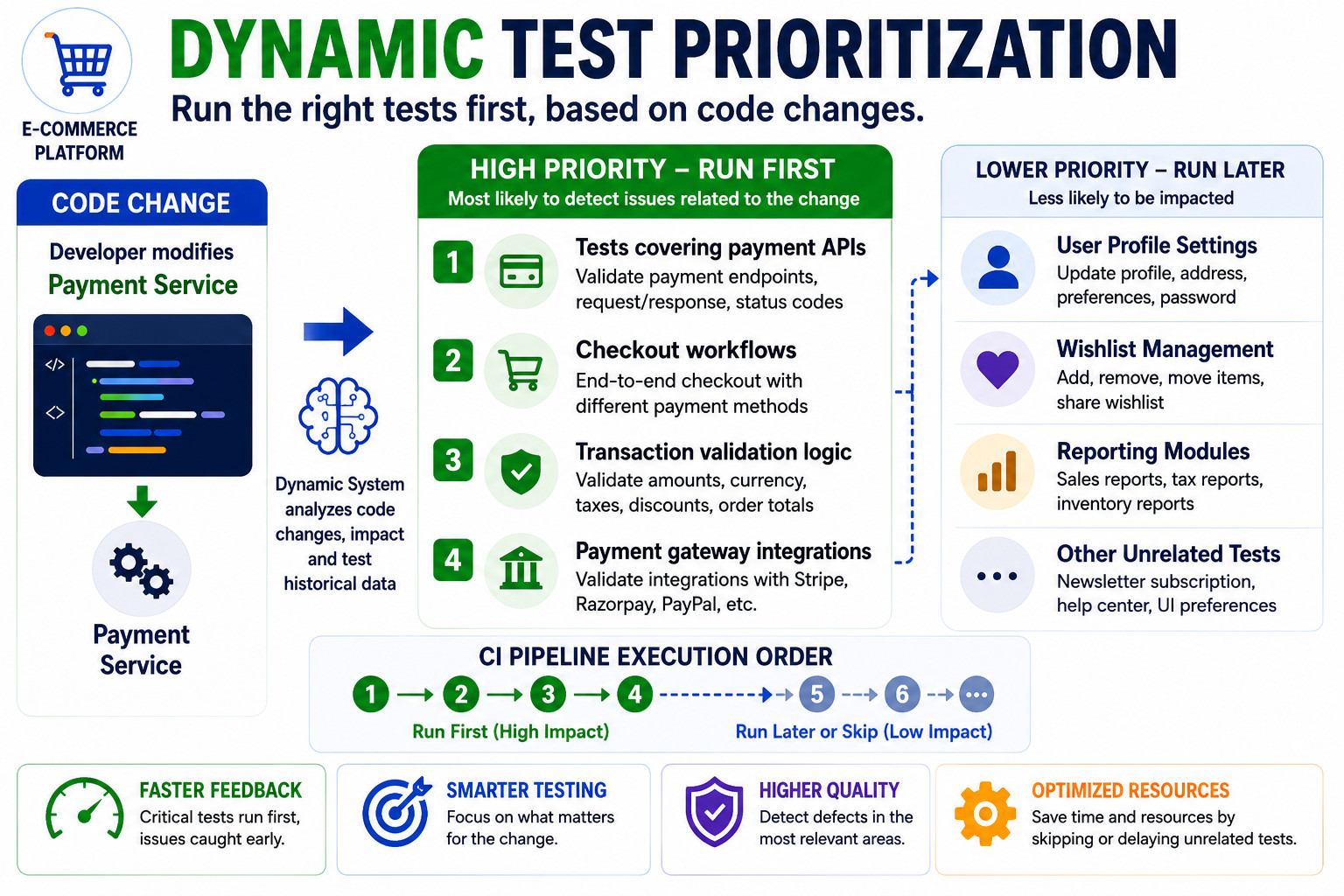
Let us take an example of an e-commerce platform. Suppose a developer modifies the payment service.
- Tests covering payment APIs
- Checkout workflows
- Transaction validation logic
- Payment gateway integrations
These tests are mostly likely to detect issues related to above change and would execute first.
Unrelated tests, such as user profile settings or reporting modules, may run later or be skipped entirely.
Advantages of Dynamic Test Prioritization
- Faster Feedback: Dynamic prioritization focuses on the test cases most likely to fail. Developers get rapid alerts on recently changed or fragile code areas, reducing context switching and accelerating debugging.
- Better Defect Detection: Dynamic prioritization is based on actual code changes, it often identifies defects earler that its static counterpart.
- Improved CI Efficiency: Dynamic prioritization allocates testing resources where they are needed rather than treating every code change as equal. This reduces build times, compute costs, and infrastructure consumption.
- Scalability: Static prioritization may become challenging to maintain as applications grow. Dynamic prioritization scales naturally as the decisions are generated automatically.
- Continuous Adaptation: A dynamic prioritization approach continuously adapts to new features, emerging defect trends, changing user behavior, and refactored code.
This adaptability makes them well-suited for modern development environments.
Challenges of Dynamic Test Prioritization
- Higher Implementation Complexity: Building a dynamic prioritization system often requires code coverage collection, dependency mapping, test analytics infrastructure, and data processing pipelines. The organization is also expected to invest in tooling and engineering effort.
- Data Quality Dependence: There is a strong dependence on data and its quality. The data provided should be complete and accurate. Incomplete coverage information or inaccurate dependency graphs can reduce effectiveness.
- Infrastructure Overhead: Execution metadata needs to be collected and maintained, which introduces additional storage and processing.
- Potential Blind Spots: Impacted areas should be adequately prioritized; otherwise, the defects may go unnoticed and slip into production.
Dynamic vs Static Test Prioritization: Key Comparison
The following table provides the key comparison between dynamic and static test prioritization:
| Feature | Dynamic Prioritization | Static Prioritization |
|---|---|---|
| Primary Mechanism | Analyzes historical run data, coverage metrics, and past test pass/fail states. | Examines unexecuted code dependencies and changed source files. |
| Execution State | Evaluates while running the software. | Evaluates without running the software. |
| Primary Goal | Correct defects by finding runtime bugs, memory leaks, or performance issues. | Prevent defects by finding logic or structure flaws early in development. |
| Speed/Efficiency | Requires initial data processing but yields massive time savings by skipping tests. | Very fast for preliminary checks; requires static code analysis tools like STARTS. |
| Fault Detection | Best at identifying regression bugs, memory leaks, and complex runtime failures. | Excels at finding logic errors, syntax flaws, and code structure issues. |
| Tooling Example | AI-driven tools like CloudBees Develocity Predictive Test Selection. | Static Application Security Testing (SAST) tools like SonarQube. |
| Common Use Cases | Regression testing, Continuous Integration (CI/CD) pipelines. | Code reviews, static analysis scans, and requirement walkthroughs. |
| Feedback Timing | Later in the development life cycle (during and after implementation). | Immediate (early in the design and coding phases). |
| Cost | More expensive; requires setting up environments and executing tests. | Less expensive since it doesn’t require a live test environment. |
| CI Speed Improvement | Significant improvement | Moderate speed |
| Scalability | Excellent scalability | Limited |
| Infrastructure Requirements | Advanced infrastructure required | Minimal infra required |
| Setup Complexity | Highly complex to build a dynamic prioritization system | Easy setup |
| Maintenance Effort | Automated but data-intensive | Moderate maintenance |
From the above comparison, you can see a clear pattern: static approaches prioritize simplicity, while dynamic approaches optimize effectiveness.
The Role of Test Impact Analysis (TIA)
A major enabler of dynamic prioritization is Test Impact Analysis (TIA).
TIA is a testing technique to identify and run only the tests affected by recent code changes. For this purpose, it analyzes recent code modifications.
TIA skips redundant or unaffected tests, and drastically reduces testing time, saves compute resources, and accelerates developer feedback loops in CI/CD pipelines.
- Source code
- Dependencies
- Automated tests
Thus, when code changes occur, the system determines which tests are most relevant to those changes.
Real-World Example of TIA
Imagine an e-commerce application containing a test suite of 5,000 automated tests. This test suite takes roughly 4 hours to run.
Let’s say a developer changes the Shipping Discount Logic in the code.
- The TIA tool identifies that the change only affects the
CheckoutService.javafile. - It cross-references the code map and determines that only 150 tests cover the
CheckoutService.javafile. - The TIA tool then dynamically reorders those 150 tests, putting recent failing tests at the top of the queue.
- Finally, it executes only those 150 tests, reducing testing time from 4 hours to just 5 minutes.
Machine Learning and Intelligent Prioritization
The latest generation of dynamic prioritization systems incorporates machine learning.
These systems use artificial intelligence (AI) to analyze historical failures, code churn, developer activity, test flakiness, and defect density.
Based on these signals, AI predicts which tests are most likely to uncover problems.
In AI prioritization, instead of running thousands of tests manually or in an arbitrary order, systems use ML algorithms to dynamically rank test cases based on the above factors.
Its primary goal is to catch bugs much earlier while saving significant time and computing resources.
- Authentication tests frequently fail after configuration changes.
- Checkout tests are highly correlated with payment service updates.
- Certain integration tests consistently detect regressions in specific modules.
The system can then rank tests according to predicted failure probability, creating a continuously improving prioritization model.
- Change Impact Analysis (CIA): ML tools map the relationship between test cases and specific code files. When developers make code changes or commits, the system automatically raises the priority of tests that cover the affected components.
- Failure Probability Modeling: AI models analyze historical data to learn frequently failing tests. Tests with a history of uncovering critical defects are moved to the front of the execution queue.
- Risk-Based Scoring: An AI model assigns a risk score to different sections of the software based on developer activity and code complexity. The high-risk modules are tested first.
- Continuous Learning: The AI models for test prioritization are self-learning. New data is constantly gathered from pipeline executions, and the predictions are continuously refined to make the next test run faster and more accurate.
CI/CD Trends Driving Dynamic Prioritization
Dynamic test prioritization in CI/CD pipelines is rapidly evolving into a highly adaptive, AI-driven practice from its traditional basic rule-based sorting. It is driven by the need to accelerate deployment cycles, cut computing costs, and manage massive test suites. At the centre of these systems is the intelligent orchestration rather than blindly running all tests.
- Predictive AI/ML Models: ML evaluates exact code changes, historical defect data, and developer activity to predict the system areas that are at the highest risk. Test execution sequence is then automatically rearranged by the model to run high-risk tests first.
- Impact Analysis: Automated tools determine the exact components that have been touched/modified by process of smart code diffing. Once the components are identified, the unrelated test suites are skipped entirely and only the tests required for modified components are dynamically triggered.
- Larger Test Suites: Modern, large enterprises often manage tens of thousands of tests, multiple microservices, and complex integration environments. This entire ecosystem cannot be executed on every commit. Hence, intelligent prioritization is a necessity.
- Frequent Deployments: Organizations with CI/CD may perform hundreds of deployments every day. In this case rapid feedback becomes essential.
- Cloud Infrastructure Costs: Dynamic test prioritization emphasizes on the “cheapest and fastest first” principle. This aborts pipelines early if critical flaws are detected to avoid wasting resources on a broken build and executing unnecessary tests that increases cloud spending. Thus, dynamic prioritization reduces compute consumption.
- Shift-Left Quality Practices: Teams have increasingly started to prioritize identifying issues as early as possible (shift-left testing). With test prioritization, relevant tests align perfectly with shift-left principles.
- Flaky Test Management: Flaky, unstable tests are dynamically sidelined or relegated to non-blocking background runs with test prioritization instead of halting a pipeline completely.
The Hybrid Approach: Best of Both Worlds
Instead of relying on only one test prioritization approach, many organizations ultimately adopt a hybrid strategy.
A common workflow for the hybrid approach looks like this:
- Smoke tests
- Security tests
- Critical business workflows
Analyze code changes and prioritize relevant tests.
- Nightly
- Weekly
- Before major releases
Such a hybrid model balances speed, reliability, and risk management. It also prevents dynamic systems from overlooking unexpected defects.
How Modern Testing Platforms Support Dynamic Prioritization
Modern test automation solutions increasingly support intelligent execution prioritization strategies.
- Analyze test execution history
- Identify impacted areas automatically
- Detect flaky tests
- Optimize parallel execution
- Prioritize tests based on risk
For example, several codeless automation platforms and AI-powered testing tools are utilizing runtime analytics to make smarter execution decisions without requiring extensive manual configuration.
As CI/CD ecosystems evolve further, intelligent test prioritization is becoming a standard capability rather than a niche optimization.
How testRigor Supports Dynamic Prioritization?
testRigor supports dynamic test prioritization primarily through its AI-driven execution intelligence, test analytics, and CI/CD integration capabilities. It does not just rely on fixed test orders, but executes tests that are most relevant to recent changes and business-critical workflows.
- Prioritization Based on Recent Changes: When you modify a specific area of an application, like the payment service in an e-commerce application, teams can prioritize tests covering payment APIs, checkout workflows, transaction validation, and payment gateway integrations.
Hence, the most relevant tests related to these modules execute first so that teams can identify issues faster and shorten feedback loops.
- AI-Powered Test Optimization: testRigor utilizes AI to determine what to test first. Testing is prioritized based on:
- User behavior and critical business flows
- Test stability
- Recent application changes
- Historical execution insights
- Focus on High-Impact User Journeys: testRigor tests are written from an end-user perspective in plain English. Hence, critical business workflows such as Login, Checkout, Order placement, and Payment processing are prioritized to ensure that the business-critical functionality is validated first during CI runs.
- Faster CI/CD Feedback: Teams can detect failures earlier, reduce overall pipeline execution time, improve developer productivity, and optimize testing resources by executing most relevant tests first. This feature aligns with dynamic test prioritization used in CI/CD pipelines.
As an example, suppose a developer updates the Payment Service.
- Payment API Tests
- Checkout Flow Tests
- Transaction Validation Tests
- Payment Gateway Integration Tests
This is because code changes in Payment Service will directly affect the above components/modules.
- User Profile Tests
- Wishlist Tests
- Reporting Module Tests
This approach used by testRigor provides faster feedback on the areas most likely to be affected by the change, rather than running the entire suite in a fixed order.
Conclusion
Whether to choose static or dynamic test prioritization is a broader challenge in the modern software industry and needs balancing speed with quality.
Static prioritization is simple, predictable, and has low implementation overhead. It is a practical choice for smaller teams, smaller applications, and highly regulated environments.
However, static optimization is not sufficient for modern CI pipelines that increasingly demand greater efficiency. As test suites grow and deployment frequencies rise, dynamic test prioritization provides a more intelligent solution by adapting to real-time code changes, focusing resources on the most relevant tests, and delivering faster feedback to developers.
However, the most effective prioritization strategy is neither purely dynamic, nor purely static. It is the hybrid approach that combines always-on critical tests with intelligent, change-aware prioritization, offering the optimal balance between speed, coverage, and confidence.
Frequently Asked Questions (FAQs)
- Which is better, static or dynamic test prioritization?
When it comes to large, fast-moving applications, dynamic test prioritization is generally more effective because it adapts to code changes and focuses on the most relevant tests. However, static prioritization remains useful for smaller projects or teams that need a simpler implementation with minimal overhead.
- Can machine learning improve test prioritization?
Yes. Machine learning can analyze historical test results, code changes, defect patterns, and test execution data to predict which tests are most likely to fail. This enables more intelligent and accurate test prioritization in CI/CD environments.
- Is static test prioritization still relevant today?
Yes, it is. Static prioritization remains valuable for smaller applications, highly regulated industries, and teams with limited resources. It offers simplicity, predictability, and lower implementation costs compared to dynamic approaches.
- How often should teams run a full regression suite if they use dynamic prioritization?
Even with dynamic prioritization, teams should periodically run full regression suites, typically nightly, weekly, or before major releases, to ensure that unrelated defects are not missed and overall application quality remains high.
| Achieve More Than 90% Test Automation | |
| Step by Step Walkthroughs and Help | |
| 14 Day Free Trial, Cancel Anytime |