
How to Effectively Communicate Quality to Stakeholders?
 |
Quality is by far the most commonly discussed concept in software development. But perhaps ironically, one of the least well understood. Everyone agrees that quality is essential. Executives desire it, it’s requested by customers, and it’s diligently worked on by your engineering teams. While the QA team even builds a career out of ensuring you have it.
However, as soon as we need to convey quality to the stakeholders. All hell breaks loose.

Why does this happen? It’s because there is no one thing called “quality”.
- To a CEO, it might be brand reputation and customer confidence.
- To a product manager, it might mean fewer customer complaints in the wake of release.
- To an engineering manager, it’s system stability and predictable delivery.
- For a QA specialist, that would be coverage, defect prevention, and confidence in the releases.
All of these perspectives are valid. But the problem is that they rarely speak the same language.
| Key Takeaways: |
|---|
|
Why Quality Feels Abstract
The biggest problem in communicating quality is that quality itself is abstract. It does not fit into one metric. Unlike revenue or user growth, it arises from a complicated web of interrelated factors like clarity about requirements, design choices, the architecture of your codebase, and the extent to which your system is adequately tested and reliable. It is also defined by teamwork, release cadence, and actual behaviour of customers over time.
When stakeholders ask whether something is good-quality, they aren’t typically asking a technical question. What they really want to know is if it’s safe to ship, will our customers be impacted, and are there unseen risks that could bite the team later? Effective quality communication begins by redefining the context of our conversations from being about test cases or defect counts to revolve around risk, impact, and confidence.
Read: Quality Assurance vs. Quality Control: Know The Difference.
Communicating Quality Through Storytelling
Where teams really have trouble is when they treat quality communication as a mere reporting exercise to check the box on test cases, defect counts or pass/fail percentage. So while an organization could get these stats as accurately, they rarely tell stakeholders the true question – what do the results mean for our business? Without context, information gets sent and cognition doesn’t get created.

Quality communication is not so much about announcing as it is about storytelling. A powerful quality story tells what could go wrong. How likely it is that it will and what the impact would be (including what has already been done to reduce risk). Without this narrative flesh, metrics are just a kind of noise and not indicators of better decision-making.
Read: A Non-Technical Founder’s Guide to Product Quality.
Stakeholder Communication: Perspectives on Quality
One of the key rules in quality communication is that people care about different things when it comes to quality. Because each role evaluates quality according to its priorities and risks, there is rarely a single, uniform message that sticks. Effective communication is about the message, not one size fits all. Let us see how and why.
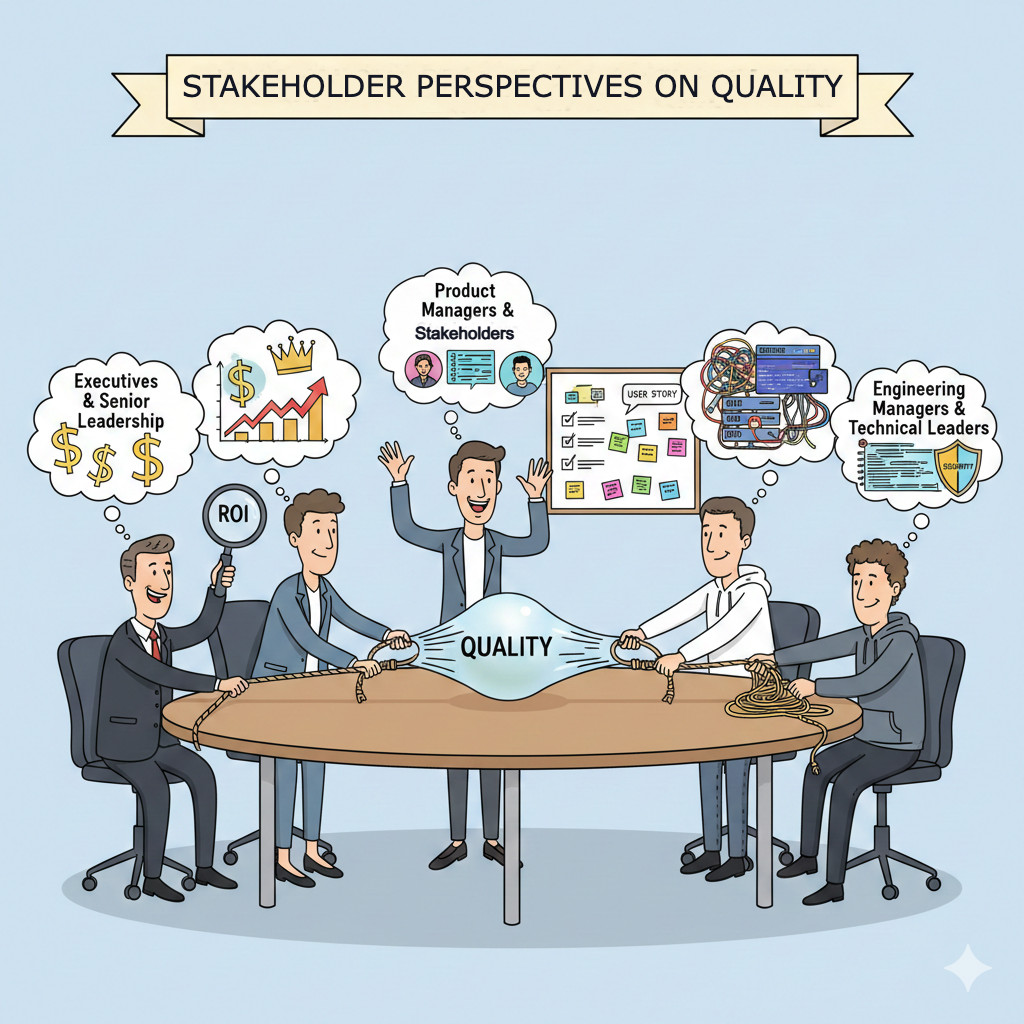
Executives and Senior Leadership
Most senior leaders couldn’t care less how the business gets done and often think in strategic terms. Usually, their concerns are all about customer satisfaction, brand integrity, revenue at risk, compliance exposure, and predictability of delivery. See both sides of this kind of debate, from a business perspective, rather than technical completeness.
In communicating quality to upper management (as with any group, for that matter,) there is the cardinal rule. Do not do deep dive technical and focus on outcomes, not activities. Quality should be described in terms of risk, confidence and explicit trade-offs to enable informed decision-making. For instance, rather than saying that you have open bugs, you explain what certain specific issues could do to the reliability of checkout. Also, how it could impact releasing a campaign.
Read: QA from the Engineering Leader’s Perspective.
Product Managers and Business Stakeholders
Product Stakeholders are at the apex of what the customer wants and what is capable of being delivered. They evaluate the usability, feature-completeness, known serious issues (bugs), customer-impacting risk, and release-readiness in general. Great discussions in this group should always tie back to how users are going to interact with the product.
When informing recipients and evaluators about quality, transparency is more valuable than enthusiasm. They need to understand what is safe, where users will have a hard time and what voids they can fill. Obvious signs of confidence in primary user journeys help them in the prioritization and release decisions they make.
Read: Test Manager Cheat Sheet.
Engineering Managers and Technical Leaders
Technical audiences generally prefer a more granular view but they still need to know the context. Among the specifics to be focused upon are system stability, causes of defects deep in the code base, technical debt levels, quality and trustworthiness of tests, and long-term sustainability. At this level of severity, a serious discussion is required that links technology discoveries to real system operation and risk.
For a technical crowd, communicating quality might be about patterns, trends, failure modes, and points of brittleness. It should also emphasize preventive actions and architectural implications instead of isolated issues. Even where we have data in all its richness, quality must always be placed in the context of priorities and decisions, rather than raw measurements.
Read: How to Become an Engineering Manager.
How to Communicate with Stakeholders
Let us see some useful advice on how to communicate with stakeholders under different circumstances.
Reframing Quality in Stakeholder Communication
One of the most impactful shifts in quality communication is repositioning quality as risk management rather than perfection. Quality is not about holding the line on all defects. It’s about understanding what your risks are and how you’re addressing them across the overall offering. All systems present a range of functional, performance, security, usability, data integrity, and integration risks.
When quality is defined as impact, likelihood, and mitigation there is an intuitive understanding of risk by stakeholders. By framing quality as “these are the risks we see and here’s how we’re managing them”, these conversations tend to be clearer and more productive. This method precludes unwarranted certainty. And it replaces categorical assertions with clear levels of confidence.
Read: Technology Risk Management: A Leader’s Guide.
Beyond Vanity Metrics When Presenting Data to Stakeholders
Most companies use metrics that look good on paper, but don’t provide useful insight into product quality. The typical vanity metrics are frequent numbers, such as the number of test cases, automation percentages, and low defect counts, without context, and green dashboards without explanation. While such metrics may serve as indicators of activity and progress, at best, they don’t represent real risk or customer impact in all cases. Therefore, they can be misleading rather than informative.
Effective quality communication depends on metrics that reflect real risk, connect directly to user impact, and support decision-making. Instead of reporting a simple pass rate, it is more valuable to explain what was truly validated and what remains uncertain.
For example, stating that all critical user flows passed while edge-case error handling remains untested provides meaningful context. This approach helps stakeholders understand both confidence levels and remaining exposure.
Read: Essential QA Metrics to Improve Your Software Testing.
Stakeholder Communication Plan: Technical Findings to Business Language
The single most important skill of quality communication is having the ability to convert technical findings into meaningful business implications. Both QA and engineering teams frequently encounter race conditions, memory leaks, timeout failures, inconsistent APIs or data synchronization issues. These problems are technically difficult to solve, but there is no need for stakeholders to understand how they work. What they need to do is understand the impact these issues have on users, revenue, and trust.
Good translation works between what doesn’t work and why it should. A phrase like “race conditions against async statefulness” might be correct, but it does not provide much in the way of explainability for folks who are not technical. Turned into “users may experience unexpected behaviour when making very fast inputs”, the risk is materialized.
This is how to ensure that the best discussions lead to understanding, alignment, and decision-making, rather than confusion.
Stakeholder Communication: Building Confidence, Not Just Status
Stakeholders care less about whether work is complete and more about how confident the team is in success. Confidence helps them feel secure, stable and ready to take things on. Because communicating confidence cleanly establishes the tone and prevents surprises when it does get out.
Confidence is influenced by:
- Test Depth: Increased depth of testing builds confidence that expected and unexpected behaviors have been exercised.
- Coverage of Critical Scenarios: Confidence is increased when your core user journeys and business-critical flows are validated thoroughly.
- Stability of Recent Changes: The fewer last-minute changes and less time for full changes within the build facilitate confidence in quality.
- History of Similar Releases: Past release outcomes provide signals about how reliable the current release is likely to be.
- Known Unknowns: Acknowledging areas that remain untested or uncertain lowers false confidence and builds trust through transparency.
Effective quality communication clearly states what the team is confident about, such as well-tested critical user flows or stable core functionality. It also openly highlights areas where confidence is lower, like edge cases, integrations, or recently changed components. Explaining why this confidence varies builds transparency and trust, even when the message isn’t entirely positive.
Stakeholder Communication Strategy
An effective stakeholder communication strategy is discussed in this section.
Make Quality Visible Over Time
Quality is not a picture that is taken at one point in time. It is actually a trend over time. What is really happening can hardly be reported in a one-time report. Or it continues to give us an accurate or real state of the quality direction. Good quality communications demonstrate the way that quality is changing and whether or not the total risk has been reduced or increased.
This can be achieved by comparing releases and highlighting recurring problem areas. Also, by showing reductions in specific risk categories. Demonstrating learning, adaptation, and continuous improvement makes quality progress visible. When stakeholders see consistent improvement over time, they gain confidence in the process, not just the current product.
Address Bad News Early and Clearly
One of the fastest ways to lose stakeholder confidence is attempting to conceal or delay bad news. Good communication isn’t about positive thinking. It is about clarity over responsibility. That sort of procrastination-as-communication strategy often just exacerbates risk and undermines trust when things go wrong. Early truth-telling manages expectations through no unexpected surprises.
When problems occur, they should be raised early with an open clarification of the potential impact. By sharing a well-defined plan for addressing the issue, stakeholders can appreciate how risk is being effectively managed. Equal emphasis should be placed on being explicit about the trade-offs and consequences of alternative choices. Stakeholders are able to process bad news much better than a surprise.
Avoid the “QA vs Business” Narrative
Poor quality communication often reinforces unhealthy dynamics between teams and creates unnecessary tension. Instead of aligning around shared goals, groups begin to see each other as obstacles or risks.
- QA as Blockers: QA is perceived as slowing progress rather than protecting customers and the business.
- Business is Reckless: Business stakeholders are viewed as prioritizing speed over stability and long-term impact.
- Engineering is Caught in the Middle: Engineers feel pressured to satisfy conflicting demands without clear guidance or support.
Good communication makes quality a joint venture as opposed to a gatekeeping function. Repositioning phrases like “QA is unable to sign off” as a risk-based narrative allows stakeholders to see the consequences of their actions. This method builds cooperation and well-informed compromises rather than producing discord or guilt.
Make Quality a Decision-Support Function
At its best, good communication does not decide but facilitates decisions. Quality professionals are there to bring clarity, not be gatekeepers. Quality, then, is the input to this process that can be relied on because it depends not on approval, but on internal factors.
- Clear Information: Quality communication presents facts in a way that is easy to understand and act upon.
- Honest Risk Assessment: It openly explains potential risks without minimizing or exaggerating them.
- Evidence-based Insights: Decisions are supported by data, observations, and real system behavior rather than assumptions.
Build Credibility Over Time
Quality communication is developed over time. It is not a one-off event. Credibility increases if messages are accurate, risks are not downplayed, and predictions align with outcomes. We need to recognize and learn from lessons. Especially failures, this reinforces transparency and accountability. Eventually, stakeholders begin to trust quality signals and rely on them with confidence.
Create a Culture Where Quality Conversations Thrive
Finally, quality communication isn’t just about reports or meetings. It is about culture. Quality is a shared responsibility, not an isolated practice in healthy organizations. This cultural underpinning influences the extent to which quality is openly and constructively discussed.
When quality is respected, discussions are encouraged, risks are acknowledged, and trade-offs are made explicit. Teams focus on learning and improvement instead of blame or defensiveness. In such environments, quality communication becomes natural, clear, and far more effective.
Conclusion
The ability to communicate quality effectively is not only a QA skill. But it’s also a leadership trait that impacts how decisions are made. It takes empathy for a variety of opinions. It requires skill in translating complexity to simplicity and courage to tell truths that might make us uneasy. Also, a focused attention on what matters. A well-implemented quality ceases to be perceived as an obstacle. It is turned into a strategic resource for the company.
During rapid releases, AI-driven development, and growing complexity, success belongs to teams that can clearly explain the meaning of their testing results. Quality, when communicated effectively, brings trust and facilitates better decisions. This ultimately yields superior and high-quality products to the user.
| Achieve More Than 90% Test Automation | |
| Step by Step Walkthroughs and Help | |
| 14 Day Free Trial, Cancel Anytime |