Why Testers Should Pay Attention to Claude’s Agent Skills
 |
Claude is no longer just answering prompts. With Agent Skills, it can follow structured workflows, use company-specific instructions, and complete repeatable tasks. That matters for QA. Much of testing is repetitive, process-driven, and based on defined standards. This means that it could affect test creation, maintenance, reporting, and release support.
Getting LLMs to perform tasks is not new. What is changing is how those tasks are packaged into repeatable workflows – and how easily teams can reuse them, especially since big names are making these “skills” accessible to all.
| Key Takeaways: |
|---|
|
What are AI Skills in LLMs?
Skills in LLMs are reusable workflows that let AI systems perform specific tasks consistently. Anthropic and OpenAI now describe “skills” as reusable ways to guide AI through specific workflows, although each platform implements them differently.
What are Claude Agent Skills?
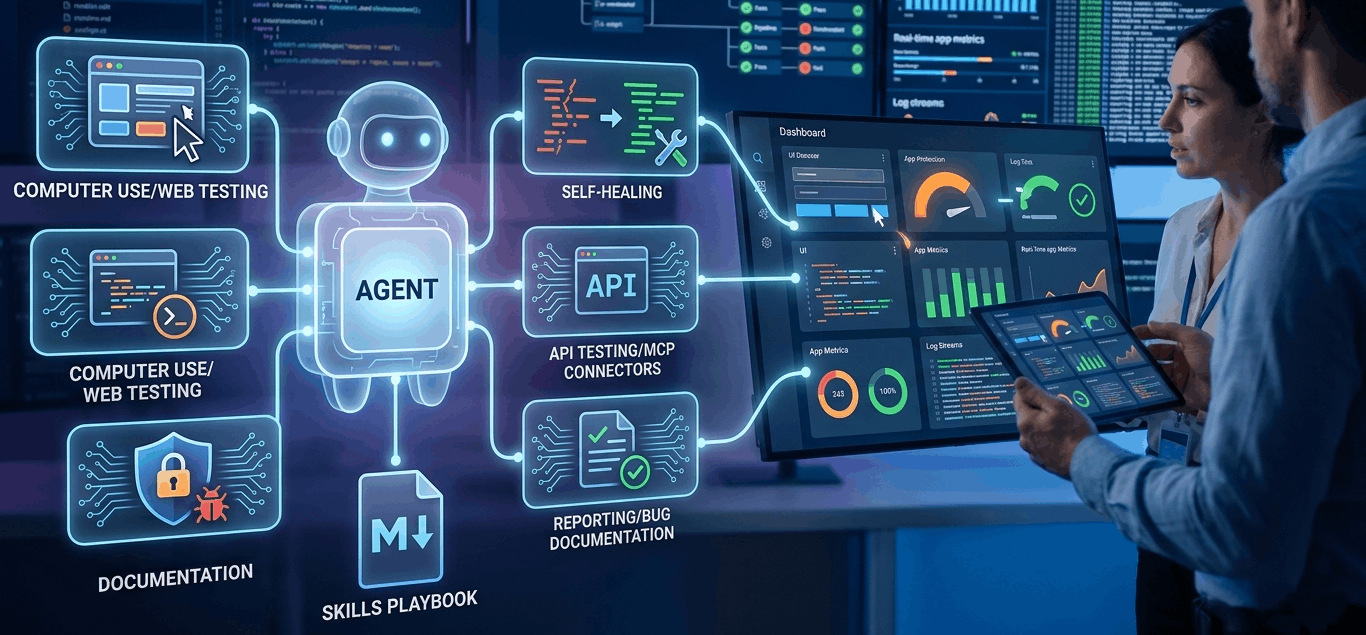
In Claude, skills are structured folders (SKILL.md file) that act as the “brain” for the agent to accomplish a specialized task. These skills also give the agent the context that is relevant to the user/team/company, essentially becoming a playbook for the agent.
- Built-in Skills: These are built-in and maintained by Anthropic. Claude will load them as and when needed.
- Custom Skills: These are folders that you can create to tackle custom tasks or workflows that are specific to your domain or organization. For example, you could have a skill file to structure meeting notes in your company’s specified format, or a skill that writes unit tests according to your company’s standards.
- Partner Skills: You can also avail skills from the Skills Directory and find skills that partners like Atlassian and Figma provide. These skills work well to ensure seamless collaboration.
Why “Open Standard” Matters to You
While Agent Skills were originally developed by Anthropic, they have been released as an open standard. If skills continue to converge around shared file-based patterns like SKILL.md, QA teams may be able to reuse more of their workflow logic across tools over time.
How Does This Impact QA?
For QA teams, the question has usually been simple: what can this tool actually automate? With the right skill setup, Claude can handle parts of QA work that used to require custom tooling or manual setup. This lowers the barrier for teams that want to automate more without building everything from scratch.
You can even use multiple agents with different skills (one for UI, one for API, one for security) working in parallel to speed up parts of release validation.
- Generate test cases or automation scaffolds
- Assist with test maintenance and flaky locator updates
- Summarize failed runs and identify patterns
- Format bug reports or Jira-ready defect drafts
- Create or transform test data
- Review gaps in coverage across user flows
- Support API, UI, and regression-related workflows
- The built-in options are available directly through Claude for tasks like document and file handling.
- Anthropic’s public GitHub repository, which includes example skills such as
webapp-testingfor testing local web apps using Playwright. - Third-party directories and repositories. These should be evaluated carefully, especially for security and access control.
A Note of Caution…
- False confidence: A skill can make outputs look consistent without making them correct.
- Test debt at scale: Poorly designed skills can generate large volumes of weak or redundant tests.
- Security and access issues: Skills that interact with internal tools, environments, or data need governance.
- Maintenance overhead: Skills themselves become assets that need updates, reviews, and ownership.
- Coverage gaps: Fast generation does not guarantee the right scenarios are being tested.
The Bottom Line for Testers
QA is entering a phase where more testing work can be packaged into reusable workflows. Agent Skills are one of the clearest signs of that shift. They are not about replacing testers, but reducing repetitive work. If you can define a testing process in a SKILL.md file, the agent can execute it. This allows QA teams to stop worrying about how to automate and start focusing on what needs to be tested to ensure a flawless user experience.
The real question for QA teams is not whether to use them, but which testing workflows are worth turning into reusable, governed skills.
| Achieve More Than 90% Test Automation | |
| Step by Step Walkthroughs and Help | |
| 14 Day Free Trial, Cancel Anytime |