
Testing Localizations and Global Compliance in ERP Systems
 |
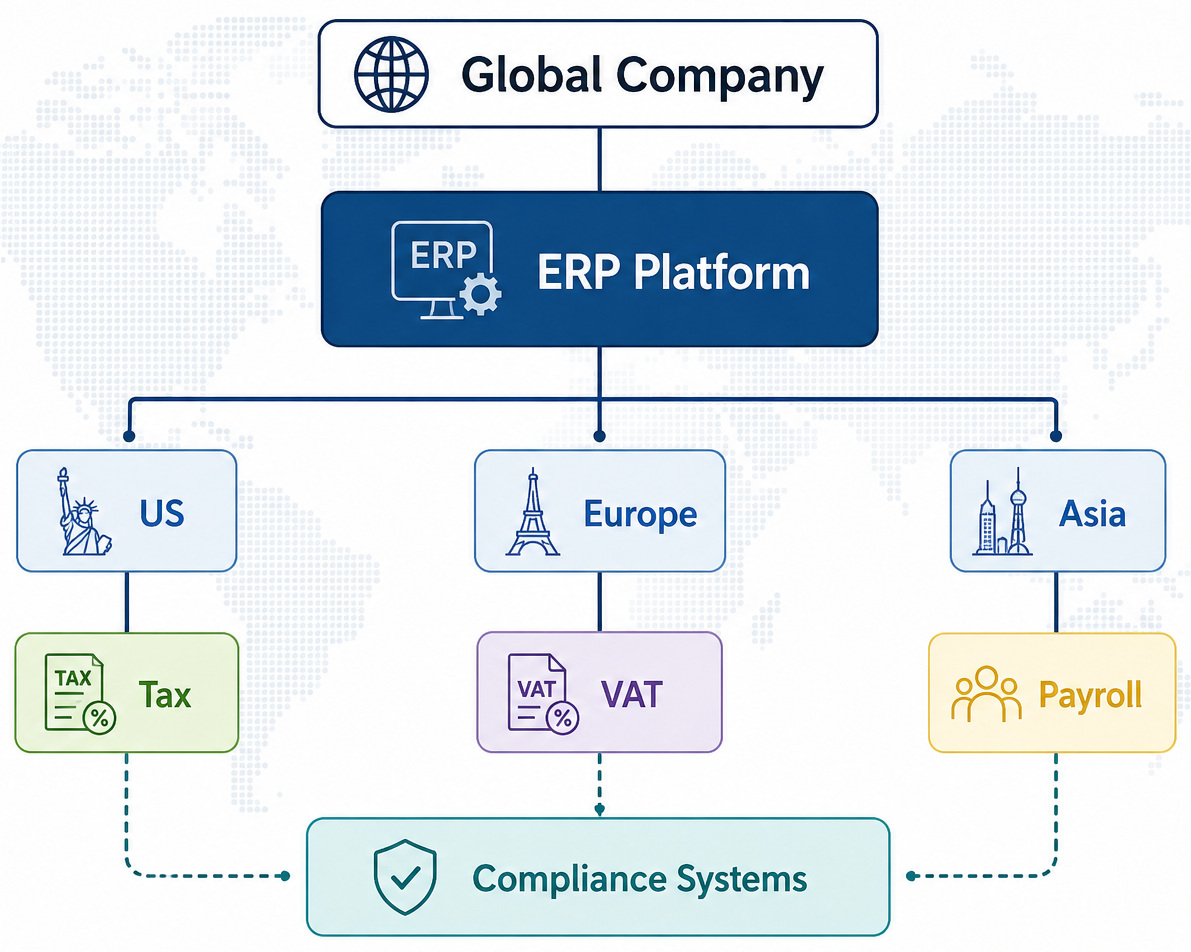
An important distinction that people often miss is that testing customer software is very different from testing enterprise apps. In a generic SaaS product, a bug might cause a broken workflow, irregular UI behavior, or an API failure that impacts user experience. In ERP systems, however, defects often cause a much bigger blast radius. A single hiccup in financial posting logic, tax calculation, or payroll calculation will directly affect revenue reporting, trigger compliance violations, or create accounting discrepancies that come up in an audit months later.
This complication becomes much harder when ERP systems work globally. An MNC executing a single ERP deployment across twenty-to thirty-odd countries is rarely running the same business logic everywhere. The purchase order workflow that runs correctly in the US may need completely different tax determination logic in Germany. Different invoice validation guidelines in Brazil, and a completely different electronic invoicing method in Saudi Arabia. This causes a testing problem that extends far beyond usual functional validation.
The challenge is rarely just validating whether software works. The challenge is validating whether software behaves as expected under multiple regulatory environments, while making sure financial and operational consistency across highly interconnected systems.
And that distinction changes how QA teams need to think about testing.
| Key Takeaways: |
|---|
|
Why ERP Localization Testing Differs
One of the more common myths around ERP localization testing is thinking that it is only language validation. In reality, language support is often the least interesting part of the problem.
Localization inside enterprise systems usually refers to adapting business logic based on region-specific operational requirements. The same workflow may execute differently depending on jurisdiction, taxation models, reporting mandates, payroll rules, or statutory compliance frameworks.
Consider something as simple as invoice generation. From the UI, the workflow appears identical regardless of geography. A user creates a sales order, generates an invoice, confirms the transaction, and completes payment processing. Underneath that relatively simple interaction, however, the system may execute multiple country-specific processing layers before the transaction is finalized.
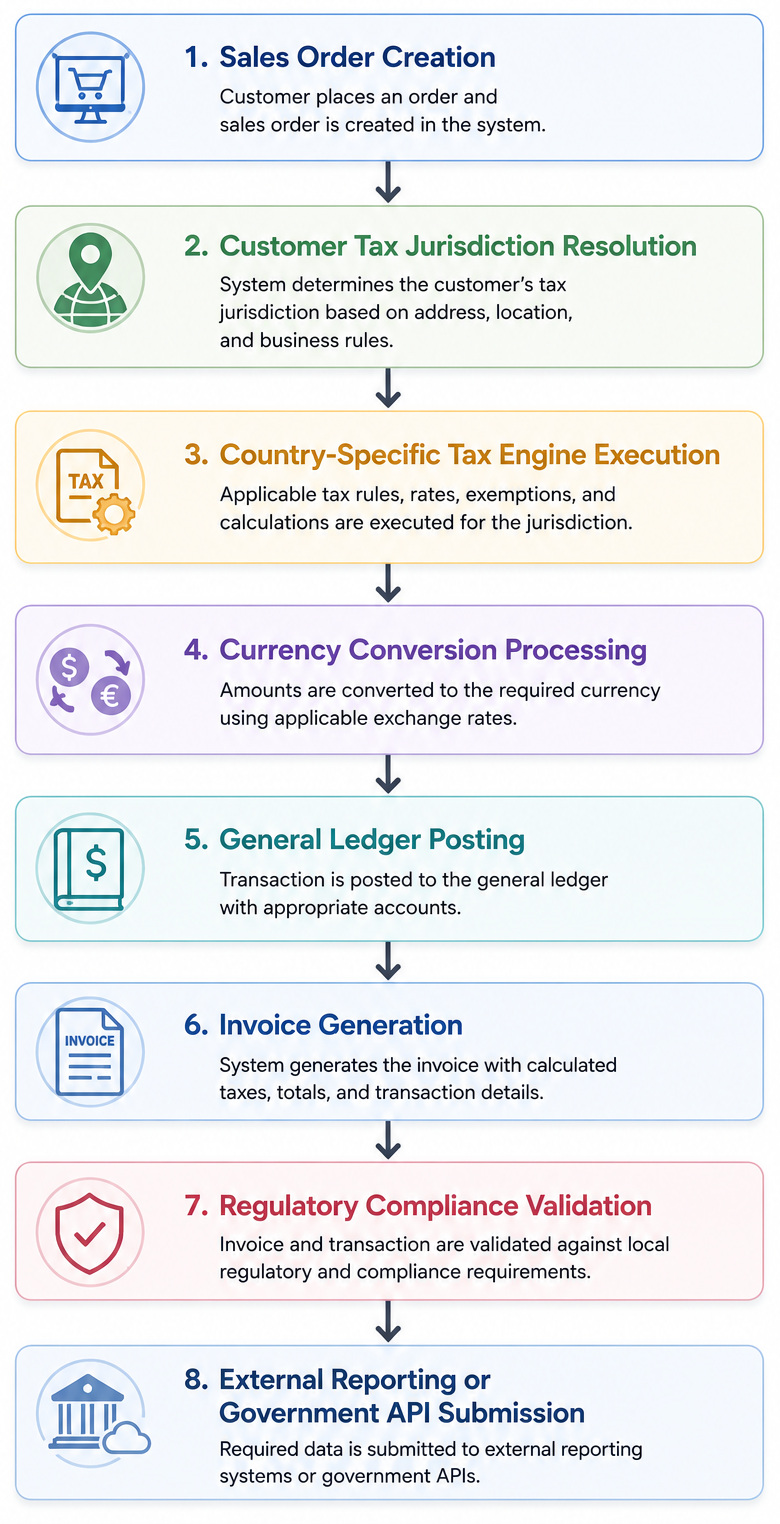
From the view of a functional tester, invoice generation may appear successful. But, from the view of enterprise QA, the real question is whether every downstream dependency executed correctly according to the regulatory rules governing that specific geography.
This is precisely where conventional testing strategies begin to fall apart.
Read: Localization vs. Internationalization Testing Guide.
Configuration Contains Localization Logic
One lesson most QA engineers learn quickly in enterprise ERP environments is that defects frequently originate outside application code.
Unlike traditional software systems where business rules are often integrated directly inside services or application logic, ERP platforms depend heavily on configuration-driven behavior. Country-specific tax rules, deduction logic, financial posting structures, invoice templates, approval hierarchies, and reporting schemas are commonly controlled through parameter tables maintained by business administrators.
This causes an entirely different testing challenge.
Consider a tax calculation service that relies on country-specific configuration data stored in the database.
SELECT country_code,
  tax_category,
  tax_rate,
  effective_date
FROM regional_tax_configuration
WHERE country_code = 'IN';
Imagine the application code is functioning perfectly.
The tax calculation service executes successfully. APIs return valid responses. No infrastructure issues exist. But the configuration table contains an outdated tax rate. From a technical perspective, nothing has failed. From a business perspective, every invoice generated in production now carries wrong tax calculations.
This difference is critical because localization defects are often silent failures. The application behaves exactly as designed, but underlying configuration errors introduce compliance violations that may remain undetected until financial reconciliation or external audits begin exposing inconsistencies.
Testing ERP systems at this level needs QA teams to validate not just software behavior, but configuration integrity itself. This demands a completely different mindset.
Why Functional Testing Alone is Insufficient
In consumer applications, functional testing often offers strong confidence because validating the expected output is usually enough. ERP systems behave differently.
Think of a tester validating invoice generation. The invoice displays successfully, the calculated tax appears correct, and the workflow completes without errors.
Most functional test suites would consider that a success. In reality, this level of validation is dangerously incomplete. An ERP transaction rarely ends at the user interface.
That invoice immediately begins impacting multiple downstream systems. Tax values are transmitted to accounting engines. Accounting engines generate ledger postings. Ledger entries feed revenue recognition systems. Financial reporting systems aggregate those entries into statutory reports that may finally be submitted to regulators.
If one dependency behaves incorrectly, the defect may not become visible until weeks later. A stronger QA strategy requires validating the full transaction lifecycle.
{
  "invoice_id": "INV_20452",
  "customer_city": "Austin",
  "customer_state": "Texas",
  "currency": "USD",
  "tax_code": "TX_SALES_TAX_8_25"
}
SELECT invoice_id,
  debit_amount,
  credit_amount,
  tax_amount
FROM accounting_ledger
WHERE invoice_id = 'INV_20452';
Only after confirming backend transactional integrity should the invoice itself be validated at the document layer. This is an iterative pattern in ERP compliance testing. The visible workflow tells only part of the story.
Read: How to Automate ERP Testing.
Tax Engines Testing is Highest Risk Area
In global ERP systems, tax engines often become the single most fragile subsystem in the architecture. The reason is quite obvious. Tax logic changes constantly.
Governments revise tax percentages, bring in new reporting rules, update exemption categories, modify filing requirements, and occasionally introduce entirely new compliance frameworks with very little notice. Organizations are forced to update ERP systems quickly, often under aggressive regulatory deadlines.
This creates dangerous deployment cycles. Most tax engines work under rule-based decision systems where transaction metadata determines which calculation logic executes.
Read Customer Location
  ↓
Determine Tax Jurisdiction
  ↓
Load Applicable Tax Rules
  ↓
Apply Product Tax Classification
  ↓
Calculate Percentage
  ↓
Round Based on Country Rules
  ↓
Return Tax Value
- But what happens when a cross-border transaction introduces dual tax jurisdictions?
- What happens when a tax exemption overlaps with an alternate product classification?
- What happens when tax rounding rules differ between invoice calculation and ledger posting logic?
These are not unusual scenarios. This is why ERP compliance testing requires significantly deeper domain understanding than traditional QA roles.
Integration Testing is More Important than UI Testing
One pattern I have repeatedly seen in enterprise testing teams is an overdependence on UI automation. For ERP systems operating globally, UI testing often provides the weakest form of validation.
The real complexity usually exists at integration boundaries. Modern ERP systems rarely operate independently. They exchange data continuously with payment gateways, payroll systems, procurement platforms, warehouse management systems, banking infrastructure, and increasingly, external compliance systems managed by regulators.
Consider electronic invoicing.
In many regions, invoice generation is no longer an internal workflow. The ERP system generates a structured invoice payload, transmits it externally for validation, receives a confirmation token, stores the reference, and only then finalizes the transaction.
- What happens if the external service returns malformed JSON?
- What happens if network latency triggers a timeout during token generation?
- What happens if the ERP retries submission automatically and creates duplicate invoice registration?
- What happens if asynchronous processing queues fail halfway through transaction finalization?
These questions become more important than validating whether the submit button works correctly. From a QA standpoint, integration testing often deserves significantly higher priority than front-end validation.
Configuration Drift
One of the least discussed and most overlooked problems in enterprise ERP testing is configuration drift. Large ERP systems experience continuous regional updates. Compliance rules change frequently, payroll calculations evolve, tax frameworks are revised, and business teams regularly update operational parameters inside administrative configuration panels.
- A tax rule updated in staging may not fully propagate to production.
- A country-specific invoice template may be overwritten during unrelated deployment activity.
- An updated payroll deduction rule may accidentally break downstream financial reporting logic.
These failures are notoriously difficult to catch because the system continues working without a hitch.
Nothing visibly crashes. The damage emerges slowly through incorrect business behavior. This is exactly why configuration validation should become part of regression testing. Many teams focus entirely on code regression while ignoring non-code configuration dependencies. In ERP systems, configuration changes frequently carry equal or greater risk than application releases.
Why ERP Automation Needs to Move Beyond Selenium
Automation strategies built entirely around UI frameworks rarely provide sufficient confidence in ERP systems. The problem is not browser automation itself. The problem is dependency depth. A single ERP transaction typically triggers multiple backend services that UI automation never validates.
As ERP systems become more configuration-heavy, many QA teams are gradually shifting from conventional Selenium-style automation and exploring newer frameworks such as testRigor that reduce maintenance overhead when workflows change frequently across regions. The challenge, however, remains the same: UI automation alone rarely provides enough confidence in enterprise systems with deeply interconnected backend dependencies.
A stronger automation strategy usually functions in layers. The transaction may begin through UI automation, but validation should continue well beyond the browser session. A mature test flow often looks something like this:
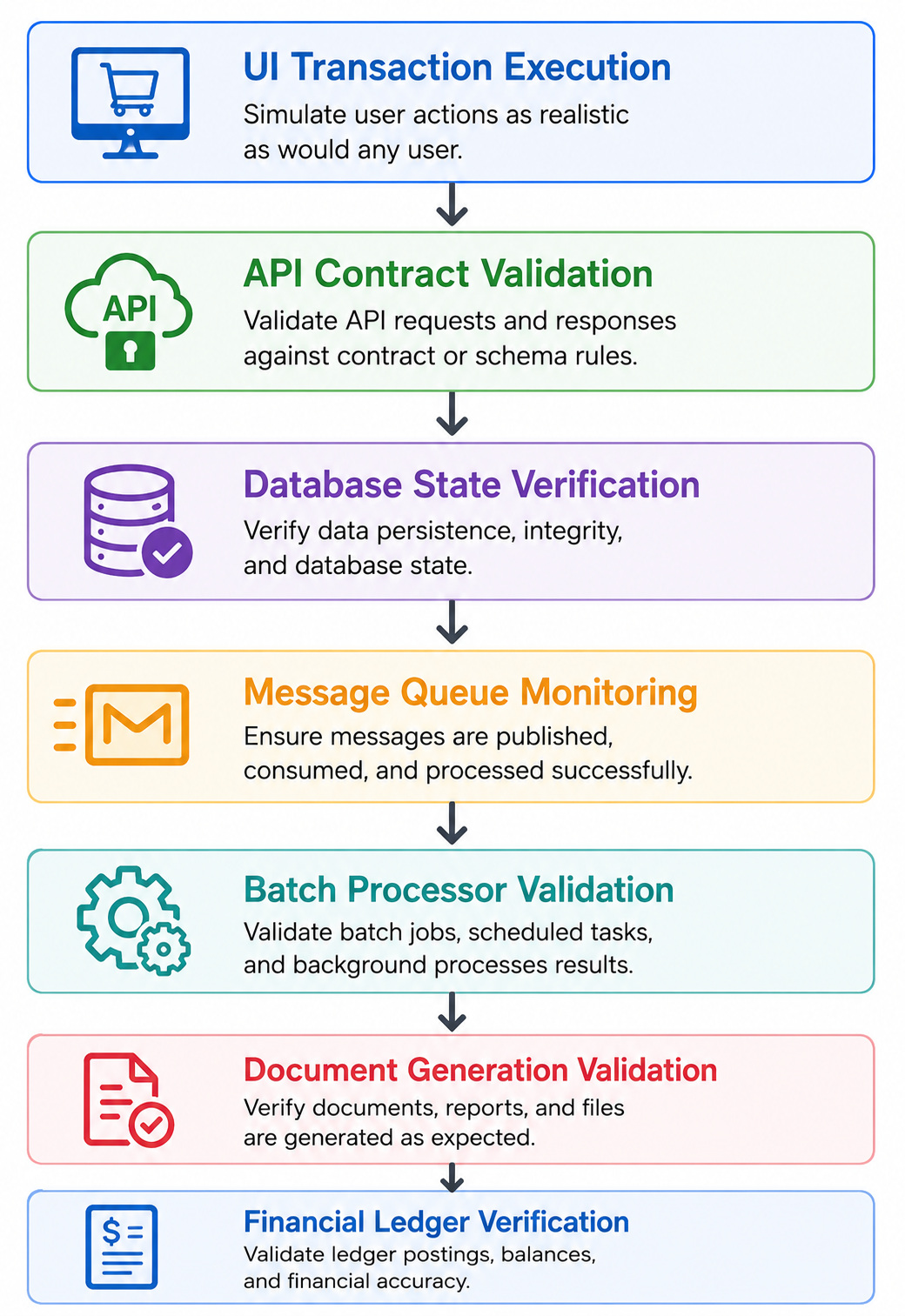
Testing stops being interface validation. It becomes system-wide transaction validation. The most mature enterprise QA teams usually spend far more effort validating backend state transitions than writing browser automation scripts.
Why Domain Knowledge is Required
- A tester validating payroll workflows should understand tax deduction frameworks.
- A tester validating financial posting should understand double-entry accounting principles.
- A tester validating tax engines should understand jurisdiction mapping, exemption logic, and reporting dependencies.
Without domain understanding, testers often validate technical execution while missing business-critical bugs hiding underneath.
This becomes even more important in global ERP environments where business rules change based on country-specific regulatory frameworks.
At that point, QA stops being purely technical work. It becomes operational risk management.
Final Thoughts
Testing localizations and global compliance in ERP systems is one of the few areas in software testing where technical accuracy alone is not enough.
A workflow can execute successfully while simultaneously violating tax regulations, corrupting financial reporting pipelines, or introducing inconsistencies that remain invisible until audit season.
This fundamentally changes the role of QA. The tester is no longer checking whether software behaves as expected. They are confirming whether complex business systems are operating legally, financially, and operationally correctly across multiple regulatory environments.
That needs deeper technical testing, stronger domain knowledge, and significantly more attention to backend systems than most conventional enterprise testing demands.
As organizations continue expanding globally, this discipline will only become more important.
And for QA engineers working in enterprise systems, few testing challenges are more technically demanding than ensuring software behaves correctly when business logic itself changes depending on where in the world the transaction happens.
Frequently Asked Questions (FAQs)
- What is localization testing in ERP systems?
A: Localization testing in ERP systems involves validating whether enterprise workflows behave correctly across region-specific business requirements such as tax regulations, invoice formats, payroll rules, currency handling, date formatting, and statutory compliance frameworks.
- What are the biggest risks in global ERP testing?
A: The highest-risk areas typically include tax engine validation, country-specific compliance workflows, financial posting logic, third-party integrations, configuration drift, payroll calculations, and asynchronous transaction processing.
- What skills do QA engineers need for ERP testing?
A: Strong ERP testers need technical testing expertise along with business domain knowledge in accounting principles, taxation systems, financial workflows, compliance frameworks, payroll structures, and enterprise integration architecture.
- Why is integration testing critical in ERP compliance validation?
A: ERP systems frequently exchange data with payment gateways, banking infrastructure, payroll systems, procurement platforms, and external regulatory APIs. Integration failures often create silent defects that impact downstream business processes.
- Why is ERP compliance testing more complex than traditional software testing?
A: Unlike traditional software systems, ERP platforms manage financial transactions, tax calculations, accounting ledgers, and regulatory reporting. A defect can directly impact compliance, financial reporting accuracy, and legal obligations rather than simply causing functional failures.
| Achieve More Than 90% Test Automation | |
| Step by Step Walkthroughs and Help | |
| 14 Day Free Trial, Cancel Anytime |