
How to Test Applications Built with Claude Code Using testRigor
 |
Claude Code can inspect repositories, build components, connect APIs, modify databases, write tests, and fix failures to quickly turn product requirements into working software. But that does not negate the need for rigorous and independent testing.

If the tests are written by the same person as the application, the same assumptions can influence both, which can lead to the oversight of misunderstood business rules, missing negative scenarios, or authorization flaws. The true measure of quality is to confirm the created software against clearly articulated business intent and practical end-to-end user scenarios.
In this article, we explain how to test applications created or changed with Claude Code and why AI-generated tests are not enough to give you confidence, and how testRigor can add a readable end-to-end acceptance layer to the Claude Code development cycle.
| Key Takeaways: |
|---|
|
How Claude Code Builds Applications
- Add passwordless authentication to an existing application.
- Build an administrative dashboard from a set of requirements.
- Create a checkout flow and connect it to a payment service.
- Migrate a frontend to a new framework.
- Correct an authorization defect.
- Add an API endpoint and update the corresponding user interface.
- Write tests for a previously untested module.
- Investigate a failed build and repair the affected code.
Claude Code can traverse an adaptive loop: acquire context, modify application, run checks, analyze failures, and modify further. Writing and running tests is a normal part of this workflow, according to Anthropic’s documentation. Claude Code can also leverage hooks to execute deterministic commands like a test suite on certain lifecycle events. Therefore, it would be inaccurate to say that Claude Code has no testing capabilities. A more precise statement is:
Claude Code can generate and execute tests, but it does not automatically provide an independent test strategy, an authoritative definition of correct behavior, production-like test environments, or sufficient coverage of business risk.
Those responsibilities still belong to engineering and quality teams.
What Claude-generated Tests may Miss
Tests do more than exercise code. Good tests establish whether an application behaves according to its requirements. This means you need a reliable source of expected outcomes, also known as a test oracle.
Claude Code knows only what is provided to it via prompts, repository files, project instructions, connected tools, and other provided context. If those sources are incomplete or ambiguous, then Claude might make a reasonable but wrong assumption.
Assume the requirement is to lock the account after 5 unsuccessful login attempts in 10 minutes. The ten-minute window was missed or misinterpreted. Claude Code may add a lock after five lifetime failures. If asked to generate tests from the completed implementation, it may generate a test that confirms the same incorrect lifetime-failure behavior. The application passes the test, but both artifacts are wrong.
This is the problem of same-source validation. The same AI system interprets the request, implements it, writes the tests, and evaluates the results. If there is a misunderstanding in the first stage, it can be repeated in the other stages.
This is not a risk unique to Claude. Human developers may also write tests to validate their own misunderstandings. But AI accelerates and scales up the volume of mutually consistent code and tests that can be produced. A large passing test suite can give an illusion of confidence without any proof that the original business intent was understood correctly. AI-generated tests are still useful. They can easily create unit coverage, identify obvious edge cases, build test scaffolding, and not duplicate effort. They are one piece of evidence, not the final authority to release an application.
Read: Write, Run & Maintain testRigor Tests with Your AI Coding Agent.
Risks of Testing Claude-Generated Code
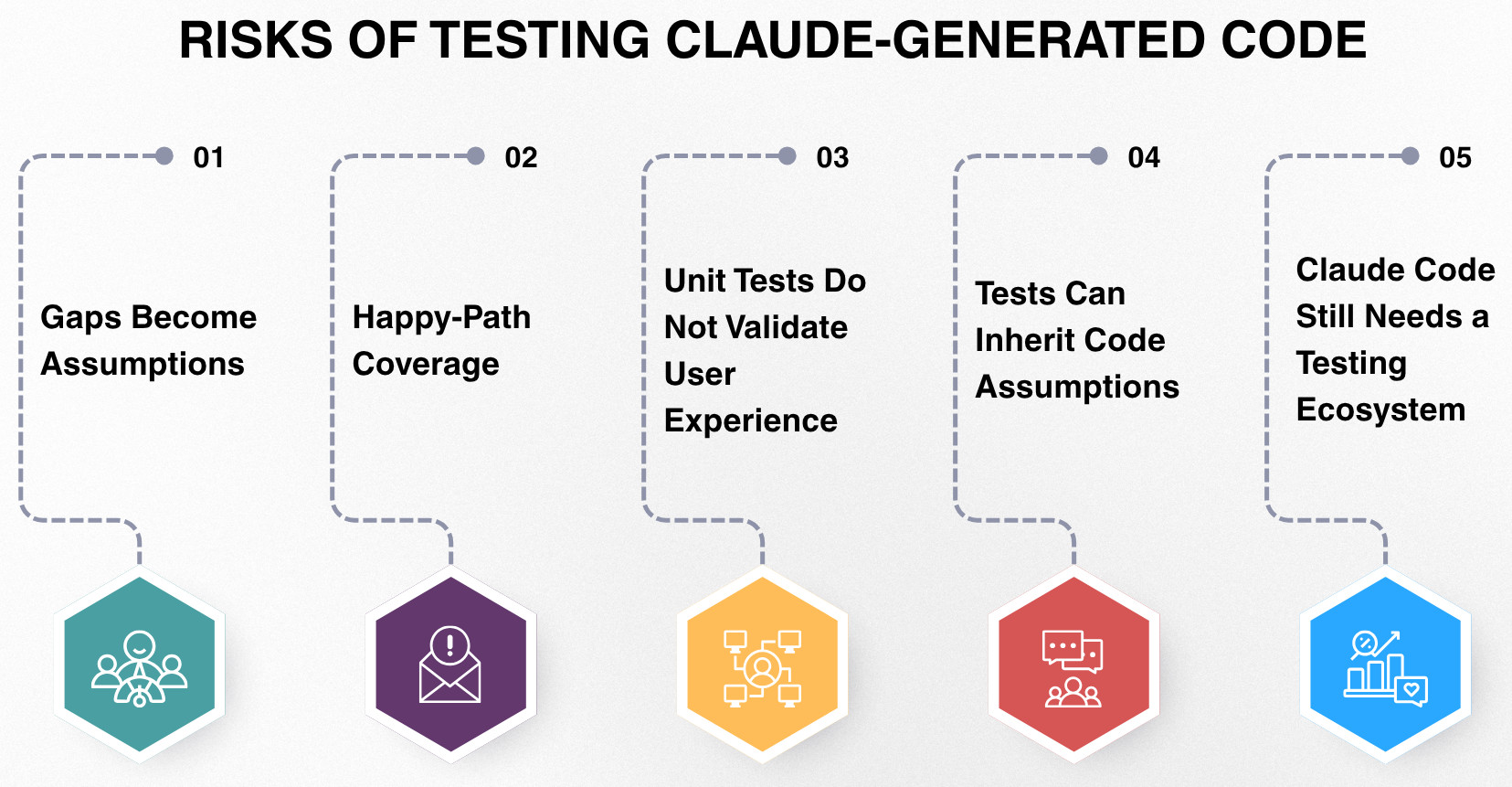
Claude Code is competent, but its output is constrained by the context it has and the checks it has linked to it. Before teams treat generated code as production-ready, they should be aware of the following limitations.
Gaps Become Assumptions
Product requirements are often incomplete. They might say what should happen if a transaction is successful but not if the payment provider times out. They may describe a user action without stating which roles can perform that action. They are able to define a field, but not boundary values, normalization rules, or behavior when empty.
Such ambiguities are usually solved by a human team, through discussions between product owners, developers, designers, security specialists, QA engineers, etc. Instead, Claude Code may guess an answer from surrounding code, or choose a plausible implementation.
Happy-Path Coverage
- An email address that already exists.
- An expired verification link.
- A resend request made repeatedly.
- A temporary email-service failure.
- Leading or trailing spaces in user input.
- A user who opens the link on another device.
- A browser refresh during an intermediate state.
- A malicious value submitted directly to the API.
The interface can appear finished even when these behavioral gaps remain. Testing must therefore start from risks and user journeys, not from a visual inspection of the generated feature.
Read: What is Vibe Testing?
Unit Tests Do Not Validate User Experience
Claude Code can churn out unit tests in a flash. Unit tests are useful because they offer quick feedback on isolated functions and classes. But an application is more than the sum of its parts.
For example, a unit test could demonstrate that a notification function produces the correct message object. This does not guarantee that a deployed application calls the function, authenticates successfully with the email provider, sends the message, and displays the right confirmation to the user.
The mocked API tests may pass, but the real systems may disagree on field names, date formats, authentication headers, timeouts, or error responses. End-to-end validation is needed to detect failures that only arise when components interact.
Read: What are Vibe Coding Tests? The Future of AI-Driven QA.
Tests Can Inherit Code Assumptions
When Claude creates tests after inspecting its implementation, it may encode the behavior already present. Such tests are valuable for regression and characterization, but they are weaker evidence that the feature satisfies an independently defined requirement.
Critical acceptance tests should be based on reviewed business examples and should be stable during the time the implementation is changing. If there is a difference between the application and an approved test, the team should investigate the requirement, rather than change the test to match the code.
Read: What is Vibe Coding?
Claude Code Still Needs a Testing Ecosystem
While Claude Code can invoke tools, it’s not a full test environment, browser and device lab, test-data service, security scanner, performance platform, or release process. Teams will still probably need unit and API frameworks, realistic environments, accessibility checks, security and dependency scans, resilience tests, reporting and CI/CD quality gates.
Asking Claude Code to generate Selenium scripts can speed up automation, but the output is still Selenium code. Fragile selectors, hard-coded waits, duplicate setup, and maintenance after UI changes will not go away just because AI wrote the scripts. Faster generation doesn’t automatically mean a test is independent, stable, or aligned with business intent.
Agentic repair loops also need control. An agent might loosen an assertion, alter test data, mock a problematic dependency, or change the test rather than fixing the feature if the sole objective is to make the checks pass. Acceptance tests that represent critical business rules should be guarded, and changes to them should be subject to review.
Read: Claude for QA Engineers: Use Cases and Limitations.
Use Independent Executable Acceptance Criteria
The safest model is a combination of Claude-generated developer tests and a separately reviewed acceptance layer. Acceptance scenarios should describe behavior that can be observed: what the user can do, what the application displays, what data changes, which actions are rejected, what notifications arrive, and what happens when a dependency fails.
These scenarios must be derived not only from the implementation generated but also from requirements and risk analysis. Unit tests can validate small pieces of logic, API and integration tests can validate contracts, and acceptance tests can validate end-to-end business outcomes. The respective security, performance, accessibility, and resilience validations are still required. These layers are not in competition but are complementary.
Read: Why Using Claude Alone for Testing Is Slowing You Down.
How to Test Claude-Generated Applications
- Expected Behavior: Define observable acceptance criteria before Claude Code implements the feature. These include: user roles and permissions, preconditions, successful workflow, negative scenarios, boundary values, state changes, error messages, and external service failures.
- Create Risk-based Acceptance Tests: Extract testable examples from high-risk business rules. For an account locking rule, test behavior before and after the failure limit, the time window calculation, and access through each supported interface.
- Expand Coverage for Critical Capabilities: Put stricter validation on authentication, authorization, payments, confidential data, destructive operations, migrations, integrations, concurrency, and regulated workflows. Add exploratory, security, and performance testing where appropriate.
- Perform Developer-level Checks: Have Claude Code write the feature and its associated tests. Run compilation, type checks, linter, unit tests, API tests, contract tests, security scans, dependency checks, and database migration validation.
- Deploy to a Representative Environment: Test the feature in realistic configurations with controlled data and accounts for each relevant role. This can surface issues with routing, permissions, credentials, databases, networks, browsers, and third-party services.
- Run Your Own E2Es: Test full workflows and real business outcomes, not just testing whether pages or elements render. Look for state changes, notifications, integration results, and authorization boundaries.
- Failure Evidence for Correction: Keep failed steps, screenshots, logs, response details, and test data. Claude Code then uses this evidence to diagnose the defect, correct the implementation, and rerun the affected and regression tests.
- Enforce Measurable Release Gates: Mandate developer checks, critical acceptance tests, regression suites, security validation, and required human approvals before release. The completion message from Claude Code is not to be used for determining ready status.
Read: How to Generate Code that Works with Claude Code /Goal Feature.
Testing Claude Code Applications with testRigor
open the application
click "Sign up"
enter "[email protected]" into "Email"
enter stored value "TestPassword" into "Password"
click "Create account"
check that page contains "Check your email"
check that email to "[email protected]" contains "Verify your account"
The scenario focuses on what the user sees. It doesn’t matter what the internal email function does, how Claude decided to implement it, or what the name of the React component is. testRigor’s plain-English approach and less dependence on CSS selectors or XPath can also decrease coupling between a changing AI-generated interface and its regression suite.
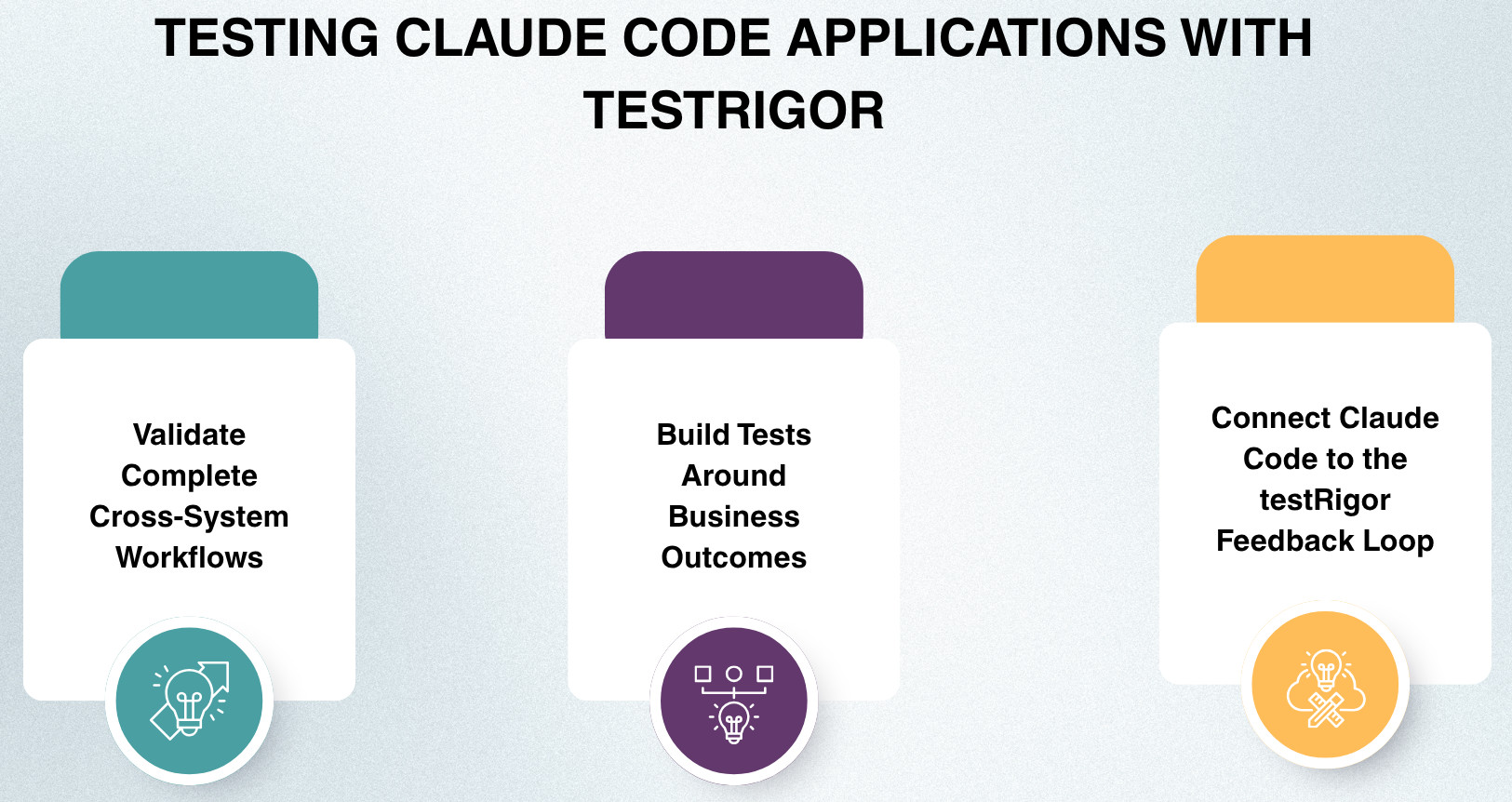
Validate Complete Cross-System Workflows
Real journeys often cross multiple systems. Registration can start in a browser, call an API, write to a database, send an email, and require the user to follow a link. A purchase involves a payment provider, an inventory service, a notification, and a second user role.
testRigor supports scenarios across web, native mobile, native desktop, mainframe applications, APIs, emails, and even SMS messages, and multi-user interactions. This allows business outcomes to be validated across boundaries that isolated generated tests may mock or skip.
Executable specifications may also be readable tests. First, the stakeholders review the behavior, then Claude Code implements it, and finally the approved scenario is run against the deployed application. The test is part of the feature definition, not documentation written after the fact.
Build Tests Around Business Outcomes
Strong acceptance tests test meaningful business outcomes, not just that a button appears or a URL changes. Stable, outcome-based tests are human readable and help product and QA teams identify when changes to approved business rules are made. Claude Code is also useful when refactoring internal components.
For multi-user workflows, tests should confirm that an action can be completed by an authorized user. Still, they cannot be accessed by an unauthorized user via the interface, direct links, or APIs. Maintainability improves with reusable rules and stored values. Screenshots, logs, and failed steps and execution details help Claude Code diagnose failures without weakening expected behavior.
Connect Claude Code to the testRigor Feedback Loop
- Stakeholders define and approve expected behavior.
- Claude Code implements the feature and developer tests.
- testRigor executes independent acceptance scenarios.
- Failed tests provide evidence about the broken workflow.
- Claude Code diagnoses and corrects the application.
- Acceptance and regression suites run again.
The important separation is that Claude does not control every definition of success. The reviewed requirement and acceptance test remain the anchor while the implementation can change. Credentials should be protected, permissions limited, and modifications to critical tests kept visible and reviewable.
Use Case: Testing Claude-Generated Registration with testRigor
- Successful registration, email receipt, verification, and dashboard access.
- Denied dashboard access before verification.
- Safe handling of expired or previously used verification links.
- Approved behavior for an already registered email address.
- Resend limits and the behavior of older tokens.
- Recovery when the email provider is unavailable.
If a scenario fails, Claude Code can inspect the evidence and revise the feature. The expected result comes from an approved example, not from Claude observing its own implementation and deciding that the existing behavior must be correct.
Focused Release Checklist
- All required unit, integration, API, and end-to-end tests have passed.
- Critical testRigor acceptance scenarios and relevant regression tests have passed.
- No unresolved critical or high-severity defects remain.
- Business-critical workflows have been validated against approved requirements.
- Authentication, authorization, and user-role restrictions work correctly.
- Security, accessibility, performance, and resilience risks have been evaluated.
- Production-like configurations and third-party integrations have been verified.
- Claude Code has not weakened, skipped, or removed assertions to obtain passing results.
- Changes to protected acceptance tests have received human review.
- Product, engineering, and QA stakeholders have approved high-risk changes.
- Release evidence, known limitations, and rollback procedures are documented.
Conclusion
Claude Code can accelerate implementation, testing, failure analysis, and software revision, but the agreement between AI-generated code and tests does not guarantee it will meet business requirements. Validation must be reliable, using independently reviewed acceptance criteria executed against a representative deployment. testRigor allows writing end-to-end tests that are readable by humans and check user intent across application and system boundaries. Claude Code gives you speed of development, testRigor gives you independent acceptance validation, and human stakeholders give you business intent and release decisions. A powerful trio!
Frequently Asked Questions (FAQs)
- Can testRigor test a Claude Code application before it is publicly deployed?
Yes. testRigor can test an application in a staging, development, or local environment, provided the test execution setup can securely access it. Teams can validate features before production while keeping test data and credentials isolated.
- How should teams manage test data when Claude Code and testRigor work together?
Teams should use controlled, reusable, and non-sensitive test data. Credentials and personal information should be stored securely, while setup and cleanup steps should ensure that repeated executions do not create conflicts or leave unwanted records.
- What should teams do when testRigor identifies a failure that Claude Code cannot reproduce locally?
They should compare environments, browser configurations, test data, network behavior, application logs, screenshots, and external-service responses. The failure may result from an integration or configuration difference rather than a defect in the local code.
- How can teams prevent Claude Code from changing critical testRigor tests?
Critical test files can be protected through repository permissions, mandatory code reviews, branch policies, ownership rules, and CI checks. Claude Code may propose changes, but approved reviewers should decide whether a business expectation genuinely needs modification.
| Achieve More Than 90% Test Automation | |
| Step by Step Walkthroughs and Help | |
| 14 Day Free Trial, Cancel Anytime |