
What is Test Plan Driven Development (TPDD)?
 |
Most in the software development industry will agree that for years, testing was treated as the last task in the SDLC. This was expensive to the company as teams invested time, effort, and money into gathering requirements, building features, pushing for delivery timelines, and only at the end was QA allowed to test the product. Critical questions such as reliability, performance, security, scalability, etc were all asked at the last stage.
Also, another issue with the older method was that people often assumed bad implementation was the cause of miserable software quality. That was not the case. Most of the time it was due to architectural decisions taken weeks or even months before testing was initiated.
This is why ideas such as Test Plan Driven Development (TPDD) are eye-catching.
Unlike typical development strategies where testing is downstream from engineering, TPDD brings QA much earlier in the lifecycle. The underlying principle is fairly simple: before developers begin implementing a system, teams should first define how that system will be validated under real-world conditions. In other words, testing stops being a verification activity and starts becoming an architectural input.
This changes the role of testing completely, especially from a QA perspective. Rather than working frantically at the eleventh hour to identify errors, QA engineers begin guiding the design of the system itself.
This difference plays an important role in modern distributed systems.
| Key Takeaways: |
|---|
|
Why Traditional Development Causes Testing Issues
One of the most persistent myths in software engineering is the concept that developers build software while QA tests it later. In theory, it sounds perfect. In practice, it leads to enormous engineering debt.
Say a fairly usual backend service for payment processing. Developers begin creating APIs, database schemas are finalized, asynchronous queue workers are brought in for transaction processing, and integrations with third-party payment providers are added. Development moves fast, sprint velocity looks healthy, and eventually the system reaches testing.
Problems start popping up at this stage.
The QA team starts asking uneasy questions.
How do we validate duplicate transaction handling under concurrency?
Can we replicate payment provider latency without affecting production-like behavior?
What happens if the queue broker fails halfway through transaction processing?
Can the system guarantee idempotency if retry mechanisms trigger unexpectedly?
The truth is that these are not testing issues. They are architectural issues.
If the system was not meant to support reliable validation, testing becomes unnecessary. Teams start building fragile workarounds, introducing complex mocks, manually reproducing failure conditions, and spending weeks debugging problems that should have been considered much earlier.
This is the gap TPDD attempts to solve.
Read: STLC vs. SDLC: Key Differences and Phases Explained.
How does TPDD Work?
Technically, TPDD is not a formalized methodology in the same manner as Test-Driven Development (TDD) is. There are no universally accepted guidelines behind it, which often causes confusion when teams discuss it.
At its foundation, TPDD means designing a system around its validation requirements before implementation begins.
Requirements > Development > Testing > Defect Resolution > Release
Requirements > Validation Planning > Architecture Decisions > Development > Continuous Verification > Release
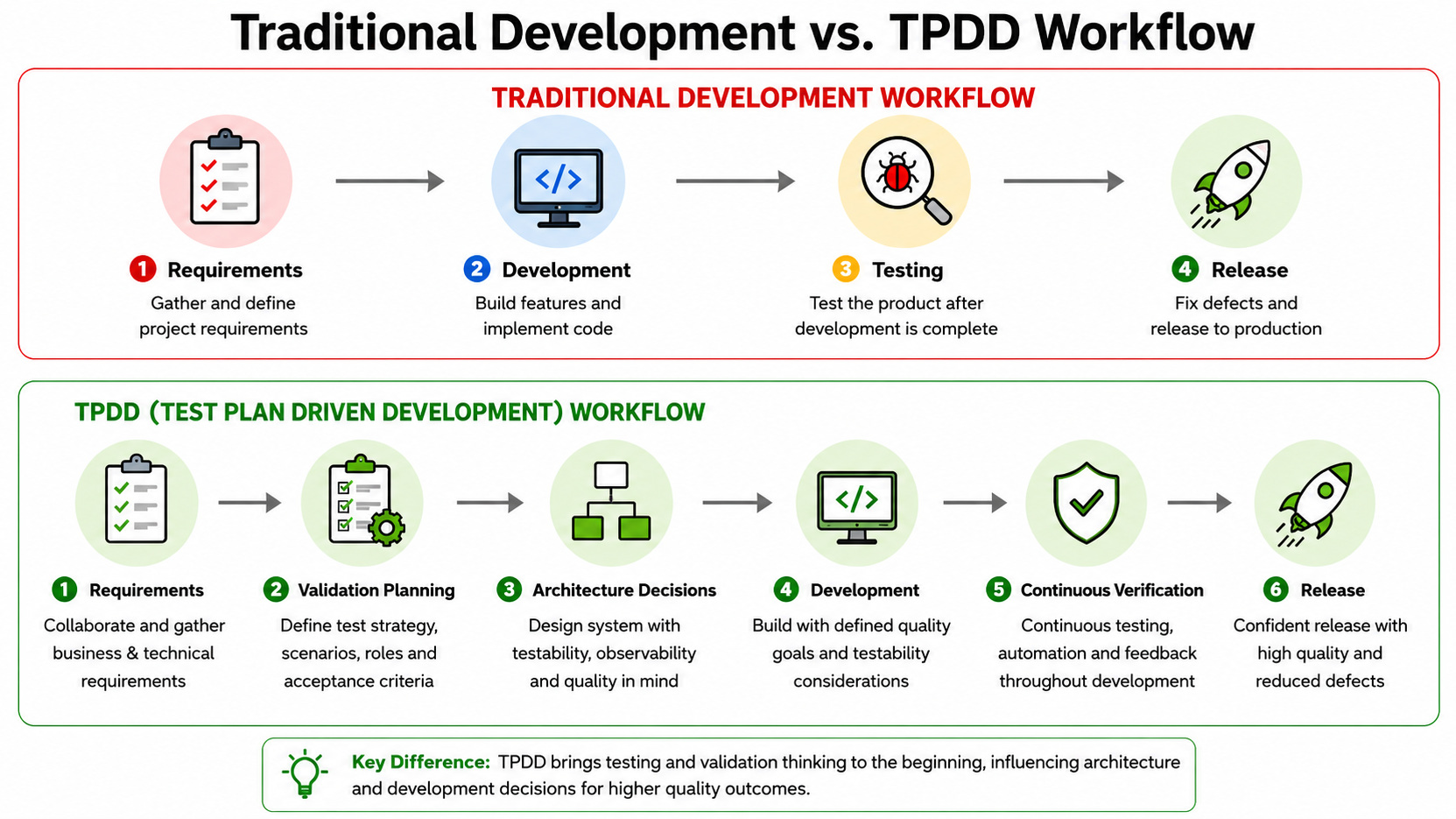
Do you understand what changed?
Testing no longer exists at the end of the pipeline. Validation requirements now directly influence architecture.
This difference may sound subtle, but it fundamentally changes engineering decisions.
A good engineering team should not simply ask what features need to be built. It should also ask how we can reliably prove this system works under expected and unexpected conditions.
That second question often forces better architecture.
Read: What is Test Driven Development? TDD vs. BDD vs. SDD.
What is TPDD?
Rather than writing test code before development, developers contribute to writing test plans. When collecting project requirements, they allow QA to design a Test Plan A and then move on to coding.
Developers work with QA and find it easier to understand project requirements. The test plan depends on developers, can be reviewed, and cannot be forged, and is automatically auditable and monitorable by team leads.
Prioritize creating test plans before test code writing. In this model, writing automated tests becomes an engineering requirement embedded within the overall test strategy, giving developers the flexibility to implement those tests either before development begins or after the feature has been built, as long as the validation criteria defined in the test plan are met.
Why QA Engineers Should Care About System Testability
One of the most ignored concepts in modern software engineering is testability. Most teams go after functionality. Does the API return correct responses? Does the frontend render correctly? Does authentication work as expected?
But mature QA organizations in the end realize that software quality is deeply connected to how testable a system is.
Poorly designed systems usually share predictable characteristics. Services become tightly coupled. Internal state changes are difficult to observe. Logging is inconsistent. Failure simulation needs production dependencies. Components cannot be isolated during integration testing.
This creates an unpleasant situation where testing becomes expensive. For example, consider a microservices architecture.
- But how do you test partial infrastructure failure?
- What happens if Redis becomes unavailable for thirty seconds?
- How does Service A behave if Service B experiences degraded latency but does not fail entirely?
- What happens if message delivery succeeds but acknowledgment packets are dropped due to network instability?
Most teams come to accept that they cannot answer these questions because the architecture was never designed with validation in mind. TPDD forces teams to think about these scenarios before implementation begins.
Read: ATDD and TDD: Key Dos and Don’ts for Successful Development.
How TPDD Changes Architecture Decisions
This is where things become technically interesting.
When engineering teams begin designing around test plans, development patterns start changing almost immediately.
Consider a backend authentication service that needs to support distributed session management across multiple geographic regions. Under normal development practices, engineers may begin by implementing JWT token generation, user credential storage, and session validation logic.
The QA team usually comes in later and begins writing API validation tests.
With TPDD, the process changes.
The team defines validation criteria before implementation starts.
The authentication service must support concurrent login requests across multiple nodes. Session revocation should propagate globally within 500 milliseconds. Brute-force login attempts need rate-limiting guardrails. Token invalidation must remain consistent even during horizontal scaling events.
This is where architecture decisions begin shifting.
Suddenly, engineers realize local in-memory session storage will not work because revocation consistency cannot be guaranteed across distributed instances. Redis-backed session storage becomes necessary.
Rate limiting middleware can no longer be considered as an afterthought because security validation depends on deterministic throttling behavior. Observability requirements emerge early because QA engineers need traceability during concurrency testing.
The architecture improves not because developers become smarter.
It improves because validation requirements exposed architectural weaknesses earlier.
Read: Acceptance Test Driven Development (ATDD).
Difference between TDD and TPDD
A simplified comparison table to make it easier to understand the difference at a glance:
| Aspect | Test-Driven Development (TDD) | Test Plan Driven Development |
|---|---|---|
| Primary focus | Writing automated tests before code | Defining a structured test strategy/plan before development or testing begins |
| Purpose | Drive code design through failing tests | Ensure project-wide testing coverage, process, scope, and validation strategy |
| When it happens | During coding, in short development cycles | Usually during project planning or QA planning |
| Who mainly uses it | Developers | QA engineers, test managers, sometimes architects |
| Workflow | Red > Green > Refactor | Requirements > Test strategy > Test cases > Execution |
| Granularity | Unit/component level | System/integration/acceptance/project level |
| Automation | Usually highly automated | Can be manual, automated, or mixed |
Read: TDD vs BDD – What’s the Difference Between TDD and BDD?
TPDD Workflow
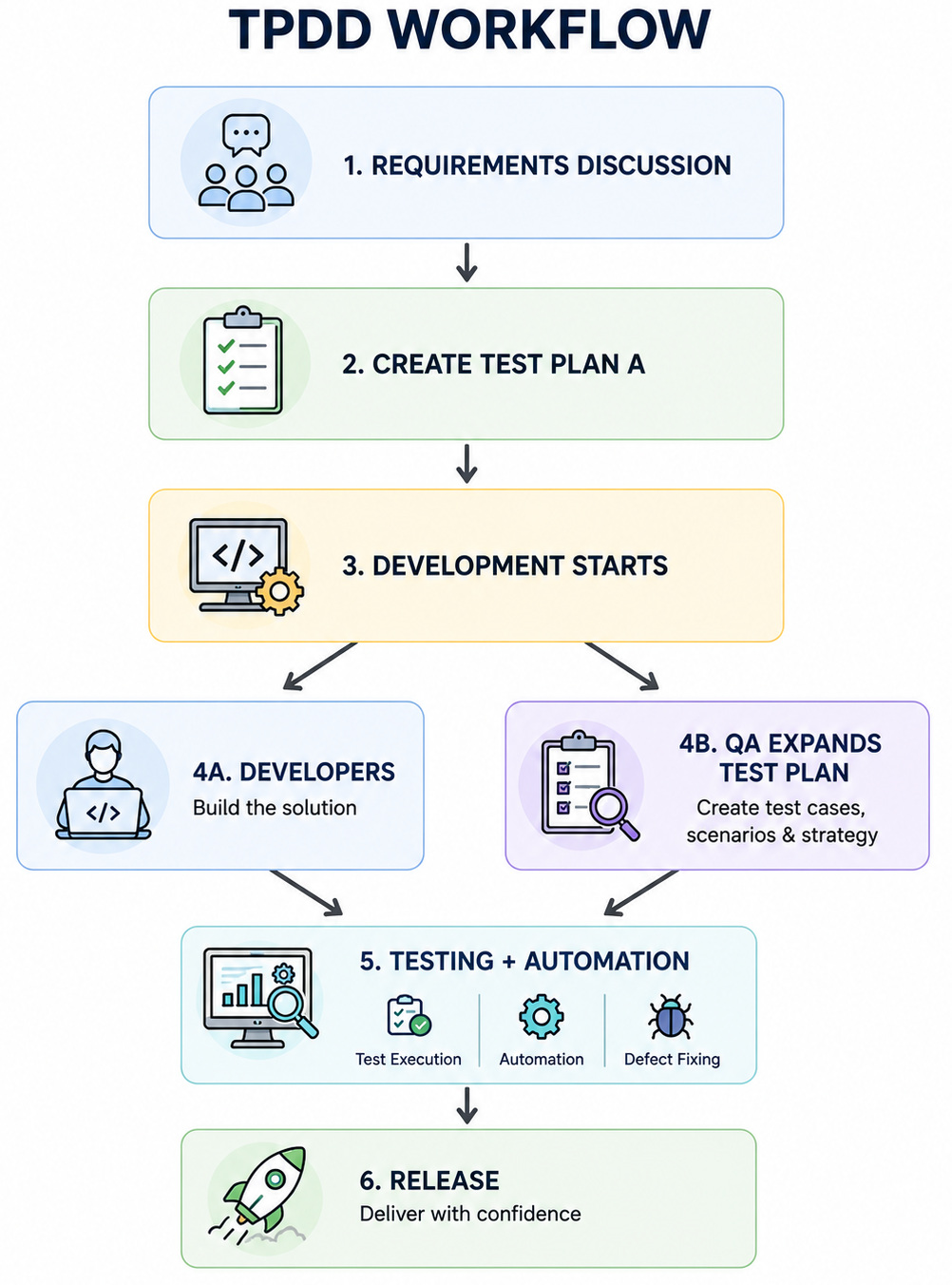
A common misconception with regards to TPDD is assuming that it functions like a typical TDD, where developers are expected to write test code before writing production code.
That is not really the concept behind TPDD.
In this method, the team prioritizes building a test plan first, not necessarily writing automated tests first. The test plan behaves as a shared agreement between developers, QA engineers, product teams, and other stakeholders, defining what the system is expected to do and how quality will eventually be validated.
Writing test code still remains important, but instead of enforcing a strict test-first approach, automation becomes part of the broader engineering process. Developers can decide whether writing tests before implementation makes sense, or whether certain tests are better written once development is completed. The important part is that validation expectations are already clear before engineering begins.
In practice, the workflow usually starts with collaborative requirement discussions involving developers, QA, product managers, business analysts, and sometimes designers. Once the team agrees on the expected functionality, they create what can be called test plan A.
- The ‘Must Have’ layer contains critical functionality that cannot fail under any condition.
- ‘Need Have’ covers important features that are necessary for product stability.
- ‘Should Have’ usually includes lower-priority or optional functionality.
Once this initial plan is agreed upon, development begins. But unlike traditional workflows where QA waits for code to be completed, both teams now work in parallel. Developers continue implementation while QA starts expanding the original test plan into deeper test scenarios, automation strategy, exploratory testing coverage, regression checks, and execution steps.
Once development begins, QA teams can start translating the original test plan into executable validation workflows. Tools like testRigor can help here by allowing teams to convert business-level test scenarios into automation much earlier, without waiting for the entire implementation cycle to finish. By the time development is finished, QA is not starting from scratch.
The biggest advantage here is prioritization. Developers know exactly what functionality matters most, and QA already understands where validation effort needs to go. In many teams, this removes the usual bottleneck where testing only begins after engineering work is already complete.
More importantly, it shifts QA closer to engineering decisions instead of treating testing as a final verification step after development is done.
TPDD in Distributed Systems Testing
Modern applications are often difficult to validate because system complexity has grown far beyond traditional web applications. Say, event-driven systems running on containerized infrastructure.
Suppose an e-commerce platform leverages multiple independent services communicating through message brokers like Kafka. Inventory updates trigger asynchronous pricing calculations. Payment services publish order confirmation events. Notification services consume downstream events independently.
- Create order.
- Validate payment.
- Confirm notification.
- What happens if Kafka acknowledges message receipt but consumer processing fails halfway through execution?
- What happens if duplicate events get replayed during partition leader re-election?
- Can services maintain eventual consistency under partial infrastructure degradation?
- Can downstream consumers handle out-of-order message delivery?
These questions push teams to think beyond traditional test cases. TPDD encourages QA teams to define these failure conditions early. And when engineers understand these validation requirements upfront, architecture becomes more resilient by design.
Does Every Team Need TPDD?
Not necessarily. Simple CRUD applications rarely gain enough to justify the overhead.
As systems become distributed, stateful, asynchronous, or business-critical, the benefits become difficult to overlook.
The banking industry is one where TPDD can make a big difference. Transaction processing platforms need deterministic consistency guarantees under concurrency. A race condition causing duplicate transactions can have catastrophic consequences.
Healthcare software presents similar challenges. Systems managing patient records require strict auditability, predictable access controls, and strong data integrity guarantees.
Infrastructure platforms operating on Kubernetes introduce their own complexity.
- How does a service behave when pods terminate unexpectedly?
- Can auto-scaling events introduce state synchronization delays?
- Does circuit breaker logic activate consistently during dependency degradation?
These are engineering questions that should not be delayed until testing begins.
Final Thoughts
Including the test plan process within the software development lifecycle can give a lot of benefits. It helps to make sure that the developers know what they are building. With this, you will build the right solution with fewer bugs.
Finally, it gives visibility of what test scenarios are missing to deploy to production.
Frequently Asked Questions (FAQs)
- Is Test Plan Driven Development (TPDD) the same as Test-Driven Development (TDD)?
A: Traditional Test-Driven Development focuses on writing automated tests before writing production code. TPDD focuses on defining the overall test strategy and validation requirements before development begins, allowing quality requirements to influence architecture decisions early.
- Can TPDD work in Agile development teams?
A: TPDD can work well within Agile teams because it encourages earlier collaboration between developers, QA engineers, product managers, and business analysts during sprint planning. The difference is that the validation strategy is defined before implementation starts.
- Can QA engineers influence architecture decisions through TPDD?
A: One of the biggest advantages of TPDD is shifting QA engineers closer to system design discussions. Instead of validating software after development, QA begins defining quality expectations much earlier.
- How does TPDD improve software quality?
A: TPDD improves software quality by identifying validation requirements earlier in the development lifecycle. This often exposes architectural weaknesses before implementation, reducing defects caused by poor design decisions.
| Achieve More Than 90% Test Automation | |
| Step by Step Walkthroughs and Help | |
| 14 Day Free Trial, Cancel Anytime |