
How to Improve QA Team Performance: 2026 Guide
 |
The software testing market size has reached USD 54.44 billion in 2026, and it will continue to grow at a CAGR of 12.92% till 2031.
AI-generated code, cloud-native architectures, and rapid release cycles have accelerated software delivery, but they have also made maintaining quality significantly more challenging. That is why software quality and QA performance are under more pressure than ever.
As a result, improving QA team performance has become a top priority for engineering organizations.
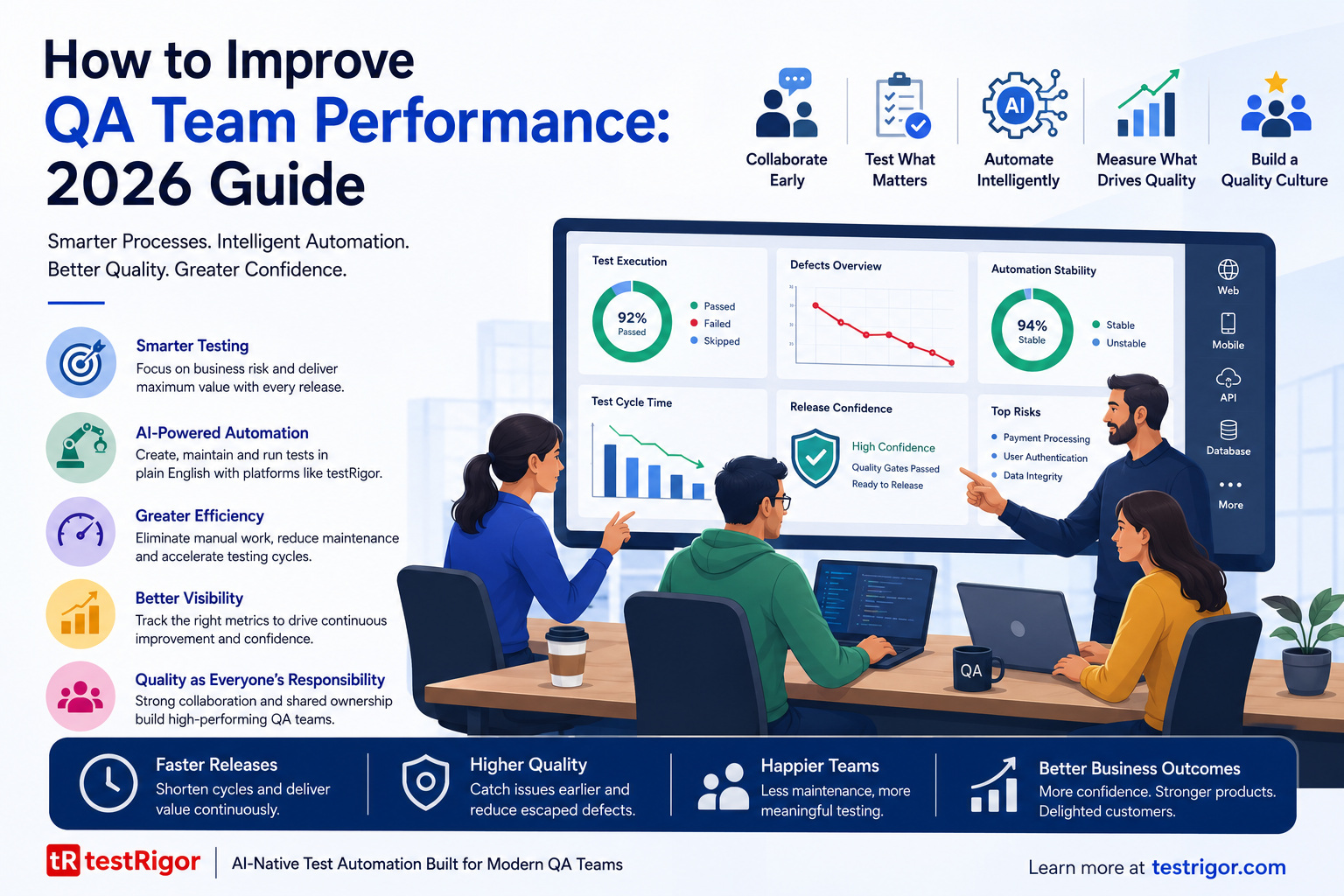
Many organizations think that better QA performance comes from running more tests, increasing automation, or growing their testing teams. In fact, a high-performing QA team is not about more testing but about providing more confidence through smarter testing, collaboration, risk-based decision-making, and continuous process improvement.
Whether your team has five testers or five hundred, these strategies can go a long way to help you dramatically improve productivity, enhance collaboration, lower production defects, and build a quality engineering culture that scales with modern software development.
| Key Takeaways: |
|---|
|
Understanding QA Performance
- Productivity is Not the Same as Performance: One of the biggest misconceptions in QA is confusing productivity with performance. A team running 8,000 unstable tests that generate false positives delivers less value than a team running 2,500 reliable, high-value tests that developers trust. True QA performance is measured by the quality of insights and confidence delivered, not by the volume of tests executed.
- Characteristics of High-Performing QA Teams: High-performing QA teams collaborate with developers and product teams, share responsibility for quality, prioritize business value, and focus on high-risk areas. They use test automation strategically. They continuously improve. They learn from production feedback, escaped defects, and from each release of software.
- QA Performance has Become More Challenging: Testing has never been more complex, as today’s software development environment includes microservices, APIs, cloud platforms, AI-generated code, and a multitude of third-party integrations. As release cycles speed up and code volumes increase, QA teams have to validate more in less time, so smarter testing strategies, automation, and AI are key to improving performance.
Read: Is Your Development Team Leaving Your QA Team in the Dust?
Build Efficient QA Processes
Many organizations respond to declining QA productivity by investing in new testing tools, assuming technology alone will improve performance. However, inefficient processes, unclear requirements, unstable builds, and poor collaboration cannot be solved by better tools alone.
High-performing QA teams first build efficient, well-defined testing processes and then use tools to enhance them.
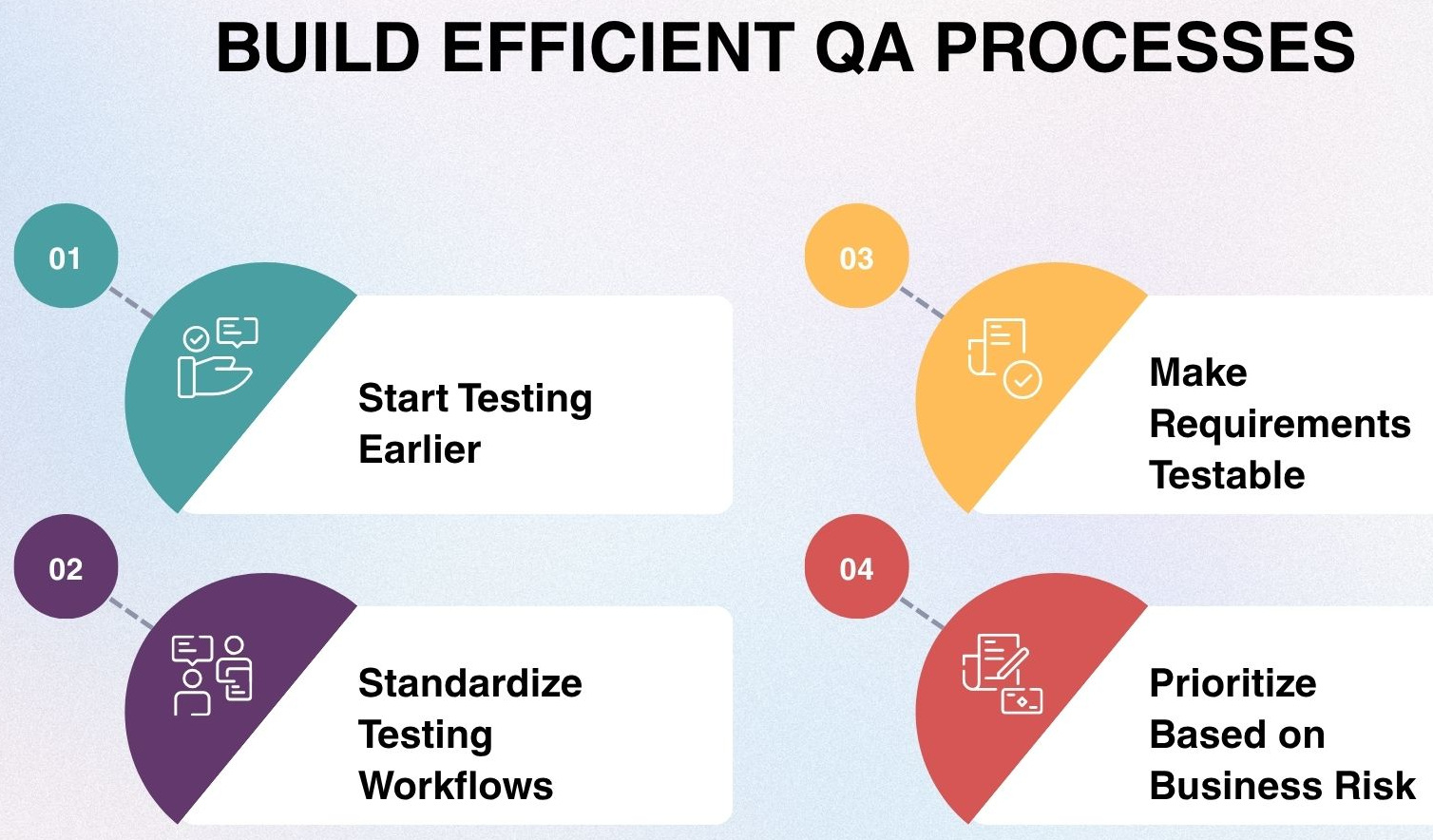
- Start Testing Earlier: Engaging QA from the requirements phase helps uncover requirement gaps, unclear acceptance criteria, and potential risks before development begins, preventing costly defects later.
For example, while reviewing an international money transfer feature, QA can identify missing scenarios such as currency conversion failures, regulatory limits, duplicate transactions, and network interruptions before any code is written. This shift from defect detection to defect prevention reduces rework, improves software quality, and accelerates delivery.
- Make Requirements Testable: Testing delays often result from poorly defined requirements, which cannot be objectively validated. Vague requirements like
the system should load quicklyorthe application should be user-friendlyare unacceptable.Requirements must include measurable acceptance criteria, for example,the dashboard loads within two seconds for 95% of usersorthe system supports 5,000 concurrent users.Clear and testable requirements decrease ambiguity, increase test coverage, and allow QA teams to validate software more efficiently. - Standardize Testing Workflows: High-performing QA teams rely on standardized workflows instead of redefining their testing process for every sprint. For example, before releasing a new feature, every team can follow the same checklist—requirements reviewed, test cases completed, automation implemented, regression passed, and business approval obtained.
Such consistency improves predictability, reduces errors, and helps new team members become productive faster.
- Prioritize Based on Business Risk: Not all features need to be tested to the same degree, so high-performing QA teams put their focus on areas that have the greatest business impact. An example is an e-commerce platform that is preparing for a holiday sale. It would prioritize testing checkout, payment processing, inventory synchronization, and order confirmation. Low-risk administrative pages would get lighter coverage.
This risk-based strategy guarantees that QA resources are applied where failures would have the greatest business impact.
Read: How to Improve QA Efficiency?
Enable QA Teams to Test More Efficiently
QA teams spend valuable time on non-testing activities like preparing test data, waiting for environments, maintaining automation scripts, documenting results, etc. This leaves less time for exploratory testing and the discovery of critical quality issues. As QA performance improves, these inefficiencies are eliminated so that testers can focus on providing better quality of software.
Let’s see how we can make QA teams more efficient.
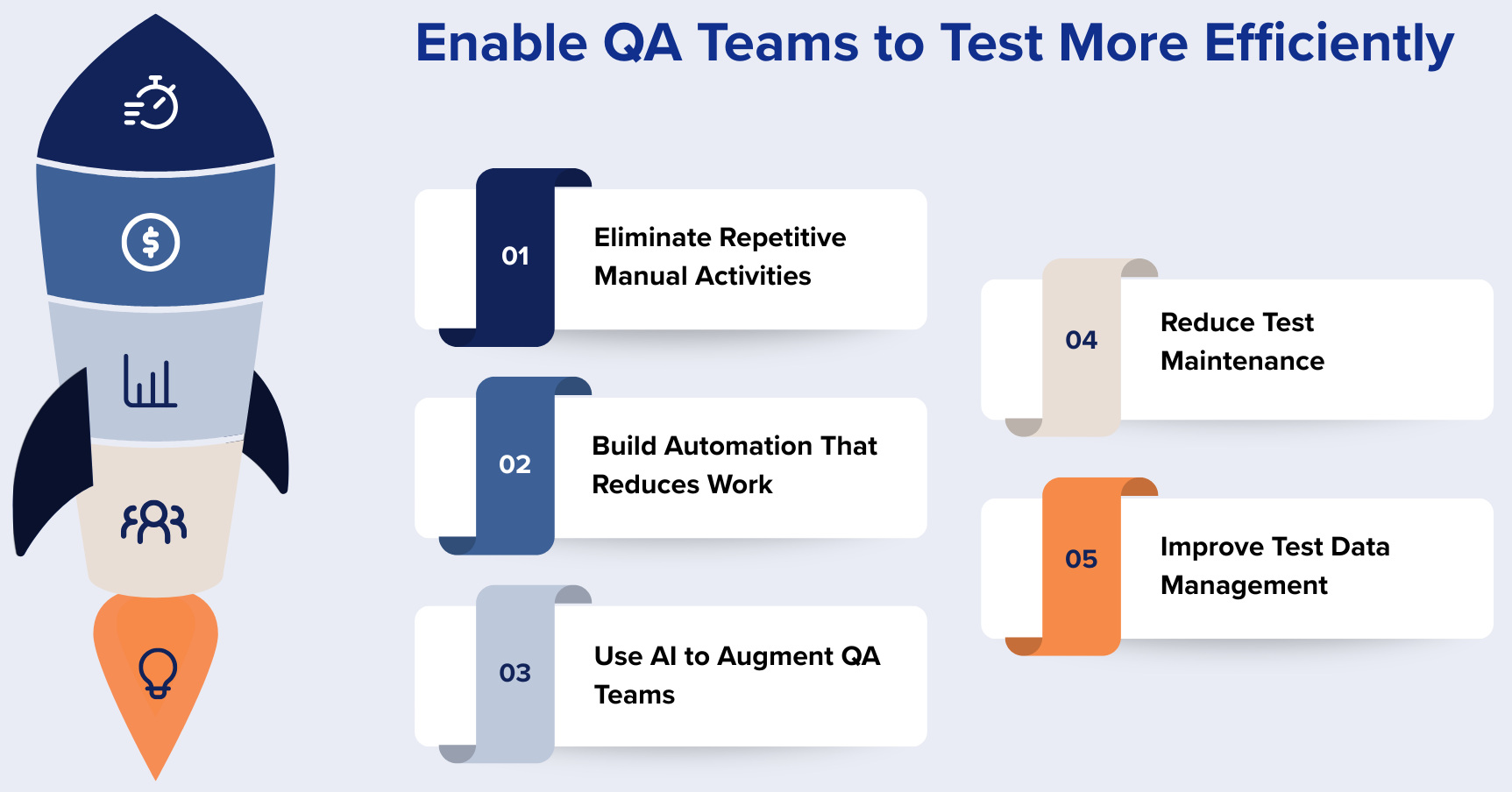
Eliminate Repetitive Manual Activities
Many QA teams spend a lot of time on repetitive tasks like preparing test data, generating reports, maintaining regression suites, and documenting results. If we can identify these low-value activities and automate them, testers can spend time on exploratory testing, improving automation, and validating new features.
Say you have a team of 10 QA engineers, and each of them spends an hour a day on repetitive manual work. That’s almost 50 productive hours the organization is losing every week. By automating these routine tasks, we can reclaim thousands of hours a year and dramatically improve overall QA performance.
Build Automation That Reduces Work
Modern AI-powered test automation platforms help QA teams spend less time maintaining automation. testRigor allows teams to create automated tests using plain English instead of traditional programming languages. Because tests are based on user-visible behavior rather than fragile implementation details such as XPath or CSS selectors, they are significantly more resilient to UI changes. This reduces maintenance effort and allows QA engineers to spend more time validating new features instead of repairing broken automation.
Read: Decrease Test Maintenance Time by 99.5% with testRigor.
Consider an e-commerce application where the “Checkout” button is moved to another section of the page during a UI redesign. Traditional script-based tools may require locator updates across multiple test cases. In contrast, an AI-powered platform like testRigor can often continue identifying the element using visible text and context, reducing maintenance effort considerably.
Use AI to Augment QA Teams
AI is most useful when it helps QA engineers do their jobs, not when it replaces them. It can speed up test case generation, produce automation scripts, detect duplicate tests, generate test data, and summarize execution results. AI automates these repetitive activities so testers can spend more time on exploratory testing, business validation, and risk analysis.
Modern AI-native quality engineering platforms take this a step further by embedding AI throughout the testing lifecycle. For example, testRigor enables QA teams to create end-to-end automated tests using plain English, reducing the need for programming expertise while minimizing maintenance caused by UI changes. It also supports testing across web, mobile, desktop, APIs, mainframes, emails, SMS, databases, AI features, chatbots, and other enterprise workflows within a single platform.
Reduce Test Maintenance
Test maintenance is one of the highest hidden costs in QA, as UI changes, API updates, and evolving business rules can quickly break automated tests. High-performing teams reduce this effort by building resilient, reusable automation that focuses on business behavior rather than fragile implementation details.
For example, a test that relies on a complex XPath may fail after a simple UI change, while one that identifies elements based on business intent remains stable. Using modular frameworks, reusable components, and intelligent element identification minimizes maintenance and gives QA teams more time to test new features.
Improve Test Data Management
Poor test data management often becomes a major productivity bottleneck, forcing QA teams to spend valuable time creating, resetting, or restoring data before testing can begin. Using reusable datasets, automated test data generation, and environment reset mechanisms allows testers to focus more on validating application behavior.
For example, instead of manually creating users for every regression cycle, an automated process can generate hundreds of test accounts with different roles, permissions, and data variations in minutes. This reduces setup time, improves test repeatability, and significantly increases QA efficiency.
Read: More Efficient Way to Do QA.
Measure the Right QA Metrics
- Measure Escaped Defects: They reveal gaps in the testing process and are one of the strongest indicators of QA effectiveness. For example, if a payment failure is discovered only after production, the team should analyze whether it was caused by missing test scenarios, inadequate test data, or automation gaps to prevent similar issues in future releases.
- Track Automation Stability: Automation is valuable only if it produces reliable and trusted results. For example, a team with 70% stable automation that consistently detects real defects is far more effective than one with 95% automation coverage plagued by false positives and frequent script failures.
- Monitor Testing Cycle Time: Measuring the time required to complete testing helps identify delays that slow software delivery. For example, implementing parallel test execution, earlier QA involvement, and AI-assisted test generation can significantly shorten testing cycles without compromising quality.
Build a Quality-First Culture
- Early Developer-QA Collaboration: Breaking the traditional handoff between development and QA helps find defects much earlier in the lifecycle. For example, QA involvement in requirement reviews enables testers to detect edge cases, missing acceptance criteria, and potential security or usability issues before development, reducing costly rework later.
- Encourage Knowledge Sharing: It helps improve the skills and productivity of the entire QA team rather than just individual engineers. For example, if one tester demonstrates a faster approach to API automation during a team session, the entire team can adopt the practice and save significant effort across future releases.
- Invest in Continuous Learning: It is a must to maintain high QA performance with the evolution of software testing with AI, cloud technologies, and modern engineering practices. Even just a couple of hours a month spent on internal workshops, pair testing, or AI experiments can gradually build up the team’s capabilities and productivity over the long run.
The Future of High-Performing QA Teams
QA is moving toward quality intelligence to make confident release decisions, not testing. AI can automate many of the routine activities that come with test generation, test data prep, reporting, regression management, and even test automation creation using AI-native platforms such as testRigor. This allows QA engineers to spend more time on business validation, risk analysis, AI assurance, and exploratory testing instead of repetitive manual work.
This is not a reduction in the importance of QA, but a transformation into a much more strategic discipline. More and more organizations will rely on QA teams to answer the more important question – “Are we confident enough to ship this software?” rather than simply “Did the tests pass?”
The future belongs to QA teams that can successfully blend human expertise with AI-powered platforms and intelligent automation. These teams will balance AI-powered productivity with engineering judgment to deliver faster releases, better software quality, and increased business confidence.
Case Studies: QA Performance in Action
Many organizations have significantly improved QA productivity by combining better engineering practices with AI-native automation platforms. The following examples demonstrate how reducing automation maintenance and empowering QA teams with AI can lead to measurable improvements in software quality and delivery speed.
- IDT Corporation: IDT increased its automation coverage from 34% to 91% in less than nine months after adopting testRigor. The team also reported a 90% reduction in bugs, allowing QA engineers to spend less time maintaining automation and more time expanding test coverage and improving software quality.
Read the case study here: How IDT Corporation went from 34% automation to 91% automation in 9 months.
- Enumerate: Enumerate built over 1,000 automated tests in just six months using testRigor, moving from virtually no automation to comprehensive regression coverage. This helped reduce developer time spent fixing production issues while significantly improving QA productivity and release confidence.
Read the case study: How Enumerate went from zero to 100% automation in 6 months and 6X QA success rate.
Wrapping Up
Better QA team performance is not about doing more testing. It’s about empowering teams to deliver more confidence through smarter processes, intelligent automation, meaningful collaboration, and AI-powered quality engineering. As software delivery continues to accelerate, organizations that invest in people, modern testing practices, and AI-native platforms like testRigor will be better positioned to release high-quality software faster, while reducing maintenance effort and improving business outcomes.
Ultimately, the QA teams that will be the most successful are those that combine human expertise and AI to make better release decisions and create a culture of quality as everyone’s responsibility.
Frequently Asked Questions (FAQs)
- How long does it typically take to improve QA team performance?
The timeline depends on the organization’s current QA maturity, team size, and processes. While improvements from better collaboration and workflow optimization can be seen within a few weeks, broader initiatives such as AI adoption, automation modernization, and cultural transformation may take several months to deliver measurable business results.
- What skills should modern QA engineers develop to stay productive in 2026?
Modern QA engineers should strengthen skills in AI-assisted testing, API testing, test automation, cloud technologies, DevOps practices, data analysis, and domain knowledge. Soft skills such as communication, critical thinking, and risk assessment are equally important as QA becomes more involved in release decision-making.
- How can engineering managers measure the ROI of improving QA team performance?
Organizations can evaluate ROI by tracking improvements in release frequency, escaped defects, testing cycle time, automation maintenance effort, production incidents, customer satisfaction, and engineering productivity. Reduced rework and faster delivery often provide measurable business value that extends beyond the QA team.
| Achieve More Than 90% Test Automation | |
| Step by Step Walkthroughs and Help | |
| 14 Day Free Trial, Cancel Anytime |