
What are Software Testing Strategies? A Complete Guide
 |
Today, we see software development moving at a surprising speed. New features come out weekly, or maybe every day. With the advent of AI in every process comes more challenges in software testing. When businesses are fighting to provide better digital experiences, products constantly evolve and grow.
In such a competitive environment, we can not have testing as an afterthought. Rather, organizations should manage quality in a systematic way. That is where software testing strategies come into the picture, to bring structure to the STLC.
| Key Takeaways: |
|---|
|
What are Software Testing Strategies?
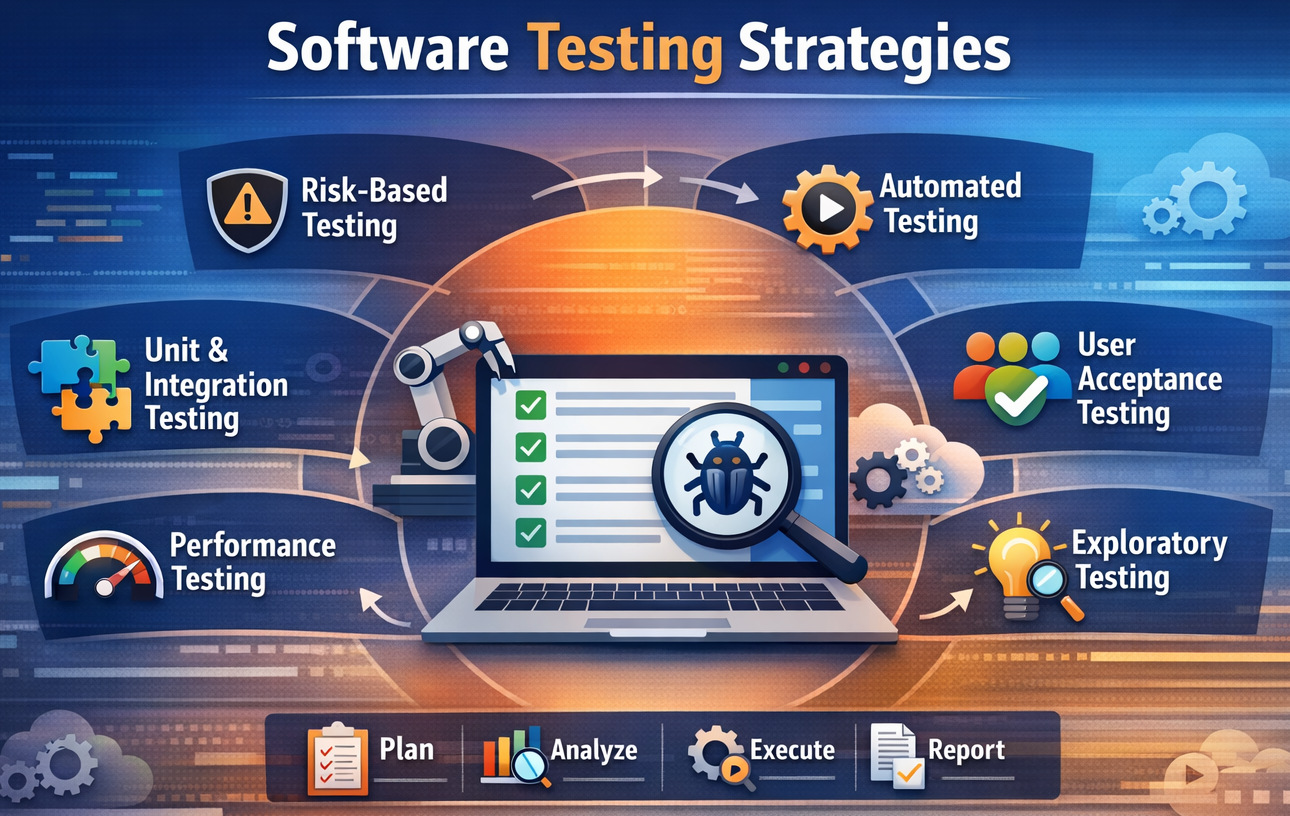
A software testing strategy is a systematic approach that defines how to test and validate the quality of a software application. It provides us with an overall framework for the testing process. It includes methodologies, testing levels, environments, and tools.
For example, a company may have adopted a normal process in which developers perform unit testing with the JUnit framework, and QA folks do system and regression testing before releasing.
A well-defined testing strategy provides clear answers to these questions that are indispensable. Which can be: the tests to be carried out, how and when they will take place, and who is responsible for specific types of test undertakings. The strategy also includes a list of the tooling and frameworks to assist with testing. It also identifies risks that need to be managed.
For instance, if in a strategy, the automated tests for the most critical workflows like login, checkout, or payment processing are included, then it can definitely help to prevent production failures.
Testing strategies are usually discussed and solidified at an organizational or project level. They serve as a guideline for the reuse in many projects. They are a high-level plan that guides the teams on when to test and how to go about testing in a repeatable way.
So, a company could have processes like continuous integration testing, automated regression suites, and performance testing in place before any major release. This helps to keep software quality levels as high as possible, product after product.
Read: The Role of Testing in Deployment Strategy.
Why do we Need Software Testing Strategies?
- Better Product Quality: A strategic testing approach makes sure that testing activities cover all critical areas of the system. It helps teams focus on risk-prone components and maintain a high product standard.
- Optimum Resource Utilization: Testing resources, whether human testers, environments, or automation infrastructure, are limited. A strategy helps teams allocate these resources efficiently.
- Faster Release Cycles: A structured strategy reduces redundant testing activities and accelerates defect detection, enabling teams to release software faster.
- Risk Mitigation: Testing strategies focus on risk assessment and prioritize testing efforts accordingly. So that critical failures are identified early in the development cycle.
- Sync with Business Goals: Testing strategies connect testing activities with business objectives such as reliability, security, performance, and user satisfaction, to keep them both in sync.
What makes a Good Software Testing Strategy
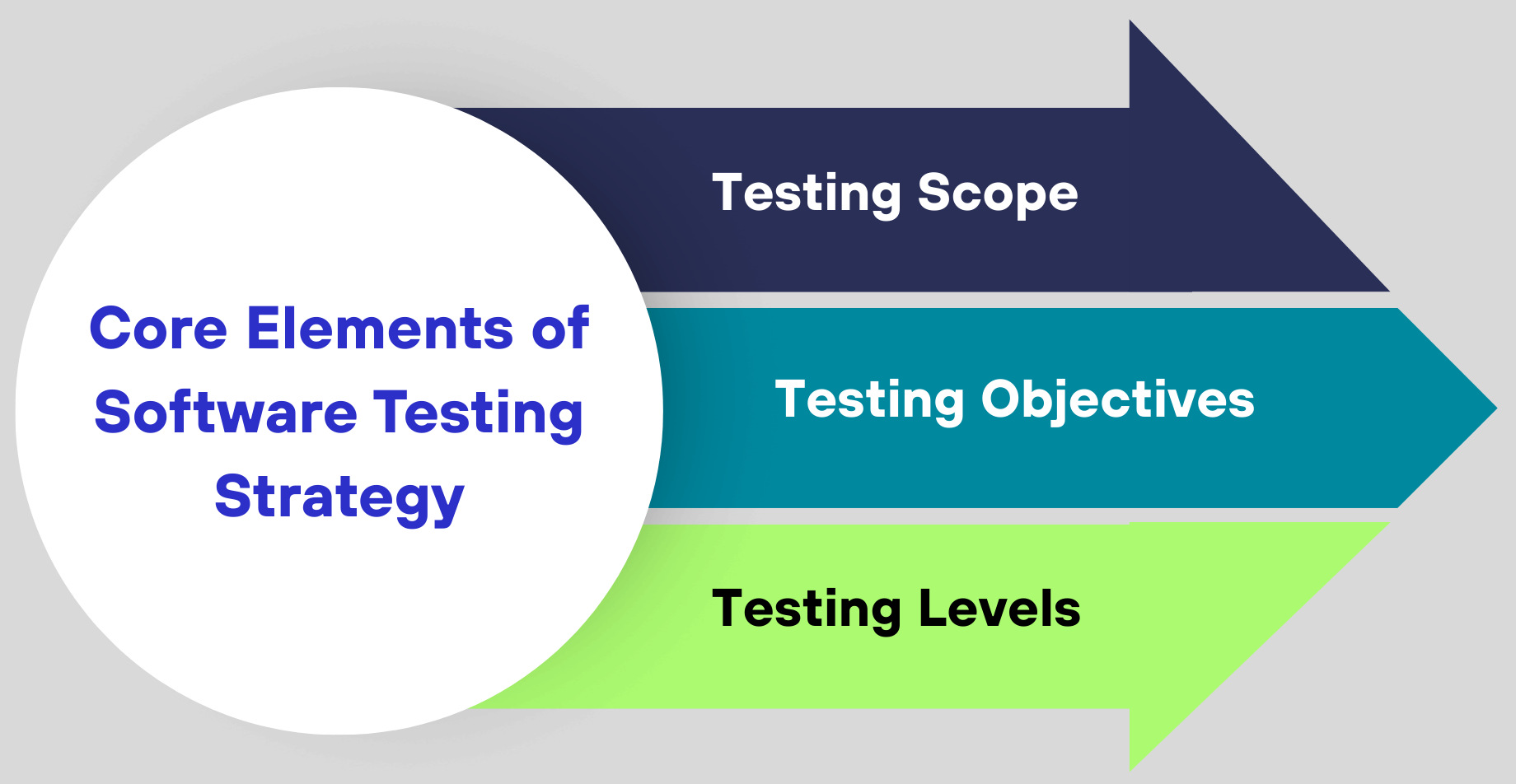
A testing strategy that will define the way we are going to execute our test cases usually contains a few components. These aspects give a systematic foundation and serve as a mechanism for teams to plan, structure, and execute testing during the software delivery process. It also helps to maintain consistency in testing practices, making it easier to bring quality across different projects.
Testing Scope
The testing scope specifies the limits of what is covered by testing activities. It identifies what features, components, and workflows need to be tested and what is out of scope. Having a clear scope allows teams to determine how far they are meant to test. It also helps them avoid wasting time on testing things that should not be tested due to their low priority.
- Core system functionality that supports the main business operations of the application. They must be thoroughly tested.
- Integration points between different modules or external systems must be validated to make sure smooth data exchange.
- User interfaces must be tested to confirm that users can interact with the system correctly and without usability issues.
- APIs must be tested to verify that requests, responses, and error handling behave as expected.
- Data processing workflows must be validated to ensure accurate data transformation, storage, and retrieval.
- Security mechanisms must be tested to ensure that authentication, authorization, and data protection measures work properly.
Read: Test Planning – a Complete Guide.
Testing Objectives
Testing objectives are the aim of testing activities: What do we want to achieve?
These are clear guidelines on what the testing process aims to achieve and help teams measure whether the software meets quality expectations. For example, we want to test for an app that the core modules are working as expected, the system remains stable under heavy load, and the application is secure and easy to use for the end-user.
- Verify that the application meets functional requirements.
- Check the system’s stability under expected workloads.
- Detect the security vulnerabilities and get them fixed
- Validate the usability and accessibility of the product
- Make sure the app/product is compatible across devices and platforms.
Read: What is a Test Charter?
Testing Levels
- Unit Testing: Tests the software is working as intended by validating individual components or functions. Developers usually run unit tests to verify that each of the modules acts as expected in isolation. Read: Unit Testing: Best Practices for Efficient Code Validation.
- Integration Testing: Tests modules interact with each other correctly. In this test, all elements should communicate and transmit data correctly, with no errors. Read: Integration Testing: Definition, Types, Tools, and Best Practices.
- System Testing: Evaluates the complete application as a unified system. This step tests that the system satisfies functional and non-functional demands. Read: What is System Testing?
- Acceptance Testing: Acceptance testing ensures the product meets business requirements and is ready for release. This testing phase usually involves stakeholders, product owners, or end users. Read: Acceptance Testing Automation – The Easy Way.
Types of Software Testing Strategies
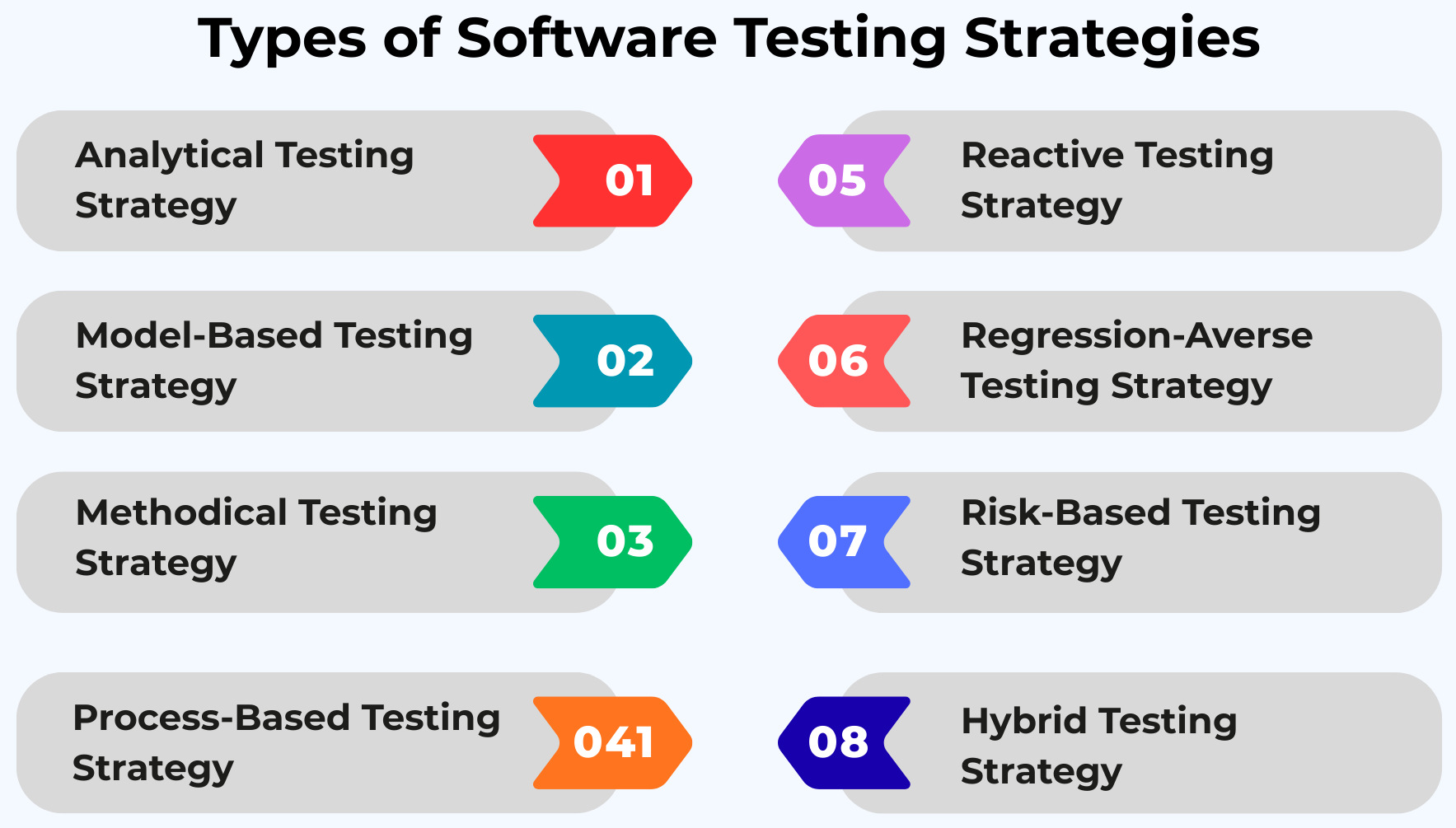
Every project tackles testing differently based on the complexity, risk level of the system being developed, development methodology, and release timelines. By selecting the appropriate strategy, teams can prioritize and distribute their testing efforts effectively while concentrating on areas that significantly influence software quality. Such a strategy helps you articulate, measure, and improve testing activities within the project to enable its successful delivery.
Let’s discuss some of the testing strategies.
Analytical Testing Strategy
An analytical testing strategy focuses on risk analysis and requirement evaluation to determine testing priorities. Instead of testing everything equally, this approach identifies high-risk areas and allocates more testing effort to them.
For example, a banking application might prioritize testing transaction processing and authentication systems because failures in these areas could cause severe consequences. Analytical strategies are particularly useful in large systems where testing every scenario is impractical. Read: How to Automate Check Analytics Testing.
Model-Based Testing Strategy
The model-based testing strategies are based on formal representations of how a system behaves in different scenarios. These visual artifacts might be state diagrams, flowcharts, decision tables, and user journey maps that represent system processes and interactions.
These models are used to derive test cases that provide systematic coverage of application behavior. For example, in an online banking application, we could show a state diagram that identifies all of the states in the system, including login, authentication, transaction selection, and payment confirmation stages, etc., and then use it to develop test scenarios that validate every possible path through the user experience.
Methodical Testing Strategy
The methodical testing strategies use well-defined test techniques to make sure testing activities are performant. Testers follow structured techniques like boundary value analysis, equivalence partitioning, decision table testing, and state transition testing to design and implement test cases. Read: Test Design Techniques: BVA, State Transition, and more.
For instance, assume that a login form accepts passwords of 8 to 16 characters; To validate such a form, testers try input values such as 7 characters (lower boundary), 8 characters (lower bound value), 16 characters (upper bound value), and above 17 characters (upper boundary). It’s a common practice in regulated industries like healthcare and finance, where compliance with stringent standards requires systematic validation and documentation.
Process-Based Testing Strategy
Process-based testing strategies focus on the software development processes and align the testing activities with them. Testing is carried out through structured frameworks like the Waterfall model, V-model, or the Agile testing lifecycle to make sure that quality checks are done at every stage of development.
Read: Testing Methodologies Uncovered: Propel Your QA Forward.
An example is the V-model, where every development phase has a corresponding test activity that validates its results. Acceptance testing validates requirements, system testing validates system design, and unit testing validates module development.
Reactive Testing Strategy
So, a reactive testing strategy is more about addressing things discovered while doing your tests and is less about the specific path laid down by a predefined plan. Dynamic testing is where the testers explore the system dynamically and change their approach according to the behaviour of users and defects found during execution.
This approach is widely used in exploratory testing, where testers explore the application to discover new defects that were not expected. Reactive strategies are great to use for prototypes or products in their early stages, where requirements and features change quite often.
Regression-Averse Testing Strategy
Regression-averse testing strategies create stability in your software as you launch frequent updates or changes. These tests confirm that new features, bug fixes, or code changes do not accidentally break existing functionality.
Automated regression testing is most widely used to check previously tested features repeatedly after every change. For example, if a new payment feature is added to an e-commerce application, regression tests ensure that existing functions such as login, product search, and checkout remain functional in a continuous integration and deployment environment.
Risk-Based Testing Strategy
Risk-based testing strategies prioritize testing activities based on the potential risks associated with different parts of the system. Factors such as system complexity, business impact of failure, feature usage frequency, and security implications help teams identify which components require the most rigorous testing.
High-risk components receive extensive testing, while lower-risk areas may undergo lighter validation to optimize time and resources. For example, in an e-commerce platform, payment processing and order checkout features are tested more thoroughly than less critical areas such as product recommendation sections.
Hybrid Testing Strategy
Hybrid testing strategies combine multiple testing approaches to create a flexible and comprehensive testing framework. Instead of relying on a single strategy, teams integrate methods such as risk-based prioritization, automated regression testing, exploratory testing sessions, and model-based scenario coverage.
This combination allows organizations to adapt testing activities based on project requirements, risks, and timelines. For example, a team may prioritize high-risk payment features using risk-based testing while running automated regression tests for core workflows and conducting exploratory sessions to uncover unexpected defects.
Strategic Approaches to Testing Levels
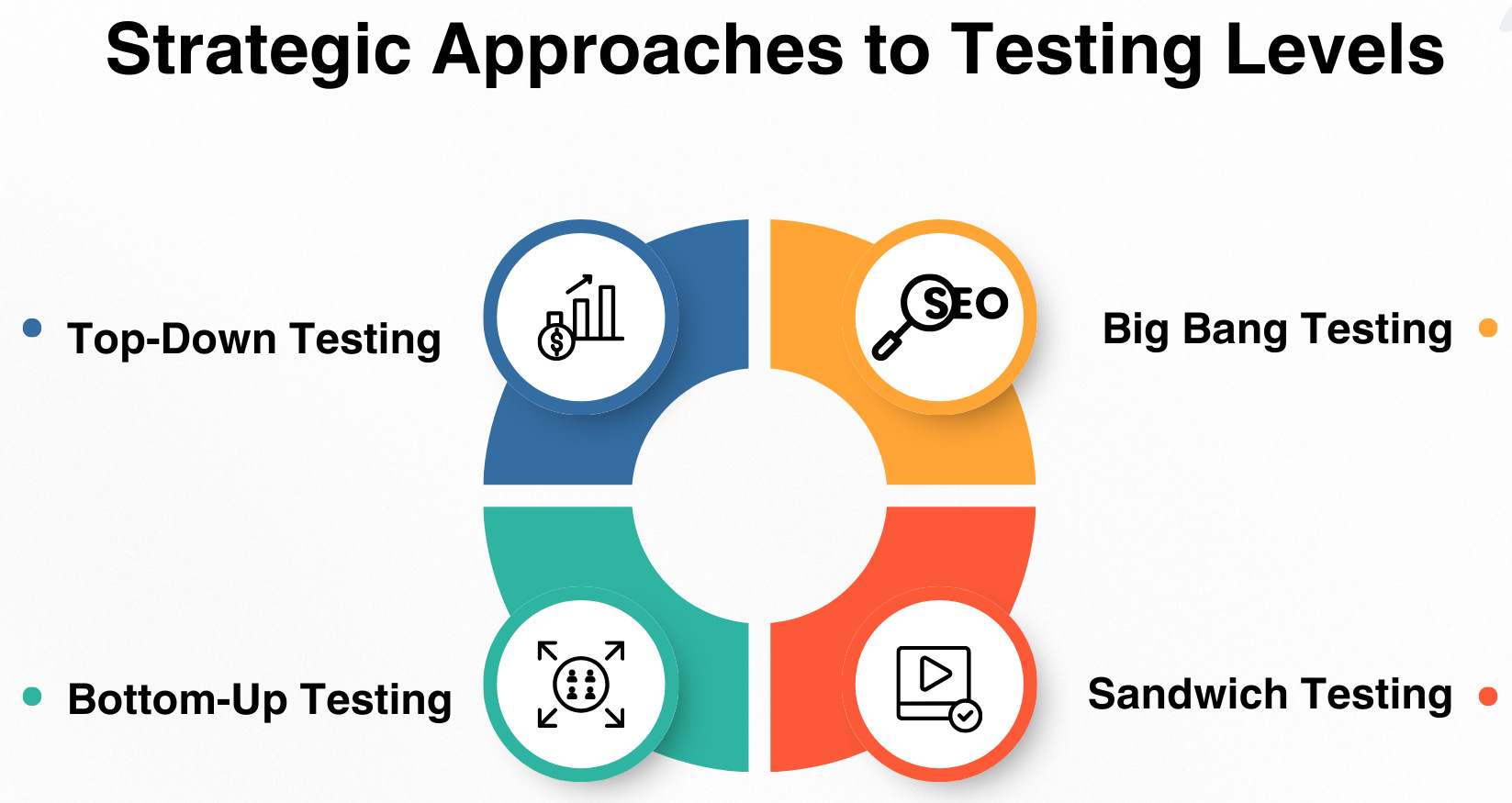
Testing strategies often encompass structured test coverage across multiple levels. Such approaches offer the framework for how various modules and components should be validated while integrating. Selecting the appropriate strategy allows teams to identify defects sooner while effectively managing testing complexity.
Top-Down Testing
In top-down testing, higher-level modules are tested first, followed by lower-level components as they become available. This approach helps validate the system architecture and major workflows early in the development process.
For example, in a banking application, the main dashboard and transaction interface may be tested first while backend modules are still under development. Temporary stubs are used to simulate lower-level modules until the actual components are completed.
Bottom-Up Testing
Bottom-up testing begins with testing individual modules or components before integrating them into larger systems. This strategy ensures that the core functionality of smaller units is reliable before building the complete system.
For instance, developers may first test database operations, authentication services, and payment calculation modules individually. Once these components are verified, they are gradually integrated to form the complete application.
Big Bang Testing
In big bang testing, all modules of the application are integrated at once and tested as a complete system. This method does not follow a phased integration process, making it simpler to implement initially.
For example, after all modules of an e-commerce platform, such as product catalog, payment processing, and order management, are completed, they are integrated simultaneously for testing. However, if a defect occurs, identifying the exact source of the problem can be difficult.
Sandwich Testing
Sandwich testing combines both top-down and bottom-up testing approaches. Testing begins simultaneously at higher-level and lower-level modules until both testing streams meet at the middle layers. Read: What is Sandwich Testing?
For example, in a large enterprise system, testers may validate the user interface and business workflows while developers test backend services and databases at the same time. Eventually, the middle-layer components, such as service integrations, are tested when both sides converge.
Read: Integration Testing: Definition, Types, Tools, and Best Practices.
Steps to Design an Effective Testing Strategy
- Understand the System Requirements: The first step in designing a testing strategy is to analyze both functional and non-functional requirements. This helps determine which types of testing, such as functional testing, performance testing, security testing, and usability testing, are necessary.
- Identify the Risks: Risk identification helps teams focus their testing efforts on the most critical areas of the system. Common risk factors include security vulnerabilities, high transaction volumes, complex integrations, regulatory compliance requirements, etc.
- Define the Test Environments: Testing environments should closely resemble the production environment. It helps in getting accurate and reliable test results. You should consider operating systems, databases, network configurations, and integration with third-party services.
- Choose Powerful Testing Tools: A testing strategy should clearly define the tools used for activities such as test management, automation, performance testing, and defect tracking. Selecting the right tools helps maintain consistency, improve efficiency, and support good collaboration across the teams.
Testing Strategy: Benefits and Challenges
Implementing a structured testing strategy offers many benefits for improving software quality, but it also introduces certain challenges that teams must address during adoption and execution.
| What are the Advantages? | These are the Challenges |
|---|---|
| Testing strategies provide a structured approach to testing. It makes sure that testing activities follow a clear and consistent process. | To design an effective strategy, you require a deep understanding of the system. This can take significant time and effort. |
| It helps prioritize testing efforts based on risk, complexity, and business impact. | Implementing new strategies may face resistance from teams. |
| Helps improve test coverage by defining what should be tested and also how testing should be performed. | To maintain and update the strategy as systems evolve rapidly, can be a challenge for the team. |
| Brings in collaboration between development, QA, and business teams through clearly defined responsibilities. | To integrate testing strategies with rapidly changing development environments can be difficult. |
| Supports better resource allocation by focusing testing efforts on critical areas. | Limited resources, tools, or skilled testers may hinder the effective execution of the strategy. |
Conclusion
Software testing strategies establish the underlying principles and guidelines for implementing quality assurance efficiently. If left to the wind, testing can be reactive, haphazard, and inefficient. However, a defined strategic approach helps the team deliver reliable software quickly, which reduces risks.
Hence, strong testing strategies are required to develop high-quality products that meet business and user expectations as the software systems are getting more complex with the use of AI capabilities and development life cycles are speeding up.
| Achieve More Than 90% Test Automation | |
| Step by Step Walkthroughs and Help | |
| 14 Day Free Trial, Cancel Anytime |