Waterfall Project Management Methodology: Principles and Practices
 |
“Project management can be defined as a way of developing structure in a complex project, where the independent variables of time, cost, resources and human behavior come together” – Rory Burke.
Indeed, project management methodologies provide a structured method for planning, executing, and controlling projects. One of the earliest and most widely recognized project management methodologies is the Waterfall Project Management Methodology.
| Key Takeaways: |
|---|
|
In this article, we will explore the waterfall model and its role in today’s project management. We will see the cases in which the waterfall model still makes sense and how it compares to more modern methodologies.
What is the Waterfall Model?
The Waterfall Model is an example of a traditional, linear, and sequential approach to project management. It structures the entire process into predefined, sequential stages. This is quite similar to how water flows down a waterfall. There is little to no overlap between phases, and each must be completed before proceeding to the next.
Historically, Royce described a sequential model but did not advocate the pure Waterfall process. Consider revising for accuracy. Over time, it evolved into a broader project management framework applicable across various industries.
The central idea of the Waterfall methodology is that each project phase has specific deliverables and review processes. The current phase must be completed and approved before the project can proceed to the next stage.
Key Features of the Waterfall Methodology
The following are the key features of the Waterfall methodology:
-
Sequential Progression with Minimal Iteration: The sequential flow of activities is one of the most fundamental principles of the Waterfall model. Each stage follows a logical sequence, ensuring tasks are completed systematically. Once a phase is complete, returning to the previous phase is costly and typically avoided.For example, requirements gathering must be completed before design begins, and design must be finalized before implementation/coding starts. This sequential structure minimizes ambiguity and creates a clear roadmap for project execution.
-
Comprehensive Documentation: Waterfall projects involve detailed documentation. Every phase creates documentation that guides future activities and serves as reference material throughout the project lifecycle.Examples of documentation prepared during various stages include project plans, requirement specifications, design documents, test plans, user manuals, and progress reports.Comprehensive documentation helps ensure consistency, accountability, and knowledge preservation.
-
Defined Requirements: The Waterfall methodology assumes that project requirements are the foundation of all subsequent project work and can be clearly identified at the beginning of the project.It emphasizes defining and analyzing requirements before the development phase begins, as later changes can be costly and disruptive.
-
Phase-Based Control: Each project phase using the Waterfall model includes approval and review mechanisms. Before the project progresses to the next phase, stakeholders must assess the deliverables and approve them.This is the phase-gate approach providing strong governance and quality control throughout the project lifecycle.
- Predictability and Planning: Planning and estimation are upfront in the Waterfall model, and hence, project managers must develop detailed schedules, resource allocation, budgets, and risk assessments in advance before execution starts. With this predictability, it is easier to monitor performance against established baselines.
Waterfall Model Diagram
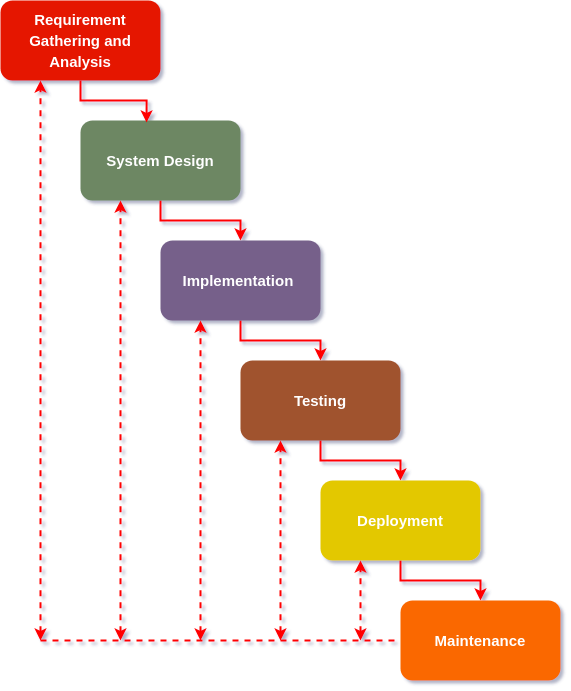
Waterfall Project Management Phases
The Waterfall Model is divided into six primary phases. Each phase has a set purpose and role in the successful delivery of a project.
Requirement Gathering and Analysis
This is the foundation of the Waterfall Model. It involves identifying and documenting project goals, stakeholder requirements, functional needs, and constraints. Without clear requirements, the rest of the project may be jeopardized. Any changes or ambiguities at this stage can have subsequent ripple effects on the next phases.
Key Activities:
- Meetings/Interviews: Engage clients, end users, and stakeholders to gather requirements.
- Documentation: Create a comprehensive Software Requirements Specification (SRS) document.
- Requirement Validation: Ensure the requirements are clear, feasible, and agreed upon by all the parties involved.
Deliverables:
- SRS document.
- A list of functional and non-functional requirements.
System Design
In this phase, the team translates the approved requirements into a technical blueprint that guides implementation. The design phase provides a clear roadmap for developers to minimize misunderstandings during implementation.
Key Activities:
- High-Level Design (HLD): Outlines the overall system architecture, including modules, components, and their interactions.
- Low-Level Design (LLD): Defines the internal workings of each component, including data structures, algorithms, and database schemas.
- Tool Selection: Identifies the technologies, programming languages, and tools to be used.
Deliverables:
- Design documents (HLD and LLD).
- Mockups, diagrams (like UML or flowcharts), and database designs.
Implementation (Coding)
This is the execution phase, where developers translate the approved design into functional code. The implementation phase marks tangible progress for the project. However, its success relies heavily on the clarity and accuracy of the design phase.
Key Activities:
- Coding: Write code for individual modules or components by following coding standards and best practices.
- Peer Reviews: Conduct peer reviews to ensure code quality.
Deliverables:
- A functional product (or prototype).
- Source code for all components.
Testing and Verification
In this phase, the developed product undergoes rigorous evaluation to identify and fix defects or bugs. This phase also verifies that deliverables meet requirements. Since testing happens after implementation, any defects found at this stage can be expensive to fix. Thorough testing is critical for ensuring product quality and reliability. Read: Different Software Testing Types.
Key Activities:
- Unit Testing: Test individual components for functionality.
- Functional Testing: Test functionality of the features.
- Integration Testing: Ensure different modules work together seamlessly.
- System Testing: Verify the entire system against requirements.
- User Acceptance Testing (UAT): Get end-user validation to ensure the product meets their expectations.
Deliverables:
- Test plans and test cases. Here is a Test Plan Template and article to explain How to Write Test Cases? (+ Detailed Examples).
- Bug reports and test results.
- A defect-free, stable product.
Deployment
This phase involves delivering the fully tested product to the customer or end-users. The primary objective of this phase is to ensure a smooth transition from development to operational use. The deployment phase creates an accessible and usable product for the intended audience. Proper setup and training minimize post-launch issues.
Key Activities:
- Environment Setup: Configure the production environment. Read: What is a Test Environment?
- Product Installation: Deploy the software to the client’s systems.
- User Training: Provide manuals or conduct training sessions for end-users.
- Documentation Delivery: Provide product documentation to end users.
Deliverables:
- Deployed software.
- User manuals and training materials.
Maintenance & Support
After deployment, the product enters the maintenance phase, which addresses issues and enhancements needed post-launch and focuses on sustaining project outcomes. The maintenance phase ensures the product remains functional, relevant, and aligned with evolving user needs or market demands.
Maintenance continues throughout the product’s operational life. Ongoing technical support ensures long-term usability and helps preserve value.
Key Activities:
- Bug Fixing: Resolve issues reported by users.
- Performance Optimization: Improve speed, efficiency, or scalability.
- Updates and Upgrades: Add new features or adapt the software to changing requirements.
- Technical Support: Provide appropriate technical support for any production issues.
Deliverables:
- Patch releases or software updates.
- Maintenance reports.
Read: Decrease Test Maintenance Time by 99.5% with testRigor.
Advantages of the Waterfall Model
The Waterfall Model, though less popular in today’s Agile-dominated world, remains valuable in specific contexts due to its unique strengths. These attributes make it particularly suitable for projects where predictability, structure, and detailed planning are paramount. Here are the key strengths:
Predictability and Stability
The Waterfall Model is highly predictable because of its linear and sequential nature, which ensures each phase is completed before moving to the next. This makes it ideal for projects that require precise planning and execution without deviations.
Why It’s a Strength:
- The fixed structure allows for accurate forecasts of timelines, budgets, and resource allocation. Read: How to Save Budget on QA.
- Any deviation from the plan can be identified early, reducing the risk of costly overruns or surprises.
- Stability in project execution ensures consistency, especially in critical fields like construction or government.
Comprehensive Documentation
One of the hallmarks of the Waterfall Model is its emphasis on producing detailed documentation at every phase. This serves as a reliable source of reference for all stakeholders.
Why It’s a Strength:
- Documentation provides a knowledge repository that can be invaluable for regulatory compliance, audits, and maintaining accountability.
- It enhances clarity and traceability, ensuring all decisions, changes, and progress are well-documented.
- When team members leave or new ones join, the documented information facilitates smooth knowledge transfer. This maintains continuity in long-term or complex projects.
Use Cases:
- Compliance-Driven Projects: In industries like healthcare and finance, regulatory bodies require exhaustive documentation as proof of adherence to standards and due diligence.
- Long-Term Projects: For multi-year projects like infrastructure development or enterprise system upgrades, documentation ensures that future team members can pick up from where others left off.
Simplicity and Clarity
The Waterfall Model’s structured, step-by-step approach makes it straightforward and easy to implement, even for teams with limited experience in modern project management methodologies.
Why It’s a Strength:
- It eliminates the complexities of iterative processes, making it accessible for beginners or less experienced teams.
- Each phase has well-defined deliverables and objectives, reducing ambiguity.
- Its simplicity makes it suitable for small-scale or straightforward projects.
Use Cases:
- Small Teams: A small team with limited exposure to Agile or hybrid methodologies can quickly adopt the Waterfall Model without extensive training.
- Educational Settings: Due to its clarity, it is often used as a teaching tool for students learning the basics of project management and software development.
Effective for Fixed-Requirement Projects
The Waterfall Model shines in projects where the requirements are clearly defined, static, and unlikely to change during the project lifecycle.
Why It’s a Strength:
- It allows for meticulous upfront planning, ensuring that the entire project roadmap is based on a solid understanding of the requirements.
- For projects with minimal uncertainty, Waterfall’s rigidity is an advantage, as it prevents scope creep and keeps the project focused.
Use Cases:
- Embedded Systems in Appliances: Developing software for appliances like washing machines or microwaves often involves well-defined specifications that remain consistent.
- Enterprise Resource Planning (ERP) Systems: Implementing large-scale ERP solutions for organizations with fixed business processes benefits from Waterfall’s structured design and deployment phases. Read: How to Automate ERP Testing.
Accurate Cost and Schedule Estimation
The Waterfall model defines the requirements upfront, due to which project managers can develop more accurate estimates.
Why It’s a Strength:
- Organizations can plan better since the requirements are more or less finalized.
- Resources can be better allocated based on the project requirements. Skilled professionals can be made available.
- With requirements known beforehand (in the first phase), project teams have better awareness of project timelines and can also accommodate any risks.
Use Cases:
- Fixed-Bid Contracts: Clients receive a clear, set price and a rigid delivery date before work starts.
- Regulatory Compliance: Heavily regulated industries use predictable timelines for mandatory auditing and certification.
Challenges of the Waterfall Approach
Though the Waterfall Model has its merits, it also encounters considerable obstacles, especially in dynamic, fast-paced contexts. Its rigid structure and sequential nature render it less flexible to current project needs, hence the limitations. What follows is a rundown of the most prominent failures, with real-life examples to back it up.
Lack of Flexibility
The Waterfall Model is inherently rigid, as each phase must be completed before moving to the next. This rigidity becomes a drawback in projects where requirements evolve over time, as revisiting or revising earlier phases is both costly and time-consuming.
Why It’s a Challenge:
- Modern projects, particularly in software development, often operate in environments where customer needs, market demands, or technological advancements can change mid-project.
- Revisiting earlier stages, like requirements or design, disrupts the linear flow, causing delays and escalating costs.
Example: In software development, consider an e-commerce platform under development. After completing the design phase, the client realizes the need for a new feature like “voice search.” Adding this feature would require revisiting both the requirements and design phases. Waterfall’s rigidity makes accommodating this change costly and time-intensive, potentially delaying the project significantly. Read: E-Commerce Testing: Why Companies Switch to testRigor.
Impact: This lack of flexibility often results in a final product that may not fully align with customer expectations or market needs.
Delayed Feedback
In the Waterfall Model, customer involvement is generally limited to the requirements-gathering phase at the start and the final delivery phase at the end. This limited interaction leads to a disconnect between what the customer envisions and what is ultimately delivered.
Why It’s a Challenge:
- Customer expectations may evolve during the project, but Waterfall does not account for ongoing feedback or iterative improvements.
- By the time the product is delivered, it may no longer meet the customer’s needs or preferences.
Example: Imagine developing a mobile banking application using Waterfall. Suppose the customer requested a modern, user-friendly interface during the requirements phase but didn’t see the product until the end. Then, the final result might feel outdated or misaligned with their expectations due to shifting market trends.
Impact: Customer dissatisfaction with the final product often leads to additional rework, missed deadlines, and higher costs.
High Risk of Late-Stage Failures
In the Waterfall Model, testing occurs only after the implementation phase is complete. This sequential structure increases the risk of uncovering major defects or issues late in the project lifecycle when fixing them is significantly more expensive and disruptive. Read: Minimizing Risks: The Impact of Late Bug Detection.
Why It’s a Challenge:
- If a critical flaw is discovered during testing, it often requires revisiting earlier phases like design or implementation, causing significant delays.
- Late-stage defect discovery increases the project’s risk profile, especially in large-scale or high-stakes projects.
Example: During the development of a healthcare management system, suppose a critical security vulnerability is identified in the testing phase. Addressing the issue may require rewriting significant portions of the code or redesigning the architecture. This leads to delays and potential compliance violations.
Impact: The reliance on late-stage testing makes the Waterfall Model less suitable for projects where quality assurance must be ongoing and integrated into every stage.
Lengthy Timelines
The sequential nature of the Waterfall Model often results in long delivery cycles, as each phase must be completed before the next begins. This approach does not align with the modern need for rapid delivery and frequent updates.
Why It’s a Challenge:
- Customers and stakeholders expect quicker results and the ability to see progress incrementally. Waterfall’s “all-or-nothing” delivery means stakeholders may have to wait months or even years to see the finished product.
- In competitive markets, long timelines can lead to missed opportunities and a loss of market relevance.
Example: Consider developing an enterprise ERP system using Waterfall. The project may take years to complete due to extensive requirements gathering, design, and testing phases. Meanwhile, competitors using iterative approaches may release similar systems in smaller increments, gaining a competitive edge.
Impact: Lengthy timelines reduce Waterfall’s appeal for organizations seeking faster time-to-market and the ability to adapt to changing needs.
Agile and Waterfall Model Debate
| Aspect | Waterfall Model | Agile Model |
|---|---|---|
| Approach | Linear and sequential. | Iterative and incremental. |
| Flexibility | Rigid; changes are difficult to implement after a phase is completed. | Highly flexible; changes are welcomed at any stage. |
| Delivery | Delivered as a whole at the end of the project. | Delivered in small increments during the project. |
| Customer Involvement | Limited to the initial and final phases. | Continuous involvement throughout the project. |
| Testing | Testing occurs at the end. | Testing is integrated into each sprint. |
| Best For | Projects with fixed requirements and stable environments. | Projects with evolving requirements and uncertain conditions. |
| Documentation | Extensive documentation at every phase. | Minimal documentation; prioritizes working software. |
| Time-to-Market | Longer timelines due to sequential phases. | Shorter timelines with frequent releases. |
| Risk Management | High risk of late-stage defects or misaligned expectations. | Lower risk due to continuous feedback and iterative testing. |
When to Use Waterfall:
- Projects with well-defined and unchanging requirements and regulatory specifications, such as construction or government contracts.
- Environments that require strict compliance and extensive documentation, such as healthcare or finance.
- Projects that need detailed planning and controlled execution, such as manufacturing projects.
- Projects with low uncertainty, where outcomes and processes are clear from the start.
- Aerospace and defense projects that demand high reliability, rigorous testing, regulatory oversight, and detailed documentation.
When to Use Agile:
- Projects with dynamic requirements, where changes are expected or unavoidable.
- Development of customer-facing products where feedback plays a crucial role in shaping the final product.
- Organizations aiming for faster time-to-market and iterative improvements.
Agile’s success in handling evolving requirements has made it the preferred choice for many software projects. However, Agile requires a cultural shift, frequent customer involvement, and flexibility, which may not suit all organizations or projects. Read: A Roadmap to Better Agile Testing.
Best Practices for Implementing Waterfall Projects
Organizations can improve Waterfall project outcomes by following these proven best practices.
- Conduct Thorough Requirements Analysis: Gathering and validating requirements should be thorough. Invest sufficient time and resources in this stage. Use key techniques like stakeholder interviews, process mapping, requirement reviews, and feasibility assessments. Costs are significantly reduced during project completion if requirements are clear.
- Establish Formal Approval Processes: Implement the phase-gate review process for stakeholders to formally approve deliverables of the current phase before progressing to the next phase. This increases accountability, improves quality control, and enhances stakeholder alignment.
- Maintain Comprehensive Documentation: Ensure the documentation is accurate, organized, and accessible throughout the project. It should be version-controlled, easily accessible, and regularly updated.
- Implement Strong Risk Management: Identify potential risks early in the project and develop appropriate mitigation plans. Look out for common project risks, including resource shortages, technical challenges, budget overruns, and schedule delays. Project resilience is improved manifold with proactive management.
- Monitor Performance Continuously: Track project performance with measurable metrics such as schedule variance, cost variance, defect rates, and resource utilization. With regular monitoring, you can take timely corrective actions.
- Ensure Effective Communication: Communicate effectively with the team by providing regular status updates, facilitating stakeholder meetings, addressing concerns promptly, and maintaining transparency.
The Future of Waterfall Design
The Waterfall model may have been dethroned, but it still reigns supreme where a comprehensive, thorough, and systematic approach is required to deliver a project to success. Its relevance moving forward will rest on how well it adapts to contemporary demand. Some important aspects influencing the future of the Waterfall model are:
- Integration with Modern Tools: Integration with the developing project administration devices like JIRA, Confluence, and MS Project can help enhance the efficiency of the Waterfall model. They automate tasks like documentation, tracking milestones, and sharing them which in turn reduces the manual efforts and makes the methodology more agile and also easily adaptable with responsiveness as a team.
- Water-Scrum-Fall: This approach combines waterfall planning with Agile development and Waterfall deployment, drawing on the benefits of all three.
- Adoption of Hybrid Approaches: The mix of Waterfall’s organized roadmap and Agile’s agility provides an appropriate response for various enterprises. You used Waterfall for higher-level phases (like requirements gathering and design) and Agile for iterations in phases like development and testing to ensure predictability and adaptability.
- Focus on Industry-Specific Applications: Structured and process-oriented approaches still play a vital role in industries like construction, healthcare, and finance. In sectors where work processes require extensive planning and comprehensive documentation, such as construction or aerospace, the waterfall model’s focus on meticulous planning, documentation, and sequential execution suits these sectors’ needs, driving its continued applicability.
Wrapping Up
The Waterfall project management methodology is one of the most influential and widely used project management approaches. It provides a structured framework for delivering complex projects with its emphasis on sequential progression, detailed documentation, comprehensive planning, and phase-based control. Though not as popular as more flexible methodologies have become, it continues to offer significant value in industries such as construction, manufacturing, healthcare, and aerospace, among others.
Waterfall projects are still applicable but to a narrower range than Agile or hybrid approaches. Not as applicable to dynamic, fast-moving environments, this model is ideal for situations that require stability, documentation, and predictability. Add the waterfall model in the software project management toolbox and use it where it is the best fit. When used in conjunction with contemporary tools and approaches, it may enable teams to gain the benefits of its strengths while minimizing its shortcomings, thus ensuring it continues to bring value to modern project complexity.
Frequently Asked Questions (FAQs)
When is the Waterfall methodology most suitable?
Waterfall is best suited for projects with stable requirements, well-defined objectives, and strict regulatory or compliance standards, such as construction, manufacturing, healthcare, aerospace, and government projects.
How does Waterfall differ from Agile project management?
Waterfall follows a sequential approach with extensive upfront planning, while Agile uses iterative development cycles, continuous feedback, and greater flexibility to adapt to changing requirements.
Why is documentation important in Waterfall project management?
Documentation serves as the foundation for project planning, communication, compliance, and knowledge transfer. It ensures all stakeholders have a clear understanding of project requirements and deliverables.
Can changes be made during a Waterfall project?
Changes can be made, but they are often difficult and costly because each phase depends on the completion and approval of previous phases. This is why requirements are carefully defined at the beginning of the project.
Is the Waterfall methodology still relevant today?
Yes. Although Agile methodologies have become popular, Waterfall remains highly relevant for projects that require detailed planning, strict compliance, predictable outcomes, and extensive documentation.
| Achieve More Than 90% Test Automation | |
| Step by Step Walkthroughs and Help | |
| 14 Day Free Trial, Cancel Anytime |