
DevOps Principles: How Testing Drives Continuous Quality
 |
Organizations today are under constant pressure to release high-quality software, and that too quickly. Traditional development approaches could not cope with this demand as their development and operations teams worked separately, often creating bottlenecks, delays, and quality issues.
DevOps emerged as a cultural and technical movement to bridge this gap by using collaboration, automation, and continuous delivery.
| Key Takeaways: |
|---|
|
This article explores DevOps principles and how testing supports and strengthens them, enabling organizations to build high-quality software efficiently.
What is DevOps?
DevOps is a combination of development (Dev) and operations (Ops) practices that delivers features, fixes, and updates frequently and reliably, shortening the software development lifecycle.
Remember, DevOps is not just about tools. It is primarily about culture, collaboration, automation, and continuous improvement.

- Faster software delivery (features, fixes, updates)
- Higher software quality
- Improved collaboration between teams
- Faster feedback loops
- Increased deployment reliability
To achieve these goals, DevOps follows several core principles.
What is DevOps Testing?
DevOps testing is a discipline that seamlessly integrates continuous quality validation with software delivery pipelines and enables organizations to test at development velocity.
In general terms, it is an approach that integrates software testing into every stage of the Software Development Lifecycle (SDLC), instead of treating testing as a separate, late-stage activity.
It is basically a difference between DevOps as an aspiration and DevOps as an operational reality. Traditional testing is too slow to keep pace with modern development velocity. While manual testing creates bottlenecks, fragile automation scripts break with every deployment. Test maintenance consumes more effort than test creation.
Thus, true DevOps testing needs intelligent systems (like AI-native) that are able to test at development speed, adapt automatically to application changes (self-healing), and provide fast feedback without human bottlenecks.
- Almost 50% sprint capacity increases
- Close to 100,000+ automated tests executed annually via CI/CD
- Release cycles reduced from weeks to days or sometimes to hours
DevOps testing enables organizations to test at development velocity through automation that executes for every code change rather than periodic manual testing.
- Shift-left strategies that allow you to test right from the requirements stage, rather than waiting for the development to complete.
- Continuous integration that executes tests automatically triggered by commits and deployments.
- AI-based intelligent automation using AI for test creation, maintenance, and analysis.
- Collaborative quality where development, QA, and operations teams share responsibility for enhanced software quality.
Core DevOps Principles
DevOps core principles focus on encouraging a culture of collaboration between development and operations teams. It speeds up software delivery, improves quality, and increases reliability. Here are the core DevOps principles:
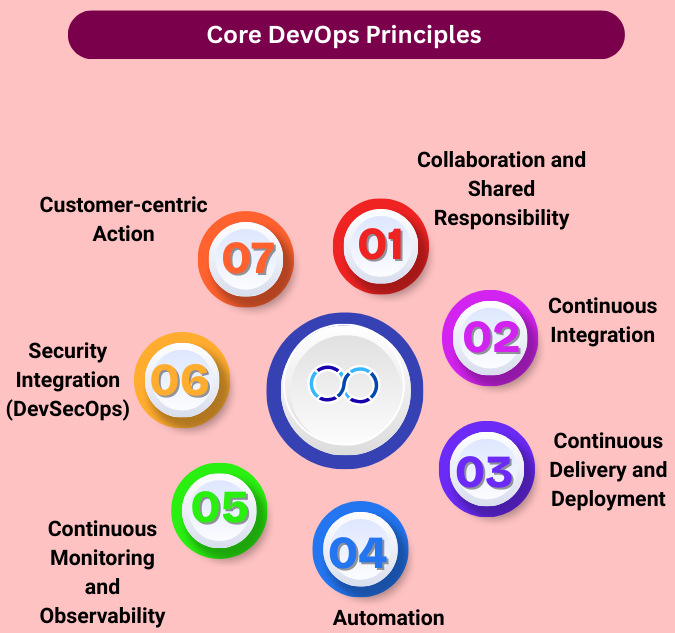
1. Collaboration and Shared Responsibility
DevOps encourages a cultivating, collaborative environment where development, operations, QA, and security teams break down barriers, share responsibility, and focus on team goals rather than individual tasks.
- Developers write unit tests.
- QA engineers design automated test strategies.
- Operations teams monitor production testing.
- Security teams run security testing.
- Defects are detected faster.
- Code quality improves.
- Blame games are reduced.
- Team communication improves.
2. Continuous Integration
Continuous Integration (CI) is a core DevOps principle where code is frequently merged into a shared central repository. Every code change and commit triggers automated builds and tests.
- Unit tests
- Integration tests
- Static code analysis
- Security scans
As automated tests run after each code commit, developers receive immediate feedback for their committed code.
- Early defect detection
- Reduced debugging complexity
- Faster development cycles
- Higher code confidence
3. Continuous Delivery and Deployment
Following CI, Continuous Delivery (CD) automatically prepares software for release. Continuous Deployment takes over after this by automatically deploying every change that passes tests.
Testing is critical for both delivery and deployment. Automated tests integrated in the pipeline ensure that software behaves as expected before it is deployed.
- Functional testing
- End-to-end testing
- Performance testing
- Security testing
- UI testing
- API testing
4. Automation
Automation is a fundamental DevOps principle and reduces manual errors, ensures consistency, and increases speed.
- On every code commit
- During builds
- During deployment pipelines
- During production monitoring
- Unit tests
- UI automation
- API automation
- Regression test suites
- Load testing
Automated testing provides faster feedback, increased reliability, reduced manual efforts, and scalable quality assurance.
5. Continuous Monitoring and Observability
DevOps does not stop at deployment. It follows deployment by tracking, measuring, and monitoring performance metrics (e.g., system health, application performance) to gain insights, ensure reliability, and inform improvements.
Testing uses methods like synthetic monitoring, canary testing, and chaos testing to contribute to monitoring. In production as well, testing teams validate system behavior under real-world conditions to identify issues that might not appear in staging environments.
6. Security Integration (DevSecOps)
Security checks are embedded throughout the SDLC rather than as a final step. QA works closely with developers, operations, and security teams to understand the project’s goals and identify potential risks early.
Security vulnerabilities, which include weak passwords, data leaks, or code that hackers could exploit, are also identified. Even after deployment, new security vulnerabilities may be identified in production. In addition, testing and monitoring are performed in production to identify problems caused by user behavior or unexpected scenarios.
Read: The Role of QA in DevSecOps.
7. Customer-centric Action
With DevOps, products and services are developed centered around user needs by using short feedback loops with customers and end users. DevOps uses real-time live monitoring and rapid deployment to enable rapid collection and response to user feedback. Teams get immediate visibility into how live users interact with a software system and use that insight to develop further improvements.
Testing Strategies for DevOps Success
Successful DevOps testing strategies fully support DevOps principles. They rely on a combination of cultural shifts, extensive automation, and integrating testing throughout the SDLC to ensure rapid, reliable, and high-quality software delivery.
Here are the testing strategies for DevOps:
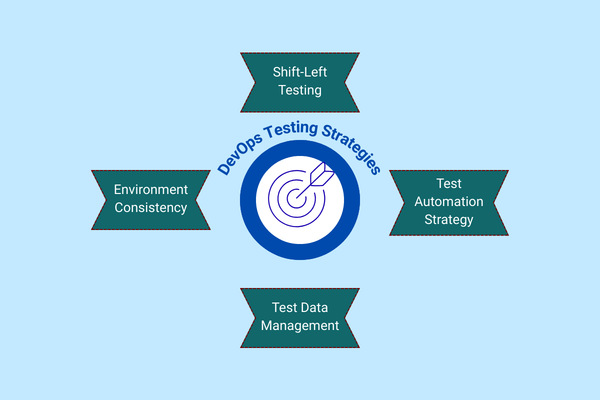
Shift-Left Testing
In shift-left testing, testing is performed earlier in the development lifecycle. Rather than testing only after development is complete, teams test during design, development, and code review phases. Shift-left testing helps with early bug detection so that fixing them is less costly than if they were identified later in the cycle. It also aids in a faster development cycle.
Read: Shift Everywhere in Software Testing: The Future with AI and DevOps.
Test Automation Strategy
For DevOps to be successful, automated testing is a must. Teams must design automated test suites that are reliable, fast, maintainable, and scalable. AI-driven automation testing handles test creation, maintenance, execution, and analysis autonomously rather than requiring constant human intervention. Self-healing eliminates maintenance burden.
Read: 5 Advantages of Autonomous Testing.
Test Data Management
Effective testing requires reliable test data that can be used to assess the behavior of the product. DevOps teams often implement automated test data generation, data masking, and environment management. Proper test data ensures accurate and consistent test results.
Environment Consistency
Testing environments must closely resemble production environments so that teams can mimic the real-world scenarios. Infrastructure as Code (IaC) tools help create consistent environments across development, testing, and production. Some of the examples include Docker, Kubernetes, and Terraform.
Consistent environments reduce deployment surprises such as unexpected behavior or wrong configurations.
Key Metrics to Track for DevOps Testing Success
Key DevOps testing success metrics are used to track DevOps testing success, primarily focusing on balancing speed and quality.
The following table summarizes the metrics used for tracking testing success:
| Metrics | Description |
|---|---|
| Deployment Frequency (DF) | How often is code successfully released to production? |
| Lead Time for Changes (LTC) | The total duration from the start of work on a change request to its deployment in production. Indicates CI/CD pipeline efficiency. |
| Change Failure Rate (CFR) | The percentage of deployments that cause a failure in production requiring remediation (e.g., hotfix, rollback). |
| Defect Escape Rate | The percentage of bugs found in production to the total number of bugs identified throughout the development cycle. |
| Automated Test Pass Percentage | The stability of the codebase and the effectiveness of automated checks. |
| Mean Time to Detection (MTTD) | How long does it take to detect a failure or bug? |
| Code Coverage | Code coverage is the percentage of code executed by automated tests to ensure sufficient testing depth. |
| Mean Time to Recovery (MTTR) | The time from the moment a bug is detected until it is fully resolved. |
| Application Usage/Traffic | Monitors if a new deployment causes dips in user activity. Acts as an indirect indicator of failure. |
Benefits of Testing in DevOps
- Faster Release Cycles: Automated testing helps with rapid validation of code changes and allows teams to release software more frequently.
- Improved Software Quality: Continuous testing with a shift-left approach identifies issues early, ensuring higher software quality and reliability.
- Reduced Risk: Continuous and frequent testing reduces the possibility of critical production failures.
- Increased Developer Confidence: As automated tests verify system stability, developers are confident when making changes.
- Cost Efficiency: Early detection of issues reduces the cost of fixing bugs compared to finding them later in production. Continuous testing also reduces the overall maintenance cost.
Challenges of Testing in DevOps
Despite its benefits, integrating testing into DevOps presents challenges.
- Cultural Resistance and Barriers: Teams may resist moving from dedicated, isolated QA teams to a model of shared responsibility among developers, operations, and testing personnel.
- Manual Testing Bottlenecks: Over-reliance on manual testing slows down the fast-paced DevOps cycle and also makes it error-prone.
- Environment Inconsistencies: Differences in development, testing, and production environments often cause deployment failures and make debugging difficult.
- Test Data Management: The lack of realistic, high-quality test data is a significant challenge and may affect the testing results.
- Maintaining Test Automation: Scaling test infrastructure and maintaining automated tests (flaky tests) as applications grow in complexity is a challenge.
- Inadequate Skills and Training: A shortage of talent with expertise in test automation, performance testing, and security practices in a continuous environment can hinder effective implementation.
- Security and Compliance Integration: Integrating continuous security and compliance checks early in the pipeline (DevSecOps) can be complex and requires a shift in mindset.
The Future of Testing in DevOps
Testing in DevOps continues to evolve as technology advances.
- AI-Aided Test Case Generation: AI can automatically generate test cases from requirements, user stories, or production data, significantly accelerating the test creation process. Read here how: All-Inclusive Guide to Test Case Creation in testRigor.
- Autonomous Testing: Agentic AI where intelligent systems can autonomously design, execute, and optimize tests with minimal human intervention, effectively creating self-testing software ecosystems.
- Self-healing Test Scripts: AI-powered tools can automatically adapt and repair test scripts when UI elements or application functionality change. This drastically reduces the time spent on test maintenance. Read more on AI-Based Self-Healing for Test Automation.
- Low-Code/No-Code Tools: The rise of low-code/no-code platforms democratizes test automation, enabling non-technical team members and other stakeholders to contribute to the testing process using visual interfaces and plain language.
Conclusion
DevOps has revolutionized modern software development by focusing on collaboration, automation, and continuous delivery. However, its success depends heavily on effective testing.
Testing fully supports every core DevOps principle from continuous integration and automation to fast feedback loops and reliable deployments. By integrating testing throughout the SDLC, organizations can deliver high-quality software faster and more confidently.
In a DevOps environment, testing is a continuous, collaborative, and automated process that ensures stability, performance, and security at every stage of development.
Frequently Asked Questions (FAQs)
- How does automated testing support DevOps practices?
Automated testing speeds up DevOps workflows by providing fast feedback on code changes. Teams can run tests frequently, reduce manual effort, and maintain high software quality while delivering updates faster.
- How does testing improve software quality in DevOps?
Testing helps identify defects early and verify functionality, ensuring performance stability and detecting security vulnerabilities. With continuous, shift-left testing, teams can maintain a stable and reliable codebase.
- Can DevOps succeed without automated testing?
No. Automated testing is a fundamental feature of DevOps. Manual testing alone cannot keep up with the speed of continuous integration and continuous deployment. Automation ensures rapid feedback and reliable releases.
- How does testing enable faster software releases in DevOps?
Testing allows teams to validate code changes quickly and automatically. By catching issues early and continuously verifying system functionality, teams can release updates more frequently with confidence.
| Achieve More Than 90% Test Automation | |
| Step by Step Walkthroughs and Help | |
| 14 Day Free Trial, Cancel Anytime |