
Testing Agentic AI in ERP: 2026 Enterprise Guide
 |
Enterprise Resource Planning (ERP) systems are the operational backbone of organizations. They integrate critical business functions such as finance, procurement, supply chain management, manufacturing, human resources, and customer service. Digital transformation and integration of artificial intelligence (AI) into ERP platforms has given rise to the emergence of Agentic AI, autonomous systems capable of reasoning, planning, decision-making, and executing tasks with minimal human intervention.
| Key Takeaways: |
|---|
|
This article explores the importance of testing Agentic AI in modern ERP systems, key challenges, testing methodologies, best practices, and future trends.
What is Agentic AI in ERP?
Agentic AI in ERP is an autonomous AI agent integrated into core business systems. This AI agent can understand goals, reason through complex workflows, and execute tasks without constant human prompting.
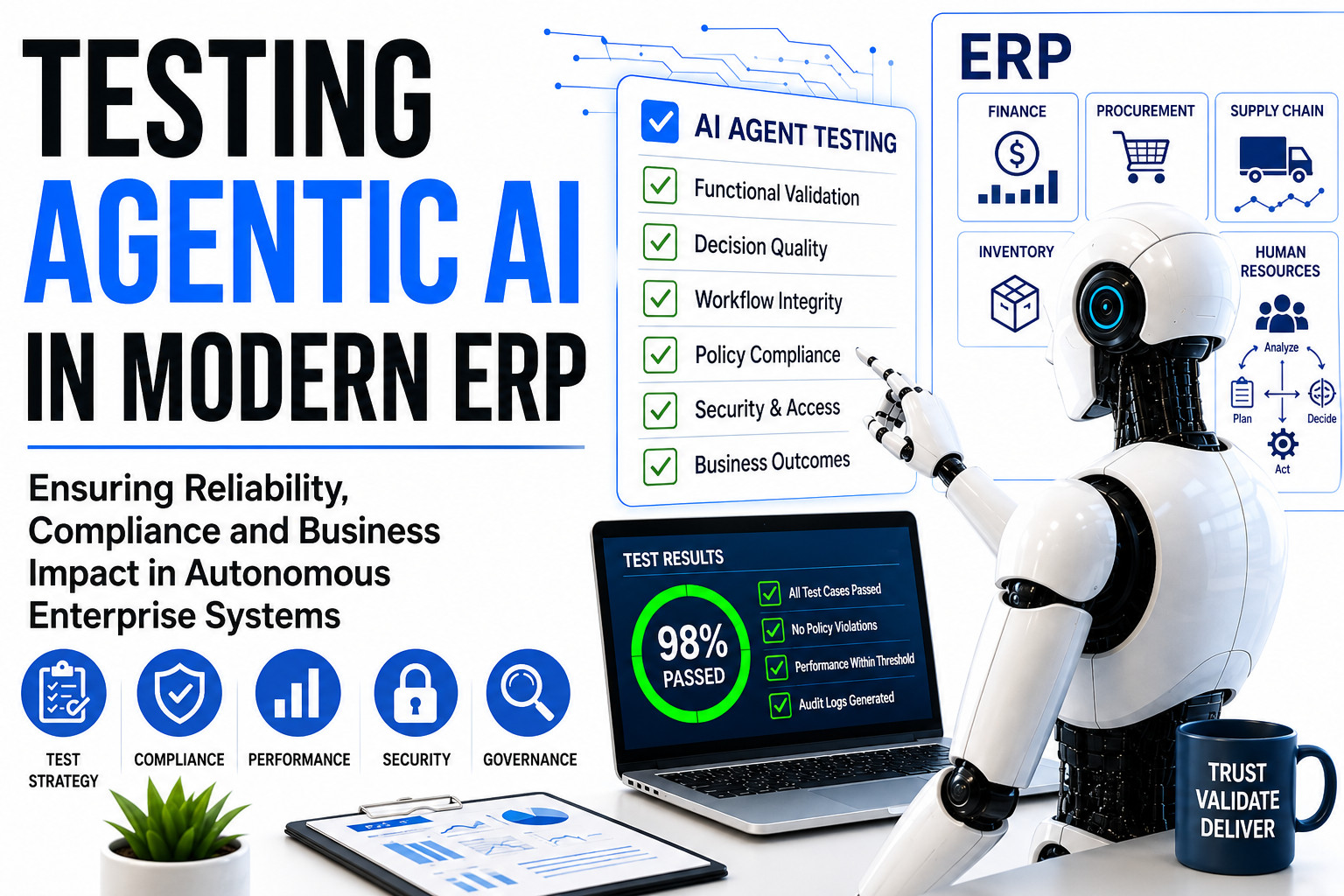
Contrary to traditional AI that mostly suggests answers, agentic AI operates independently to get the job done.
Agentic AI possesses the ability to:
- Understand the goals and objectives of ERP systems
- Plan and execute multi-step actions
- Interact with various enterprise systems
- Make autonomous decisions for the system
- Learn from feedback and outcomes
- Adapt to changing business environments
In ERP ecosystems, Agentic AI may perform tasks such as:
- Automatically approve purchase orders
- Predict inventory shortages
- Negotiate vendor contracts
- Detect financial anomalies
- Manage workforce scheduling
- Coordinate supply chain operations
For example, an AI procurement agent may perform various functions such as analyzing supplier performance, comparing pricing, identifying declining inventory levels, generating purchase orders, seeking required approvals, and initiating procurement actions without direct human intervention.
As you can see, an AI agent can perform the function autonomously. However, from a testing perspective, such autonomous work is too complex. This is because, being autonomous, the system’s behavior is no longer entirely deterministic.
Refer to the links:
- Enterprise 21 ERP Testing
- ERPNext Testing
- Accelerated ERP Testing
- Access ERP Testing
- How to Validate Composable ERP: A Modular Testing Guide
Why Testing Agentic AI in ERP is Critical?
Testing Agentic AI in an ERP system is critical because these autonomous agents usually manage high-stakes financial, supply chain, and operational workflows without human oversight. With functions being performed autonomously, the behavior is non-deterministic. Therefore, rigorous testing has to be performed to ensure that these autonomous systems make accurate decisions, handle exceptions gracefully, and avoid cascading business errors.
ERP systems often handle mission-critical business processes. Failures within these systems can result in financial losses, regulatory violations, supply chain disruptions, customer dissatisfaction, and reputational damage.
When Agentic AI is added to these systems, the risks multiply because the system can autonomously make decisions and trigger actions.
Consider the following possibilities that may occur when Agentic AI is added to ERP systems:
- An AI agent incorrectly forecasts demand and causes inventory shortages.
- A financial AI agent misclassifies transactions, affecting compliance reporting.
- A procurement agent purchases materials from an unauthorized supplier.
- An HR agent inadvertently introduces bias into recruitment decisions.
Therefore, testing Agentic AI becomes critical in ERP systems. The main reasons are as follows:
- Financial Integrity: Testing prevents automated AI agents from making incorrect payments, entering invalid journal entries, or executing faulty inventory reconciliations.
- System Interconnectivity: Agentic testing verifies that AI actions in one department (like Sales) do not break integrated workflows in another (like Manufacturing).
- Edge Case Handling: It ensures agents know exactly how to behave when unexpected market changes or data anomalies occur.
- Regulatory Compliance: Agentic testing validates that automated decisions follow all local and international business laws and auditing standards.
- Continuous Updates: Modern, cloud-based ERP platforms integrated with CI/CD pipelines have frequent updates; testing Agentic AI ensures these agents are always aligned with new changes.
Testing must therefore verify not only that the AI works correctly but also that it behaves responsibly, predictably, and in accordance with organizational policies.
Unique Challenges of Testing Agentic AI
Testing agentic AI is fundamentally different from testing traditional software. As these systems act autonomously and make their own decisions, the testing shifts from executing a few scripts to evaluating unpredictable, context-dependent behaviors. However, there are numerous challenges that are encountered during the testing process:
-
Non-Deterministic Behavior: Agentic AI systems, especially those powered by Large Language Models (LLMs), generate responses that are different under similar conditions. The behavior of Agentic systems is non-deterministic and complicates the test case creation and validation, as expected outcomes are not always fixed.
-
Dynamic Decision-Making: One critical function of Agentic AI is to continuously evaluate changing business conditions before making decisions. For example, Agentic AI systems have to evaluate conditions such as supplier availability changes, market price fluctuations, customer demand shifts, or regulatory requirements that evolve.These dynamic scenarios must be taken into account while testing, which makes it quite complex.
-
Multi-Step Autonomous Workflows: The functions performed by AI agents in ERP systems are not single, one-step functions. They are the long chains of actions involving multiple departments.For example, a single procurement transaction may involve various functions such as inventory analysis, demand forecasting, supplier evaluation, budget verification, purchase order creation, approval routing, and order execution. A failure at any step of this workflow may make end-to-end testing significantly more complex.
-
Learning and Adaptation: Agentic AI systems improve through continuous learning. However, a model that passes tests today may not behave in the same way for future training cycles. Hence, systems must implement ongoing validation mechanisms rather than relying solely on pre-deployment testing.
- Explainability Challenges: Business stakeholders seek explanations for the decisions that AI agents make. To provide these explanations, testing is expected to evaluate whether the AI can provide transparent reasoning, traceable decision paths, and audit-friendly outputs. The AI agents should be explainable, especially in regulated industries like banking and healthcare.
Core Areas of Agentic AI Testing in ERP
Testing autonomous AI agents in complex ERP environments is more than just verifying output. The core focus areas for agentic testing include:
- Task Accuracy: Testing is performed to validate if the AI correctly identifies business goals and produces the right final outputs (e.g., proper purchase order limits).
- Tool-Use Correctness: This area is tested to verify if the agent properly invokes, maps, and uses correct ERP APIs, data tables, and modules (e.g., seamlessly querying inventory tools).
- Memory and Context: Agentic testing assures the agent retains relevant conversation or task context (history) and maintains long-term memory to handle multi-step, drawn-out workflows.
- Escalation and Authority: In case of ambiguous requests, AI agents should promptly stop them or escalate to human managers in case of conflicts or authority limitations. Testing in this area verifies this.
- Failure and Recovery: Agentic testing of this part validates if the agent retries safely, resumes from the right checkpoint, and avoids duplicating ERP actions in the event of system interruptions or data bottlenecks.
In addition to these core focus areas, Agentic testing must also target specific process scopes as AI agents are embedded across various business-critical ERP functions.
- Supply Chain & Inventory: This module is tested to validate autonomous stock reordering, demand forecasting, and routing rules.
- Financial Operations: Agentic testing of this module assures compliance, payment approvals, and accurate invoice processing across large databases.
- Human Resources: This module is evaluated for screening protocols and employee onboarding workflows while strictly checking for decision bias.
- Customer Service: Testing in this area ensures intelligent ticket routing and multi-step knowledge-base automation for accuracy and tone.
As autonomous AI agents influence and impact live production environments, rigorous systemic and architectural testing should be performed. Here are the types of testing that are usually carried out:
-
Functional Testing: Functional testing verifies that the AI agent performs intended functions correctly, including purchase order generation, invoice matching, inventory replenishment, and payroll processing.Using functional testing, testers verify that expected business actions are completed.
-
Integration Testing: Agentic AI interacts with multiple enterprise modules, including ERP modules, CRM platforms, supply chain applications, data warehouses, and External APIs. Integration testing ensures seamless communication and accurate data exchange between these systems.
-
Decision Validation Testing: This testing assesses the quality of AI decisions. During this testing, several questions are asked, including:
- Is the decision logically sound?
- Does it align with business objectives?
- Does it comply with organizational policies?
For example, if an AI agent selects a specific supplier, decision validation testing is performed to verify that the supplier meets cost, quality, and compliance requirements. -
Workflow Testing: Agentic AI frequently orchestrates complex business workflows. These workflows should be thoroughly tested to validate process completion, task sequencing, exception handling, and escalation mechanisms.The objective of this testing is to ensure reliable execution across multiple business processes.
-
Security Testing: Evaluates access controls, privilege management, authentication mechanisms, and data protection measures. Agentic AI often requires broad access across enterprise systems.ERP organizations must ensure that AI agents performing various functions do not exceed authorized permissions.
- Compliance Testing: Many ERP environments must comply with strict regulatory requirements. Compliance testing ensures that ERP systems comply with GDPR, SOX, HIPAA, industry-specific regulations, and internal governance policies.
Testing Methodologies for Agentic AI
Testing Agentic AI in ERP systems requires a shift from deterministic “pass/fail” scripts in traditional testing to probabilistic validation frameworks. Autonomous agents execute multi-step business operations, reason through exceptions, and make independent choices. Hence, testing methodologies are required to test these functionalities in a non-deterministic environment.
Here are the methodologies for Agentic AI.
Scenario-Based Testing
Scenario-based testing simulates realistic business situations in ERP systems. For example, you can simulate scenarios such as supplier bankruptcy, sudden demand spikes, currency fluctuations, and inventory shortages. In this type of testing, AI’s response is evaluated against expected business outcomes.
Goal-Oriented Testing
Agentic AI focuses on achieving objectives rather than executing predefined steps. Hence, testing should verify that the goals are achieved effectively. For example, if the goal is to maintain inventory above the defined safety stock levels, goal-oriented testing will verify whether the AI agent has successfully prevented stockouts while minimizing excess inventory.
Simulation Testing
In this method, simulation environments are used that help organizations to safely evaluate AI behavior before production deployment.
Digital twins of ERP systems can simulate supply chain disruptions, financial market changes, and operational bottlenecks. Simulation testing helps identify risks without affecting live operations.
Adversarial Testing
In the adversarial testing approach, AI systems are intentionally challenged with difficult or unexpected situations. Situations such as conflicting data, incomplete information, malicious inputs, or policy conflicts are deliberately fed to the system to assess its resilience and robustness.
Human-in-the-Loop Testing
Human oversight is often required during AI deployment. With human-in-the-loop testing, verification occurs for escalation triggers, approval workflows, and intervention mechanisms.
With this testing, humans can effectively supervise autonomous actions.
Performance Testing for Agentic AI
Performance testing in Agentic AI extends beyond traditional ERP response-time measurements. Key metrics used in performance testing include:
-
Decision Latency: Measures how quickly the AI can analyze information and generate recommendations, and execute actions. Business processes expect near real-time responses.
-
Scalability: Performance is measured under varying workloads, including thousands of simultaneous procurement requests, large-scale inventory analyses, and high transaction volumes.The Agentic AI systems should maintain performance without degradation.Refer to Testing AI Performance Under Peak Usage.
- Resource Utilization: AI agents often consume substantial computational resources. Hence, testing should monitor CPU utilization, memory consumption, GPU requirements, and network bandwidth. The system needs to be optimized for cost-effective deployment.
AI-Specific Evaluation Metrics
Traditional software metrics fall short when evaluating Agentic AI. Hence, you require additional metrics shown here:
- Task Success Rate: How often the AI successfully completes assigned objectives.
- Decision Accuracy: Whether decisions align with business expectations.
- Policy Compliance Rate: Compliance with organizational rules and regulations.
- Recovery Effectiveness: How well the AI recovers from errors or unexpected situations.
- Explainability Score: The quality and clarity of AI-generated explanations.
- Human Acceptance Rate: How frequently users accept AI recommendations without modification.
Continuous Testing in Production
Agentic AI testing is not a one-time process. It is a continuous process that should continue even after deployment. It is essential to continuously monitor the system as AI behavior may evolve over time. Key monitoring activities in Agentic testing include:
- Drift Detection: Any changes (drifts) in the system, such as changes in data distributions, business environments, and AI performance, are identified through continuous monitoring.
- Outcome Monitoring: Business KPIs, including forecast accuracy, inventory turnover, procurement savings, and process efficiency, are tracked in this activity.
- Automated Regression Testing: Regular regression testing is conducted to detect unintended behavioral changes resulting from model updates, ERP upgrades, and configuration changes.
Best Practices for Testing Agentic AI in ERP
Organizations should adopt the following best practices for Agentic testing:
- Establish Clear Governance Frameworks: All AI responsibilities, decision boundaries, escalation procedures, and accountability structures should be established and defined clearly.
- Combine Business and Technical Testing: A good collaboration among QA teams, data scientists, ERP specialists, business stakeholders, and compliance officers to ensure thorough business and technical testing should be established.
- Use Layered Testing Approaches: Testing should be performed at multiple levels, including component level, workflow level, system level, and business outcome level.
- Create Realistic Simulation Environments: Realistic digital twins scenarios that enable safe experimentation and risk reduction should be simulated.
- Implement Continuous Validation: Agentic AI should be assessed throughout its lifecycle.
- Prioritize Explainability: Transparent reasoning to improve trust and facilitate troubleshooting is necessary.
The Future of Agentic AI Testing
As ERP vendors increasingly embed Agentic AI capabilities into their platforms, testing methodologies will continue to evolve. Some of the emerging trends in Agentic AI testing include:
- AI Testing Agents: Autonomous testing agents to validate other AI systems, creating self-improving testing ecosystems.
- Digital Twin Expansion: Advanced enterprise digital twins to offer realistic environments for continuous validation.
- Regulatory Standardization: Governments and industry bodies are coming together to introduce formal standards governing autonomous AI systems.
- Real-Time Governance Monitoring: Organizations are increasingly deploying automated governance platforms to continuously evaluate AI actions against policies and regulations.
- Explainability-Driven Testing: Placing greater emphasis on validating transparency and reasoning quality.
Conclusion
Agentic AI is a transformative advancement in modern ERP systems that enables organizations to automate complex decision-making processes and achieve unprecedented operational efficiency. However, this very advancement introduces significant testing challenges that traditional ERP testing methodologies cannot adequately address.
Effective testing of Agentic AI requires a comprehensive approach encompassing functional validation, decision-quality assessment, workflow verification, security evaluation, compliance assurance, performance testing, governance controls, and continuous monitoring. With the non-deterministic nature of Agentic AI, organizations must adopt scenario-based, simulation-driven, and outcome-oriented testing strategies.
Robust testing of Agentic AI will serve as the foundation for trust, reliability, compliance, and business success.
Frequently Asked Questions (FAQs)
What types of testing should be performed for Agentic AI in ERP?
Organizations should conduct functional testing, integration testing, decision validation testing, workflow testing, security testing, compliance testing, performance testing, and governance testing to ensure comprehensive validation of Agentic AI systems.
How can simulation testing improve Agentic AI validation?
Simulation testing creates realistic business scenarios, such as supply chain disruptions or demand spikes, allowing organizations to evaluate how AI agents respond to complex situations without impacting live ERP operations.
What role does explainability play in Agentic AI testing?
Explainability helps organizations understand why an AI agent made a particular decision. Testing should verify that AI systems provide transparent reasoning, decision traces, and audit-ready records to support trust, governance, and regulatory compliance.
Why is continuous testing necessary for Agentic AI in ERP?
Agentic AI systems can evolve as business conditions, data patterns, and models change. Continuous testing helps detect performance drift, validate ongoing compliance, identify emerging risks, and ensure that AI-driven processes continue to deliver expected business outcomes.
How does Human-in-the-Loop (HITL) testing support Agentic AI governance?
Human-in-the-Loop testing ensures that AI agents can escalate critical decisions to human stakeholders when necessary. It validates approval workflows, intervention mechanisms, and oversight controls to maintain accountability and reduce risks.
| Achieve More Than 90% Test Automation | |
| Step by Step Walkthroughs and Help | |
| 14 Day Free Trial, Cancel Anytime |