
ERP Testing Guide: Best Practices & Strategy for 2026
 |
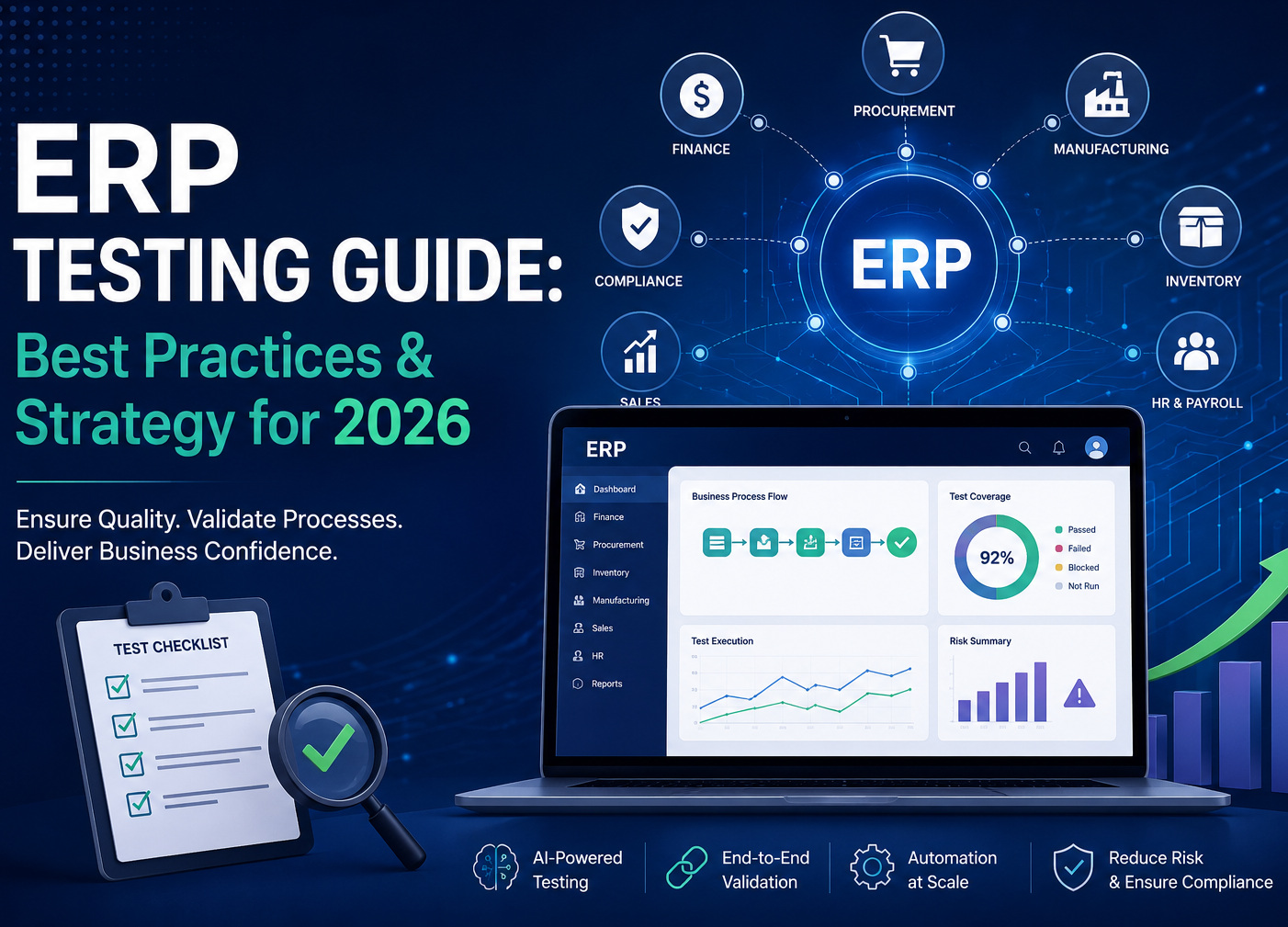
The global ERP software market size was valued at USD 77.1 billion in 2025 and is projected to grow to USD 157.1 billion by 2033. Another study by Gartner predicts that by 2027, over 70% of recently implemented ERP initiatives will fail to fully achieve their original business goals.
What does this mean?
It means that major businesses (95% of the firms with $1 billion in revenue) use ERP and will continue to do so. And, they need to have a strong test strategy and follow best practices to keep the implementation successful.
Enterprise Resource Planning (ERP) systems have evolved from business applications into the operational backbone of modern organizations. Finance, procurement, manufacturing, inventory, HR, payroll, logistics, sales, and compliance often operate within a single ERP ecosystem, making reliability essential for day-to-day business operations.
| Key Takeaways: |
|---|
|
Unlike traditional software, ERP platforms connect complex business processes across multiple departments. In 2026, AI is transforming ERP testing by helping teams generate tests, identify risks, create test data, and maintain automation more efficiently, enabling organizations to validate increasingly complex systems faster and with greater confidence.
Why ERP Testing is Different
When testing a traditional web application, the focus is usually on verifying individual features such as login, user registration, search, shopping carts, or checkout. Often these functions can be tested in isolation, because they have few effects on other parts of the application.
Every business process connects multiple departments and workflows. ERP systems are very different in that sense. One transaction can pass through procurement, inventory, finance, manufacturing, compliance and reporting before it gets marked as done.
Imagine a manufacturing company purchasing raw materials. Typically, it begins with supplier selection, purchase requisitions, and concludes with purchase order approvals and goods receipt. Then it updates inventory, triggers invoice matching, processes vendor payments, posts accounting entries, and contributes to financial reporting.
If there is a flaw anywhere in this chain, it can cause problems throughout the organization. For example, an incorrect tax calculation on a purchase order can result in incorrect supplier payments, inventory valuation errors, incorrect GST or VAT calculations, financial reconciliation issues, or audit findings.
Hence, ERP testing is more about validating end-to-end business results rather than testing individual functionality.
Read: ERP Testing 101.
The Growing Complexity of ERP Systems
Today’s ERP environments are not just a single application, but a network of interconnected applications that interface with CRM platforms, APIs, banking systems, payment gateways, government tax portals, warehouse automation, manufacturing equipment, IoT devices, HR platforms, email services, business intelligence tools, and supply chain partners. Such integrations enable organizations to automate the end-to-end business process while ensuring data consistency across multiple systems. This has brought about much more interconnected and complex ERP ecosystems.
A single business transaction (for example, a customer order or a purchase request) may require communication with many external applications. Only testing the ERP application gives limited confidence, as failures often happen at integration points, not the core system itself. Effective ERP testing validates the entire business ecosystem, ensuring that every connected system exchanges data accurately and reliably.
Read: Testing Localizations and Global Compliance in ERP Systems.
Best Practices for Successful ERP Testing
Testing ERP successfully does not only involve checking individual features or running a lot of test cases. This requires a business-first approach that validates end-to-end processes, manages complex integrations, and uses AI to drive efficiency, mitigate risk, and improve test coverage.
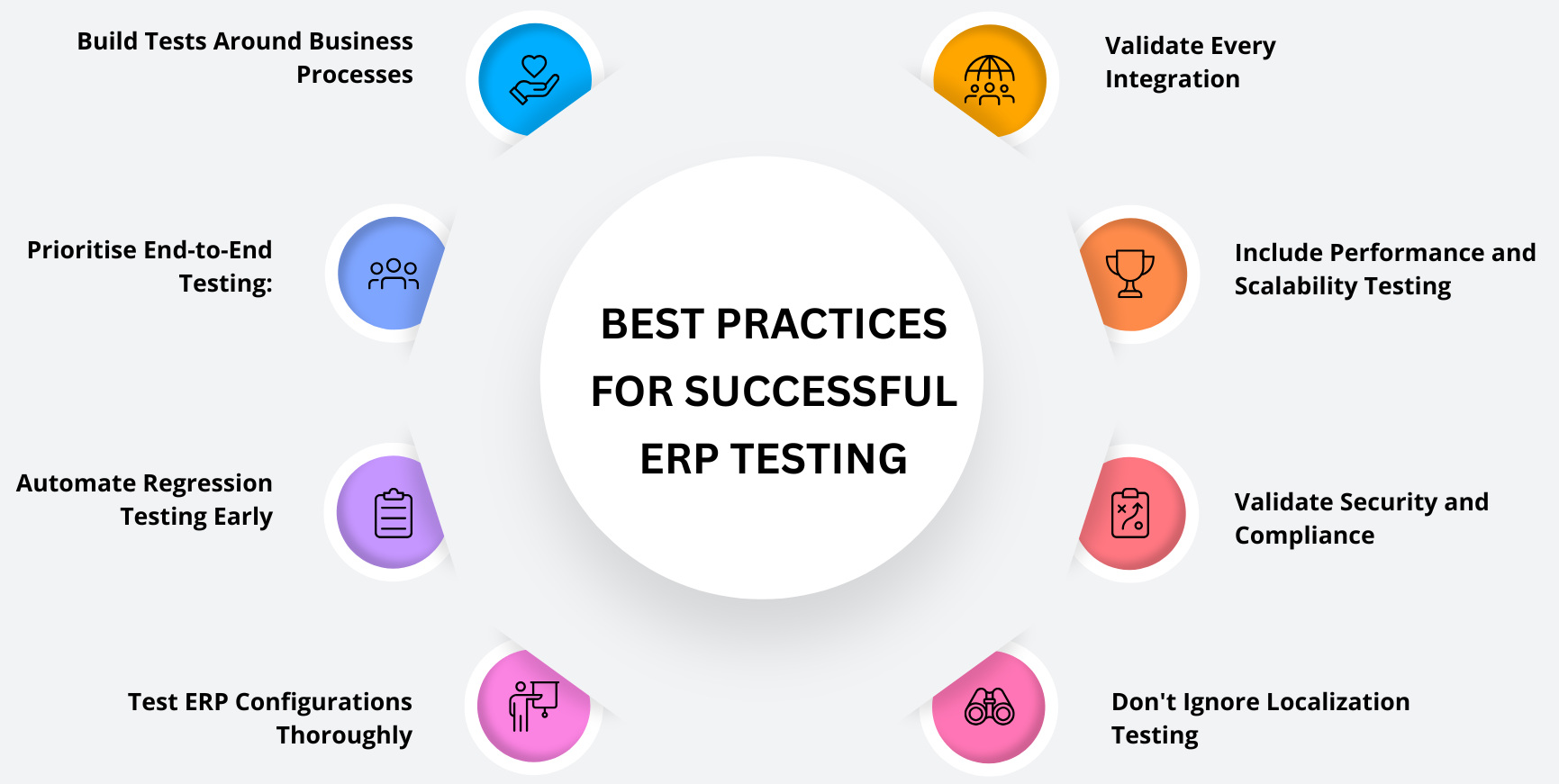
- Build Tests Around Business Processes: ERP users think about completing business operations, not interacting with individual screens or buttons. Tests that are built around full workflows ensure that the entire business process is working properly and produces the expected result. AI can analyze business requirements and process documentation to automatically generate complete workflow-based test scenarios, reducing manual test design effort.
This means instead of testing only the Purchase Order screen, we need to validate the complete procurement process:
- Create a purchase requisition
- Convert it into a purchase order
- Submit it for approval
- Approve as ‘Finance Manager’
- Receive the goods
- Verify inventory updates
- Generate the supplier invoice
- Confirm accounting entries are posted
This verifies the entire procurement lifecycle rather than individual transactions. - Prioritize End-to-End Testing: ERP modules are closely tied together, and testing them independently often misses defects that only manifest when complete business processes are executed. End-to-end testing validates that transactions are correctly processed across departments, systems, and integrations. AI strengthens this approach by identifying dependencies between modules and recommending the business processes most likely to be affected by a change.
When a retailer introduces a new promotional discount in the Sales module, while the discount appears to work correctly, testing should also verify inventory valuation, tax calculations, customer loyalty points, supplier rebates, revenue recognition, and financial reporting.
- Automate Regression Testing Early: ERP applications have thousands of critical scenarios that need to continue working after every update or configuration change. Automating these high-value workflows early reduces testing effort, speeds up release cycles, and builds confidence in every deployment. AI-powered platforms such as testRigor further simplify regression testing by automatically generating test scenarios from requirements or app descriptions, maintaining tests after UI changes through self-healing, and enabling teams to execute large ERP regression suites faster with less effort.
Automate recurring business processes such as employee payroll, customer order processing, vendor payments, invoice generation, inventory replenishment, and financial reconciliation. These processes execute frequently and directly impact daily business operations.
- Test ERP Configurations Thoroughly: Many ERP problems are caused by wrong configurations rather than software bugs, and configuration validation is an unavoidable part of every testing strategy. Even a minor change to business rules, tax settings, or approval workflows can affect multiple business functions. AI can compare configuration changes across releases and automatically identify the business processes that require regression testing.
For example, if the VAT rate changes from 20% to 22%, testing should verify purchase orders, sales orders, invoices, credit notes, tax reports, payment calculations, and financial reports to ensure every affected process reflects the new rate accurately.
- Validate Every Integration: Modern ERP platforms exchange data with numerous internal and external applications, making integrations as critical as the ERP system itself. Testing should verify that data flows accurately, reliably, and securely across every connected system. AI can analyze integration logs and API traffic to detect anomalies, failed transactions, duplicate messages, and unusual communication patterns before they impact business operations.
An example is when a customer places an order, tests should verify that the CRM updates the customer record, inventory reserves stock, the warehouse receives the picking request, the payment gateway confirms payment, the courier receives shipment details, and the accounting system records the transaction.
- Include Performance and Scalability Testing: ERP systems must remain responsive while processing large transaction volumes during peak business activities. Performance and scalability testing ensures that critical operations continue to function efficiently under realistic workloads. AI can predict potential performance bottlenecks by analyzing historical workload patterns and previous test results, enabling teams to focus optimization efforts earlier.
Examples include running payroll processing for 100,000 employees or simulating Black Friday order volumes to measure response times, database performance, resource utilization, and overall system stability.
- Validate Security and Compliance: ERP platforms store highly sensitive business and customer information, making security testing a business necessity rather than an optional activity. Verifying access controls, data protection, and regulatory compliance helps reduce operational and legal risks. AI can identify unusual user access patterns, detect potential segregation-of-duties violations, and recommend additional security test scenarios.
Examples to test are: Verify that warehouse employees cannot access payroll information, HR users cannot approve supplier payments, and finance administrators cannot modify employee medical records without appropriate permissions.
- Don’t Ignore Localization Testing: Global ERP deployments must support country-specific business rules, languages, currencies, taxation, and regulatory requirements. Localization testing ensures the system behaves correctly for every region where the organization operates. AI can automatically generate country-specific test scenarios based on regional regulations and quickly adapt tests whenever compliance requirements change.
For example, generate invoices for customers in Germany, India, Japan, and Brazil, then verify local tax calculations, invoice formats, currencies, date formats, and statutory reporting requirements for each country.
Read: Performance Testing in Global ERP Deployments.
A Practical ERP Testing Strategy
Organizations require a comprehensive testing strategy, rather than merely a collection of testing activities, as ERP systems become more intelligent and interconnected. The right ERP testing strategy validates business processes, automation, AI-led insights, and continuous quality assurance across the software life cycle. These are the practices that form the foundation of a modern ERP testing strategy.
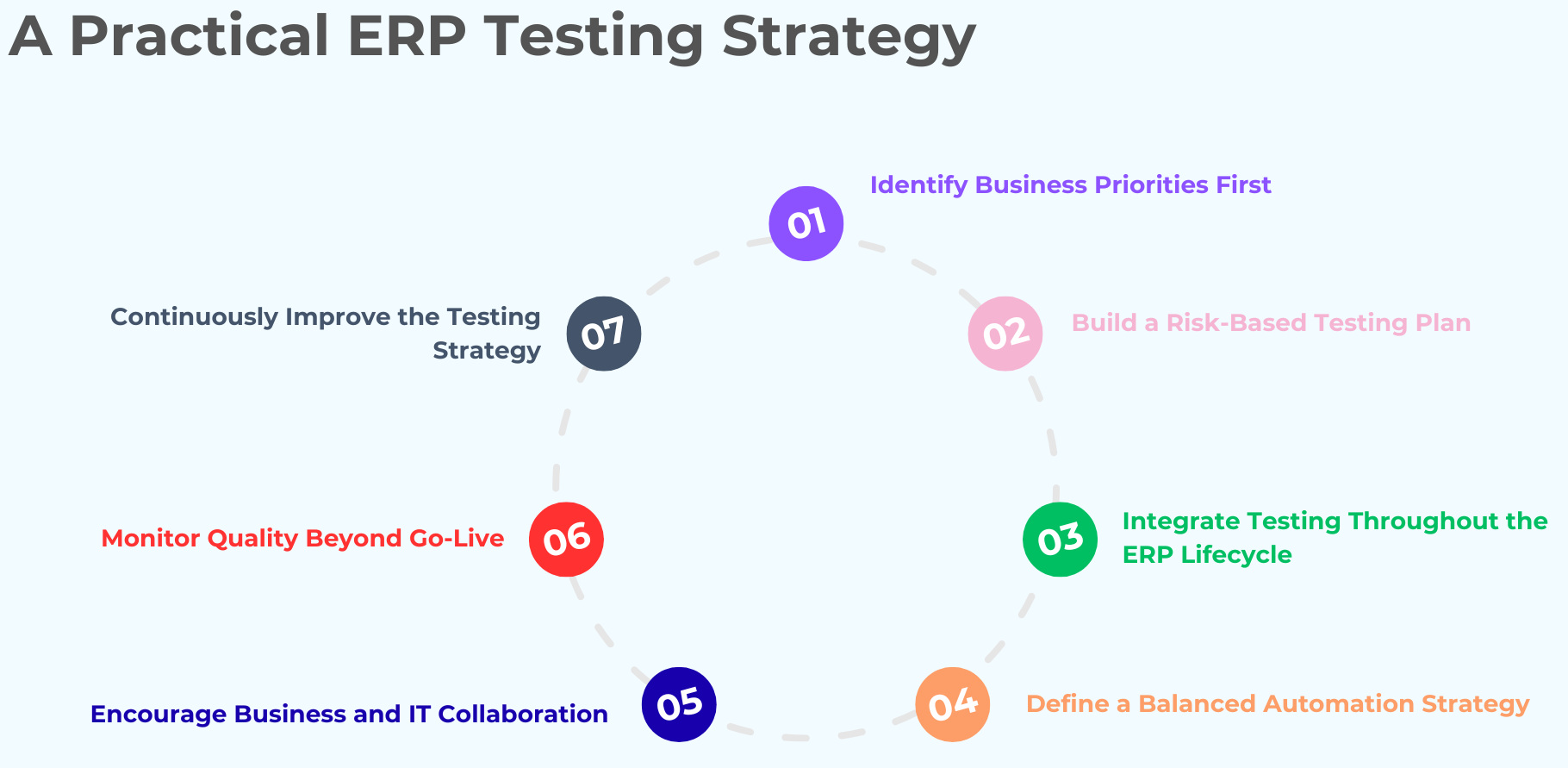
- Identify Business Priorities First: All ERP implementations support hundreds of business processes, but not all have the same degree of business impact. Before defining the scope of testing, organizations should identify the processes that directly impact revenue, regulatory compliance, financial reporting, customer experience, and operational continuity.
- Build a Risk-Based Testing Plan: Testing resources are always scarce, so it is not possible to test everything to the same degree. A risk-based approach centers testing around business impact, application changes, production history, and usage patterns. AI can help teams continuously refine those priorities as the ERP changes.
- Integrate Testing Throughout the ERP Lifecycle: Testing should start during the requirements-gathering process and continue through the development, deployment, and production monitoring processes. Embedding quality activities throughout the lifecycle helps detect defects earlier, reduces rework, and improves overall quality of the release.
- Define a Balanced Automation Strategy: Automation should be used to support manual testing, not replace it, by automating repetitive, high-volume, business-critical scenarios. AI strengthens this approach by building tests, keeping automation, change impact analysis, and regression execution optimization, while testers work on exploratory and business validation.
- Encourage Business and IT Collaboration: To test an ERP successfully, QA teams, business users, developers, solution architects, and functional consultants must work closely together. AI-powered natural language testing platforms such as testRigor allow business experts to participate directly in automation by writing or generating tests in plain English. Functional consultants, procurement managers, HR specialists, and finance teams can describe business workflows and create tests without programming, while QA engineers focus on quality strategy, integrations, and exploratory testing.
- Monitor Quality Beyond Go-Live: An ERP testing strategy should not stop at deployment but should include ongoing monitoring of business transactions, integrations, application performance, and user behavior. Analytics driven by AI can spot anomalies, predict failures, and send early warnings before business operations are impacted.
- Continuously Improve the Testing Strategy: ERP systems are constantly changing with new features, integrations, regulatory changes, and business requirements. Organizations should constantly reassess testing priorities, automation coverage, quality metrics, and AI recommendations to keep the testing strategy in line with the ERP landscape.
Read: How to Validate Composable ERP: A Modular Testing Guide.
Real-World Examples of AI-Powered ERP Testing
The principles discussed throughout this guide are already helping organizations improve testing efficiency, increase automation coverage, and validate complex business workflows.
Let us have a look at a few real-life examples that have achieved success through testRigor’s intelligent capabilities.
IDT: Scaling Automation While Reducing Maintenance
IDT Corporation modernized its testing strategy by adopting testRigor to automate a significantly larger portion of its regression suite. Automation coverage increased from 34% to 91% in less than nine months, while automation maintenance dropped to less than 0.1%. Manual testers were able to create and maintain automated tests using plain English, enabling faster regression testing without relying exclusively on automation engineers. The organization also achieved an estimated 7X ROI through improved testing efficiency and reduced maintenance effort.
This demonstrates how AI-powered, low-maintenance automation enables organizations to execute large regression suites more efficiently, accelerate release cycles, and maintain high confidence in business-critical applications.
Read more: How IDT Corporation went from 34% automation to 91% automation in 9 months.
Wine Access: Validating End-to-End Business Processes
Wine Access adopted testRigor to automate critical customer journeys spanning order placement, payment processing, fulfillment, and post-order validation. The company tripled its automation coverage, reduced production hotfixes by 33%, achieved 62% annual QA cost savings, and shortened test execution time from 75 seconds to 43 seconds per test.
By automating complete business workflows rather than isolated test cases, the company improved release confidence while significantly reducing the effort required to maintain its automation suite.
The case highlights the value of business process-driven testing, where complete workflows are validated across multiple systems and integrations. Combined with resilient AI-powered automation, this approach helps organizations ensure that critical business operations continue to function reliably as applications evolve.
Read more: How Wine Access was able to 3x their automated test cases while saving 62% of the QA budget.
Conclusion
ERP testing is no longer about validating application functionality; it’s about making sure that end-to-end business processes continue to run reliably across complex, interconnected enterprise ecosystems. By combining business process-driven testing, intelligent automation, continuous monitoring, and AI-powered insights, organizations can improve software quality, reduce operational risk, and accelerate ERP releases.
The ultimate success of ERP testing is the confidence it provides in critical business operations, enabling organizations to innovate and keep the business running.
Frequently Asked Questions (FAQs)
- How often should ERP regression testing be performed?
ERP regression testing should be executed whenever there are application updates, configuration changes, security patches, or new integrations. Many organizations now run automated regression suites as part of every CI/CD pipeline to detect issues before production deployments.
- What are the biggest risks of skipping ERP testing before a major upgrade?
Skipping ERP testing can lead to failed business transactions, inaccurate financial reporting, inventory discrepancies, compliance violations, payroll errors, and integration failures. Even small defects can disrupt multiple departments because ERP systems are highly interconnected.
- Which ERP platforms require specialized testing approaches?
Leading ERP platforms such as SAP S/4HANA, Oracle Fusion Cloud ERP, Microsoft Dynamics 365, Infor CloudSuite, Workday, and Oracle NetSuite all have unique workflows, configurations, and integrations. While testing principles remain similar, each platform requires validation tailored to its business processes and ecosystem.
- How can AI reduce the cost of ERP test automation?
AI helps reduce testing costs by automatically generating test scenarios, identifying high-risk areas, maintaining automated tests after UI changes, creating test data, and optimizing regression execution. This enables testing teams to spend less time maintaining automation and more time validating critical business processes.
| Achieve More Than 90% Test Automation | |
| Step by Step Walkthroughs and Help | |
| 14 Day Free Trial, Cancel Anytime |