Small Language Models vs Large Language Models
 |
Over the past decade or so, artificial intelligence (AI) has undergone a remarkable transformation, largely driven by advances in language models. These models are trained on huge amounts of text data and can understand, generate, summarize, and translate human language with a high degree of accuracy. Organizations increasingly adopt the two types of language models: Small Language Models (SLMs) and Large Language Models (LLMs) for AI-powered solutions. As a result, a critical distinction between these two models has emerged.
| Key Takeaways: |
|---|
|
This article explores the differences between SLMs and LLMs, their strengths and limitations, use cases, and how businesses can choose the right model for their needs.
What Are Language Models?
A language model is an AI computational system designed to understand and generate natural human language.
Language models are probabilistic machine learning models trained to predict word sequences. They predict the probability distribution of words to generate sequences of text that emulate human language.
- Text generation
- Question answering
- Translation
- Summarization
- Code generation
- Content creation
- Customer support automation
Language models are trained on massive datasets containing websites, books, articles, and other resources. They are typically based on transformer architectures.
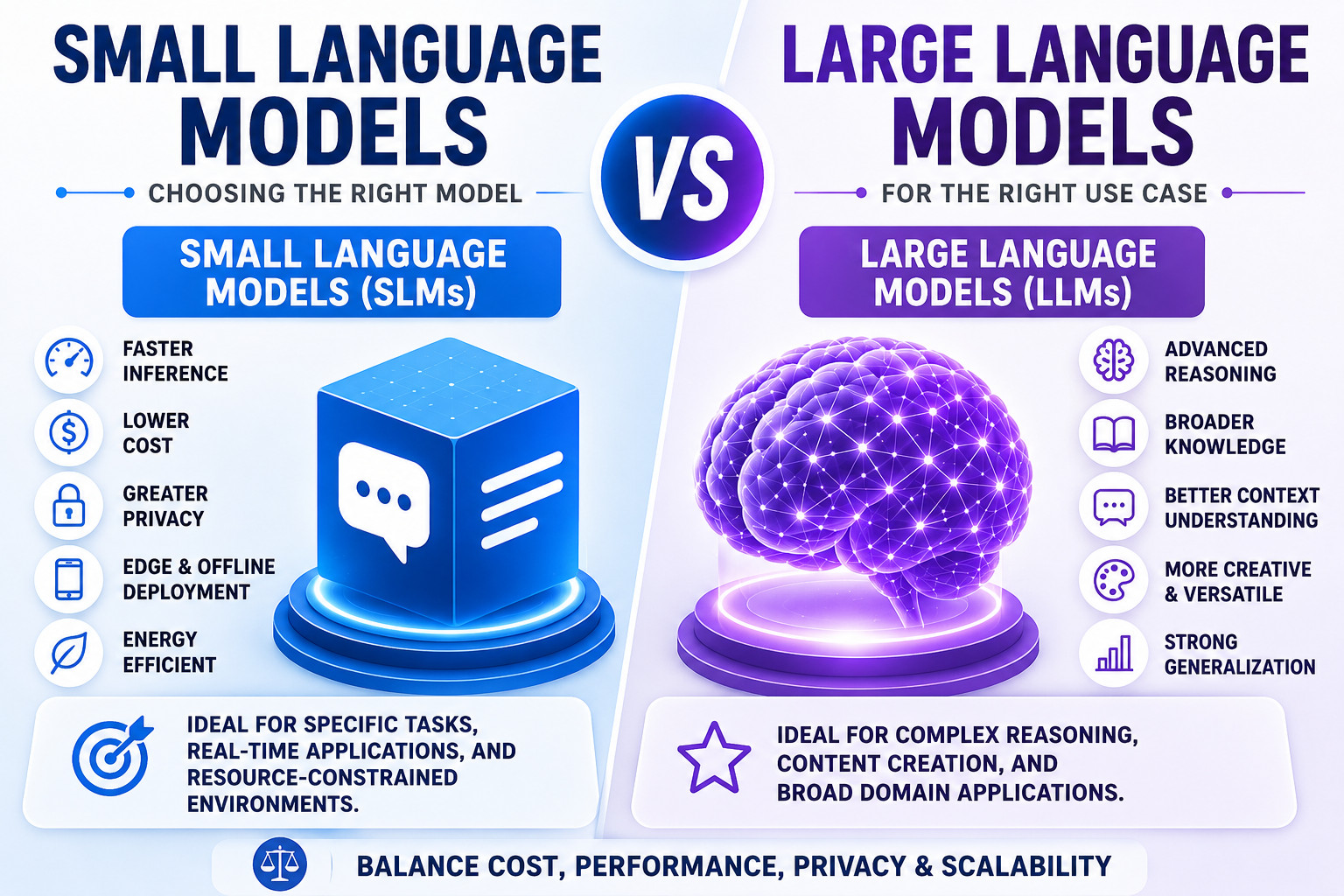
Language models are of two types: Small Language Models (SLMs) and Large Language Models (LLMs). The primary distinction between SLMs and LLMs is the number of parameters they contain and the computational resources required to train and run them.
What Are Large Language Models (LLMs)?
Large Language Models (LLMs) are AI models that contain billions or even trillions of parameters. These parameters are the internal values that the model learns during training, which enable it to understand language patterns and relationships.
- GPT-4
- Claude 3
- Gemini 1.5
- Llama 3 70B
- Mistral Large
As these models are trained on enormous datasets, they require significant computational infrastructure, often involving thousands of GPUs and substantial energy consumption.
LLMs have deep contextual understanding and are incredibly adaptable for complex problem-solving, coding assistance, and nuanced content generation.
However, because of their heavy processing requirements, they generally reside in the cloud, rely on an internet connection, and are expensive to operate.
LLMs are primarily used in open-ended research, writing long-form content, and comprehensive data analysis.
- LLM Architecture: How Large Language Models Work
- Explainability Techniques for LLMs & AI Agents: Methods, Tools & Best Practices
- LLM vs SLM in Test Automation: Which One Should QA Teams Use?
- Why Do LLMs Need ETL Testing?
- What is LLMOps?
What Are Small Language Models (SLMs)?
Small Language Models (SLMs) are AI systems designed to understand and generate natural language, and they contain significantly fewer parameters, ranging from a few million to several billion. They operate with a fraction of the computational requirements of massive LLMs.
SLMs are smaller in size and are often optimized for specific tasks or domains.
- Phi-3 Mini
- TinyLlama
- DistilBERT
- MobileBERT
- Gemma 2B
SLMs operate efficiently on edge devices, smartphones, laptops, and private enterprise environments.
Why SLMs are Gaining Popularity
- Compact Architecture: SLMs are smaller in size and use fewer parameters, reducing memory and computational requirements.
- Data Privacy: Due to their compact size, SLMs can run entirely “on-device” (like on a smartphone or local PC). As a result, sensitive data never has to be transmitted to the cloud.
- Offline Capabilities: SLMs can function without an active internet connection and are ideal for remote areas or smart appliances.
- Cost Efficiency: These models require less computing power and therefore incur low operational and cloud infrastructure costs.
- Speed: SLMs perform tasks much faster and generate responses more quickly, due to their smaller architectural footprint.
- Domain Specialization: Many SLMs are optimized for specific industries or tasks.
Key Differences Between SLMs and LLMs
SLMs and LLMs differ primarily in the following aspects:
1. Model Size
The most obvious difference is the number of parameters used by the models.
SLMs use millions to a few billion parameters and their computational demand is moderate. With fewer parameters, they have low storage requirements and low memory usage.
LLMs, on the other hand, use billions to trillions of parameters and have a very high memory usage and extensive computational demand. Their storage requirements are also high.
Larger parameter counts generally aid in better understanding and generation capabilities but require significantly more resources.
2. Performance and Accuracy
- Multi-step reasoning
- Advanced problem solving
- Context retention
- Creative writing
- Coding assistance
Modern SLMs can achieve better results on many specialized tasks than LLMs that are often generalists. For example, an SLM trained specifically for medical document classification may outperform a general-purpose LLM in that narrow domain.
3. Training Costs
- Massive datasets
- High-end GPU clusters
- Extended training periods
- Smaller datasets
- Fewer computational resources
- Shorter training times
Therefore, startups and smaller organizations favor SLMs.
4. Inference Speed
Inference in language models refers to generating outputs after training.
SLMs typically offer faster response times, lower latency, and better real-time performance.
LLMs, while powerful, are huge in size and complexity and may introduce delays.
Applications such as mobile assistants, IoT devices, and real-time monitoring systems often benefit from SLMs.
5. Deployment Flexibility
LLMs with heavy resource requirements are usually hosted in cloud environments.
SLMs however can run on smartphones, laptops, embedded systems, private servers, or edge devices.
Hence, organizations seeking local AI solutions mostly prefer SLMs due to their flexibility.
6. Energy Consumption
Environmental sustainability is an important consideration in AI development.
LLMs consume significant energy during training, fine-tuning, and inference.
SLMs consume considerably less power, making them more environmentally friendly.
The following table summarizes the key differences between SLMs and LLMs:
| Feature | SLMs | LLMs |
|---|---|---|
| Size & Scope | Typically under 15 billion parameters. Often trained on smaller, domain-specific data. | Hundreds of billions of parameters. Trained on the entire open internet. |
| Architecture | Shallower and simpler (fewer layers, less complex) | Deep and complex (multiple layers, extensive transformers) |
| Hardware & Cost | Can be run completely offline, locally on devices like laptops, smartphones, or edge devices. | Heavy reliance on cloud infrastructure and expensive GPUs to operate. |
| Latency & Speed | Faster inference and real-time response times. | Higher latency due to the massive computational calculations required. |
| Privacy & Security | Ideal for highly confidential data (healthcare, finance) because it can run entirely locally without external servers. | Requires cloud transmission, making it trickier for strictly confidential or regulated data. |
| Training Cost | Lower, due to reduced size and simpler training | High, due to computational demands and large datasets |
| Use Cases | Specific, repeatable tasks like document extraction, translation, and text classification. | Open-ended tasks, complex reasoning, creative writing, and cross-domain knowledge. |
Advantages of SLMs and LLMs
The following table provides the advantages of SLMs and LLMs:
| SLM Advantages | LLM Advantages |
|---|---|
| Cost Efficiency: SLMs have lower infrastructure requirements and reduce operational expenses significantly. | Superior Reasoning: LLMs are excellent at handling complex questions and nuanced conversations. |
| Faster Response Times: Interactions with SLMs are nearly instantaneous, which greatly benefits users. | Better Generalization: LLMs can perform well without extensive retraining across a wide range of topics. |
| Enhanced Privacy: SLMs can operate on local devices and hence sensitive information remains within organizational boundaries. | Rich Context Understanding: LLMs can maintain context across long documents and conversations. |
| Offline Functionality: SLMs are capable of operating without internet connectivity and are suitable for remote or secure environments. | Creativity: LLMs are highly effective at tasks like story writing, content generation, marketing copy creation, and brainstorming. |
| Easier Customization: SLMs can be fine-tuned for specific tasks using relatively modest resources. | Few-Shot Learning: LLMs can learn new tasks without additional training using just a few examples. |
Challenges of SLMs and LLMs
Here are the challenges faced by SLMs and LLMs:
| Challenges in SLMs | Challenges in LLMs |
|---|---|
| Limited Knowledge: SLMs lack the broad knowledge base available in larger models. | High Costs: LLMs incur high costs for development and maintenance. |
| Reduced Reasoning Ability: These models have limited reasoning capabilities, making complex reasoning tasks challenging. | Infrastructure Complexity: LLMs require sophisticated hardware and cloud resources. |
| Shorter Context Windows: SLMs have shorter context windows and cannot process very long documents. | Privacy Concerns: LLMs are deployed in the cloud and often raise concerns regarding sensitive data. |
| Lower Generalization: SLMs do not generalize easily and often struggle with tasks outside their training domain. | Environmental Impact: Training LLMs on massive datasets consumes substantial electricity and contributes to carbon emissions. |
| Hallucinations: LLMs may generate incorrect or fabricated information. |
Real-World Use Cases for SLMs and LLMs
- Mobile Assistants: SLMs can run on smartphones.
- Healthcare Devices: SLMs can be used with medical devices to process information locally while maintaining privacy.
- Industrial Automation: Manufacturing systems benefit from fast, on-device language processing.
- Enterprise Applications: SLMs can be deployed internally to maintain data security.
- Edge AI: Smart cameras, IoT devices, and sensors rely on SLMs.
- Customer Service: LLMs are used in advanced chatbots to handle complex customer interactions.
- Content Creation: Marketing teams use LLMs to generate content including articles, blogs, and social media posts.
- Software Development: Developers leverage LLMs for:
- Code generation
- Debugging
- Documentation
- Research Assistance: Researchers use LLMs to summarize papers and extract insights.
- Education: LLMs provide tutoring, explanations, and learning support.
Choosing Between SLMs and LLMs
The decision about choosing SLM or LLM depends on several factors.
- Cost is a major concern.
- Real-time performance is required.
- Privacy is critical.
- Deployment must occur on edge devices.
- The application focuses on a specific domain.
- Task is clearly defined
- Require strict offline functionality
- Complex reasoning is necessary.
- Broad knowledge is required.
- Creativity is important.
- Multi-domain support is needed.
- High accuracy justifies increased costs.
The Hybrid Approach
Organizations have started to adopt hybrid approaches that combine SLMs and LLMs.
- Use an SLM for routine requests.
- Escalate complex queries to an LLM.
- Balance cost, speed, and accuracy.
For example, a customer support platform may handle FAQs or daily tasks using an SLM but direct sophisticated technical issues to an LLM.
This hybrid approach optimizes resource utilization while maintaining high-quality responses.
Future Trends
- More Efficient LLMs: With new techniques being developed for LLMs such as quantization, pruning, and distillation, the aim is to reduce model size while preserving its performance.
- Smarter SLMs: SLMs are getting increasingly smarter with advancements in architecture and training techniques.
- Specialized AI: Specialized SLMs are being developed that are tailored to particular industries.
- Edge AI Expansion: Demand for compact, efficient language models is increasing with the growth of edge computing.
- Hybrid Architectures: Models of different sizes will work together to maximize efficiency and performance.
Conclusion
Understanding the differences between SLMs and LLMs is not about determining a universal winner but is about selecting the right tool for the right task.
LLMs are ideal for complex applications that require broad knowledge and deep understanding. They offer unmatched reasoning, creativity, and versatility. However, they can be expensive, have huge infrastructure demands, and high energy consumption.
SLMs are comparatively smaller in size, faster, affordable, and more secure. They are great for specialized tasks, edge computing, and environments where resources are scarce.
With the evolution of AI technology, this distinction between SLMs and LLMs may become less pronounced. With improvements in efficiency, model compression, and hybrid architectures, smaller models may achieve increasingly impressive performance. The future of AI will likely involve a strategic combination of SLMs and LLMs, allowing organizations to balance intelligence, efficiency, scalability, and cost.
Ultimately, whether to choose SLM or LLM depends on the specific goals, constraints, and requirements of the application.
Frequently Asked Questions (FAQs)
- Are Small Language Models more cost-effective than Large Language Models?
Yes. Small Language Models require less computational power, storage, and infrastructure, making them significantly more affordable to train, deploy, and maintain compared to Large Language Models.
- When should businesses choose a Small Language Model?
Businesses should choose SLMs when they need fast response times, lower operating costs, enhanced data privacy, offline functionality, or deployment on edge devices such as smartphones, laptops, and IoT systems.
- Which language model is better for data privacy and security?
Small Language Models often provide better privacy because they can be deployed locally on private servers or devices, reducing the need to send sensitive data to cloud-based systems.
- Do Large Language Models consume more energy than Small Language Models?
Yes. Due to their size and computational complexity, LLMs require significantly more energy for training and inference, whereas SLMs are more energy-efficient and environmentally sustainable.
- Which is better for enterprise AI adoption: SLMs or LLMs?
The best choice depends on business requirements. SLMs are ideal for cost-sensitive, privacy-focused, and task-specific applications, while LLMs are better suited for complex workflows requiring advanced reasoning, creativity, and broad domain knowledge.
| Achieve More Than 90% Test Automation | |
| Step by Step Walkthroughs and Help | |
| 14 Day Free Trial, Cancel Anytime |