
LLM vs SLM in Test Automation: Which One Should QA Teams Use?
 |
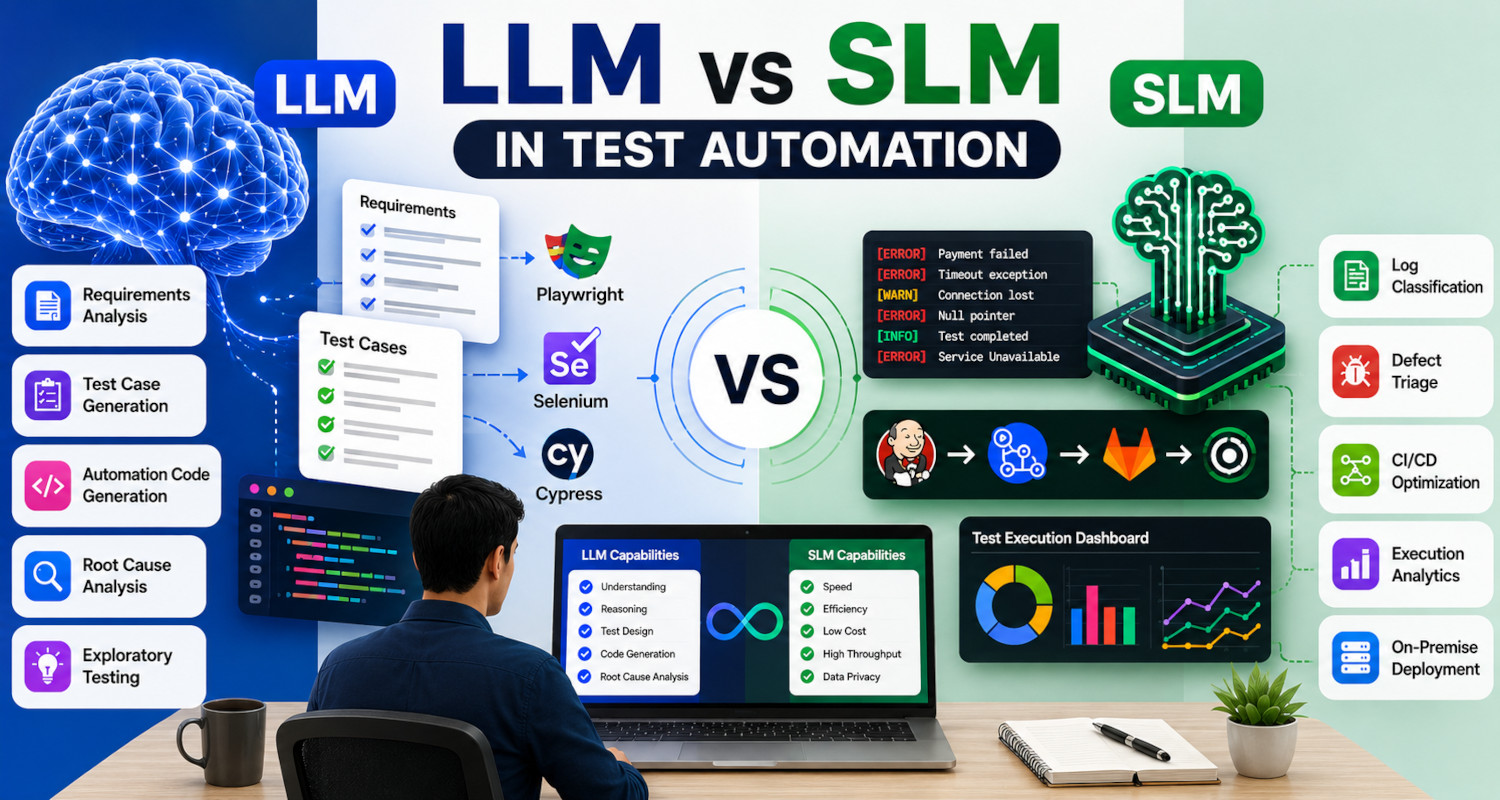
Artificial intelligence has played a major role in how software testing has changed over the past couple of years. It has influenced the changes in designing, execution, and maintenance of test cases. In the last two years, Large Language Models (LLMs) have become the core of attention for QA teams looking to speed up test creation, automate analysis, and reduce maintenance overhead. Headlines proclaim models boasting billions and trillions of parameters, indicating a future where massive AI easily resolves most complex hurdles. The benchmark has often been set by vast architectures of models such as GPT-4 and Gemini Ultra.
At the same time, Small Language Models (SLMs) have come in as a practical replacement for organizations concerned about latency, privacy, cost, and infrastructure needs.
Most often, the conversation is showcased as a debate: LLM vs SLM. However, for modern Quality Assurance teams, the real question is not which model is better in absolute terms, but which model is best suited for specific testing activities.
Getting to know the pros and cons of both methods is more important as organizations integrate AI into their automation pipelines, CI/CD pipelines, and QE practices.
| Key Takeaways: |
|---|
|
What are LLMs and SLMs in the Context of QA?
A Large Language Model (LLM) is a neural network trained on massive amounts of text data and usually contains billions of parameters. Models such as Claude, Gemini, GPT, and bigger Llama variants come under this category.
These models are built to execute sophisticated reasoning exercises, understand context, generate code, summarize information, and respond to complicated queries.
On the other hand, a Small Language Model (SML) includes significantly fewer parameters and is often optimized for a narrower set of use cases. Phi, Gemma, Mistral Small, and personalized domain-specific models are all examples of SMLs that fine-tune for internal enterprise workflows.
Technically, both model categories contribute value from the POV of software testing. The difference is based on the type of testing being executed.
The Size Paradox
Previously, the AI industry adhered to a “bigger the better” motto, resulting in big models like Gemini Ultra and GPT-4, which have a very high volume of parameters (to the tune of trillions). While it is useful for general tasks, this big scale often leads to an unnecessary computational burden without offering proportional gains in specialized domains like software testing. This is called the size paradox in software testing.
A Stanford AI Index study a few years ago highlighted that specialized models with fewer than 10 billion parameters can function better than larger models by 37% on domain-specific tasks when fine-tuned. This difference in efficiency explains why only the biggest AI might not guarantee the best strategy for efficient AI testing services. Instead, using right-sized models, possibly through cloud testing or on-prem, becomes a necessity for a robust test automation solution.
Read: What Is Right-Sized AI in Test Automation?
Why QA Teams Are Looking at AI Models
Traditional test automation has several dogged challenges:
- High test maintenance costs
- Slow test creation cycles
- Limited test coverage
- Growing application complexity
- Increasing release frequency
- Resource constraints within QA teams
Modern applications often include distributed services, APIs, event-driven architectures, microservices, mobile applications, and cloud-native components. Testing these systems requires significant effort in designing test scenarios, maintaining automation frameworks, analyzing failures, and validating business requirements.
With language models, you get the opportunity to decrease manual effort across most of these activities. But not all these testing tasks need the reasoning power of a large model.
Read: Explainability Techniques for LLMs & AI Agents: Methods, Tools & Best Practices.
Areas in Test Automation that LLMs Succeed at
Here are the main areas where LLM works well.
Requirement Analysis and Test Design
One of the most valuable use cases for LLMs is transforming requirements into actionable test scenarios.
Consider a user story describing an e-commerce checkout process. A senior QA engineer would typically review the requirements, identify acceptance criteria, define positive and negative scenarios, and evaluate potential edge cases.
LLMs can perform a significant portion of this analysis automatically.
For example, given a checkout specification, an LLM can identify:
- Input validation requirements
- Business rule constraints
- Security risks
- Boundary conditions
- Error handling scenarios
- Integration dependencies
The model’s ability to reason across multiple sections of documentation makes it particularly useful during the test planning phase.
Read: How to Work with Requirements as a Tester.
Automated Test Case Generation
Generating meaningful test cases is not only about producing scripts. Effective testing requires understanding business workflows, user intent, risk exposure, system behavior, and failure conditions. Large language models can build extensive test suites that cover both happy paths and edge cases.
For example, when prompted with a payment workflow, an LLM can generate:
- Valid transaction scenarios
- Invalid card scenarios
- Expired card validation
- Duplicate transaction detection
- Currency conversion testing
- Retry mechanisms
- Timeout handling
This level of contextual understanding remains difficult for most smaller models.
Read: How to Write Test Cases? (+ Detailed Examples).
Test Automation Script Generation
Many teams now use LLMs to speed up the generation of automation code. A QA engineer can provide Page Object structure, API specifications, and existing framework conventions.
The model can then generate:
- Selenium tests
- Playwright scripts
- Cypress tests
- REST API validations
- Mock service definitions
- Data-driven test implementations
While the LLM written code needs review, it highly reduces development effort.
Read: All-Inclusive Guide to Test Case Creation in testRigor.
Root Cause Analysis
Failure analysis is another place where LLMs establish strong capabilities.
A typical production test failure may involve:
- Application logs
- Network traces
- Stack traces
- Screenshots
- Test reports
An LLM can correlate information across these artifacts and provide probable failure causes. Instead of wasting thirty minutes manually inspecting logs, a tester will receive a prioritized list of likely issues within seconds. This becomes highly valuable in bigger regression suites where hundreds of failures may occur simultaneously.
Read: The Role of AI in Root Cause Analysis (RCA): How AI Accelerates Problem Detection.
Areas in Test Automation that SLMs Succeed at
While LLMs receive most of the hype, SLMs often offer superior efficiency for operational QA workloads.
Log Classification
Large enterprises generate enormous volumes of test execution logs.
Most failures fall into recurring categories:
- Environment failures
- Network issues
- Data inconsistencies
- Application defects
- Infrastructure problems
Training an SLM to organize these failures can lead to highly accurate results while needing substantially fewer computational resources. In many cases, a 7-billion-parameter model is sufficient for this task. Using a large model would provide minimal additional value.
Read: Test Log Tutorial: Boost Your Testing Skills with Industry Best Practices for Success.
Defect Analysis and Prioritization
Many organizations struggle with defect prioritization.
An SLM can analyze:
- Ticket descriptions
- Historical defect patterns
- Error messages
- Component ownership
The model can then assign categories or route defects to appropriate engineering teams. As these tasks follow predictable patterns, smaller models often achieve comparable results to larger alternatives.
Read: Defect-based Testing: A Complete Overview.
CI/CD Pipeline Optimization
Continuous integration environments require fast decision-making.
Examples include:
- Build status summarization
- Regression trend analysis
- Execution result categorization
- Test selection recommendations
These tasks prioritize speed and efficiency over deep reasoning. SLMs are often a better fit because inference times are much lower.
Read: Continuous Integration and Continuous Testing: How to Establish?
On-Premises Deployments
Privacy remains a major concern in regulated industries. Organizations working in banking, healthcare, telecommunications, and government sectors may be prohibited from sending sensitive data to external AI services.
Smaller models can often be deployed locally with reasonable hardware requirements. This allows teams to maintain data sovereignty, reduce compliance risks, control model behavior, and lower operational costs.
Comparison Table: LLMs vs SLMs
| Aspect | LLMs (Large Language Models) | SLMs (Small Language Models) |
|---|---|---|
| What they are built for | Designed to manage a wide range of tasks, including reasoning, content generation, coding, and problem-solving. | Designed to perform specific tasks efficiently without requiring massive computational resources. |
| Usual model size | Usually includes billions of parameters and is trained on enormous datasets. | Much smaller in size, often optimized for a narrower problem space. |
| Understanding requirements | Better at interpreting business requirements, user stories, and ambiguous documentation. | Can work with requirements, but performs best when the inputs follow consistent patterns. |
| Test scenario generation | Useful when creating comprehensive test scenarios that involve business logic, integrations, and edge cases. | Can write test cases for well-defined workflows but may miss broader testing risks. |
| Handling incomplete information | More likely to infer missing context and detect gaps in requirements. | Tends to depend heavily on the information provided and may not identify hidden assumptions. |
| Automation code generation | Can generate framework-level code, reusable components, and complex test flows with reasonable context. | More suitable for generating smaller snippets or repetitive automation tasks. |
| Root cause analysis | Helpful when failures involve multiple systems, logs, APIs, and dependencies. | Better suited for identifying known patterns rather than investigating complex failures. |
| Scalability in large QA programs | Powerful, but costs and latency become important considerations as usage grows. | Often easier to scale for repetitive operational workloads. |
| Best fit in testing | Requirement analysis, test design, exploratory testing support, automation development, and failure investigation. | Log classification, defect routing, execution monitoring, regression analysis, and CI/CD support. |
| How most mature QA teams use them | As a reasoning layer for complex testing decisions. | As an operational layer for repetitive, high-volume testing activities. |
| Practical limitation | It can be expensive to run for every testing task. | May struggle when deep reasoning or broad contextual understanding is required. |
| QA takeaway | Acts like a senior engineer helping you think through a problem. | Acts like a specialized assistant handling repetitive work efficiently. |
The Technical Compromises QA Leaders must be Aware of
Let us review the risks or limitations that, as a QA leader, you should be aware of before choosing between LLM and SLM.
Context Window Limitations
Testing activities frequently involve large amounts of contextual information. A test engineer may need to provide requirements documents, API contracts, architecture diagrams, existing test suites, and defect histories. LLMs generally support larger context windows, making them more suitable for analyzing complex systems. SLMs may struggle when information overflows their context capacity.
Read: AI Context Explained: Why Context Matters in Artificial Intelligence.
Hallucination Risk
One of the most discussed challenges with language models is hallucination. In testing, hallucinations can be particularly dangerous.
Examples include:
- Invented API endpoints
- Nonexistent business rules
- Invalid assertions
- Incorrect test data assumptions
While both model categories can hallucinate, larger models typically display stronger reasoning capabilities and better contextual grounding. Regardless of model size, generated outputs should always undergo validation before entering production test suites.
Latency and Throughput
Test automation platforms often process thousands of events per hour. Consider a regression suite executing 20,000 test cases daily. If every failure needs LLM-based analysis, operational costs and response times may become unsustainable.
SLMs typically offer:
- Lower latency
- Higher throughput
- Reduced infrastructure consumption
For repetitive QA workflows, these characteristics often outweigh the benefits of advanced reasoning.
Cost Considerations
Cost remains one of the strongest arguments for adopting SLMs.
An enterprise-scale QA organization may process:
- Millions of log entries
- Thousands of defect records
- Hundreds of daily test executions
Running all workloads through premium LLM APIs can quickly become expensive.
A hybrid architecture often provides better economics:
- LLMs for high-value reasoning tasks
- SLMs for repetitive operational tasks
This method balances capability with scalability.
When Should QA Teams Choose LLMs?
LLMs are the preferred option when testing activities require complex reasoning, business context understanding, test design expertise, multi-system analysis, code generation, and root cause investigation. They are especially useful during the nascent stages of testing, where understanding and interpretation are necessary.
If your team spends significant time analyzing requirements or designing automation strategies, LLMs can produce immediate productivity gains.
When Should QA Teams Choose SLMs?
SLMs are the better choice when priorities include:
- Cost efficiency
- Low latency
- High-volume processing
- On-premises deployment
- Privacy requirements
- Operational scalability
Tasks involving classification, routing, filtering, and summarization are often perfect candidates. Organizations processing large amounts of testing telemetry regularly benefit from deploying SLMs as part of their CI/CD infrastructure.
The Future of AI-Powered Test Automation
The future of software testing will not be dominated by a single model category in the near future. Instead, we are seeing the emergence of specialized AI ecosystems where different models handle different responsibilities.
LLMs will continue to guide activities that mimic the work of experienced test architects:
- Requirement interpretation
- Test design
- Exploratory testing support
- Root cause analysis
SLMs will increasingly power operational workflows:
- Log processing
- Defect triage
- Test execution analytics
- Pipeline intelligence
At the same time, platforms like testRigor are demonstrating how AI-native test automation is moving beyond raw model selection. Rather than forcing teams to choose between LLMs and SLMs directly, these systems abstract the underlying model layer and focus on higher-level capabilities such as plain English test creation, self-healing automation, and reducing long-term test maintenance.
As model efficiency improves, the distinction between large and small models may become less important. What will matter most is selecting the right model for the right testing problem.
Read: Evaluate AI Testing Tools: Cut the Marketing Hype.
Conclusion
Bigger is not always better. The whole debate around LLM versus SLM in test automation often misses the practical realities of modern QA engineering. Large Language Models offer outstanding reasoning, test generation, and analysis capabilities that can considerably improve testing effectiveness. Small Language Models provide faster, cheaper, and more scalable solutions for repetitive operational workloads.
For most QA teams, the best strategy is not choosing one over the other. It is building a testing ecosystem where each model contributes according to its strengths.
Teams that successfully mix LLM-driven intelligence with SLM-powered efficiency will be best positioned to scale quality engineering practices, accelerate releases, and maintain software reliability in increasingly complex development environments.
FAQs
Can Small Language Models generate automated test cases?
SLMs can write test cases for structured workflows and iterative scenarios. However, they may struggle to identify hidden edge cases, business risks, or system-level interactions that larger models can often detect.
Are LLMs replacing QA engineers?
LLMs can speed up test creation, failure analysis, and documentation review, but they do not replace the critical thinking, domain expertise, and risk assessment skills that experienced QA professionals offer to software testing.
Why are enterprises considering SLMs despite the popularity of LLMs?
A: Many organizations give higher priority to cost control, data privacy, low latency, and on-premises deployment. SLMs often deliver sufficient accuracy for operational QA tasks while requiring significantly fewer infrastructure resources.
What is a hybrid AI testing strategy?
It mixes both LLMs and SLMs. LLMs are used for reasoning-intensive activities such as requirement analysis and root cause analysis, while SLMs manage high-volume operational tasks such as log processing, defect classification, and execution analytics.
| Achieve More Than 90% Test Automation | |
| Step by Step Walkthroughs and Help | |
| 14 Day Free Trial, Cancel Anytime |