Evaluate AI Testing Tools: Cut the Marketing Hype
 |
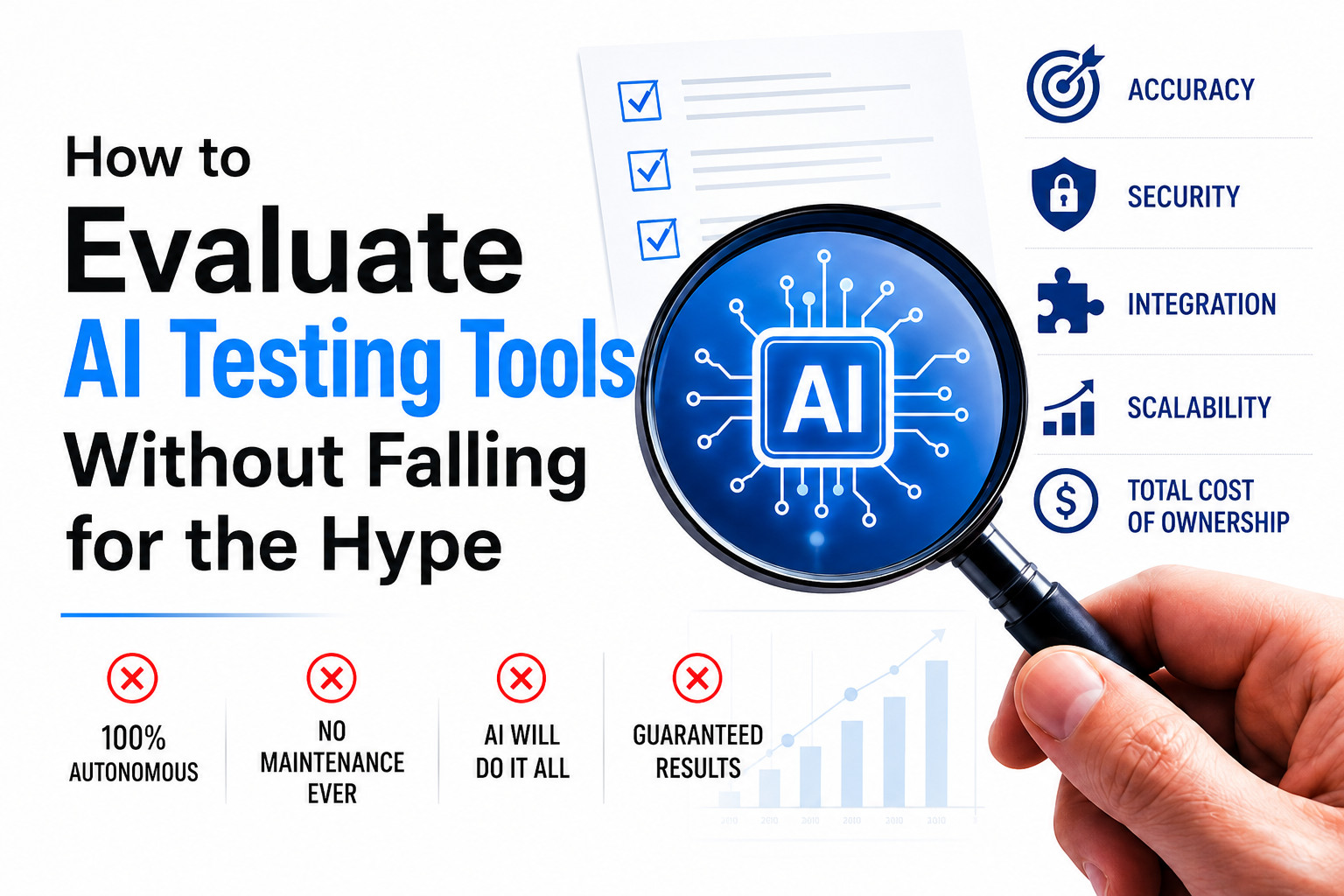
Artificial intelligence (AI) has become ubiquitous across industries. AI-powered applications are used for almost all tasks in the digital field. In the software field, a new category of solutions has emerged to support their validation and quality control: AI testing tools. At present, there are countless AI testing tools available in the market, making all the hype about the features they offer.
However, not all the tools live up to this hype. Hence, it is essential to evaluate these tools before you finalize them.
| Key Takeaways: |
|---|
|
This article explores the practical strategies for evaluating AI testing tools objectively, so that organizations can make informed decisions and maximize their ROI.
What AI Test Automation Tools Actually Do?
So what qualifies as an AI testing tool?
True AI testing tools typically incorporate machine learning (ML), natural language processing (NLP), computer vision, or advanced analytics to improve testing activities.
AI testing tools automate, optimize, and maintain software tests by using ML and generative AI. These tools use NLP, visual recognition, and predictive analysis to streamline quality assurance and testing, eliminating the need for engineers to manually write and update code for every test.
Common capabilities of AI testing tools include:
- Automated test case generation
- Self-healing test scripts
- Intelligent defect prediction
- Visual testing and UI validation
- Test prioritization and optimization
- Risk-based testing recommendations
- Natural language test creation
- Autonomous test maintenance
However, sometimes vendors label conventional automation platforms as “AI-powered” after adding a few intelligent features. However, including a chatbot interface or a simple recommendation engine does not necessarily indicate meaningful AI capabilities.
Therefore, there is a need to evaluate every AI testing tool to validate if it really provides the AI capabilities listed above.
Evaluating AI Testing Software: Steps
In the remainder of this blog, we will present various strategies for evaluating AI testing tools.
Let us get started!
1. Start with Business Problems, Not Vendor Features
Most organizations evaluate tools based on the vendor’s feature list. A vendor may advertise:
- Autonomous testing
- Generative AI test creation
- Predictive analytics
- Self-healing automation
However, though these capabilities sound impressive, they are only valuable if they help you address actual challenges within your testing process.
To validate this, first identify your organization’s specific pain points:
- Are test maintenance costs too high?
- Is regression testing slowing releases?
- Are critical defects escaping into production?
- Is test coverage insufficient?
- Does your team lack automation expertise?
Once these challenges are clearly identified, you will know which tool you want. Based on this, evaluate whether the tool directly addresses the specific challenges you face.
A solution that solves a significant operational problem in your organization will often deliver more value than a tool with dozens of advanced features that remain unused.
2. Demand Clear Explanations of AI Functionality
With AI bloom, many AI testing vendors use ambiguous language to convey that they use AI features, such as:
- Intelligent automation
- Smart testing
- Cognitive quality assurance
- Autonomous validation
These terms may sound innovative, but they often offer little insight into exactly how the technology works.
Hence, when you evaluate the tool, ask vendors specific questions:
- Which AI models are used to power the platform?
- What tasks are automated through machine learning?
- What training data is used?
- How does the system improve over time?
- What human oversight is required?
- What happens when predictions are incorrect?
Vendors should be able to provide concrete explanations to these queries rather than relying on marketing language.
If a vendor struggles to explain how AI contributes to outcomes, the AI component may be superficial, and you should rethink this tool.
3. Evaluate Real-World Performance using Proof of Concept (POC)
Product demonstrations are uniquely designed to showcase best-case scenarios only.
Moreover, these demonstrations are prepared in a controlled environment, and they perform impressively because:
- Test environments for the demo are carefully prepared.
- Applications are simplified so that everything works.
- Data quality is optimized.
- Scenarios are scripted in advance and made to work before the demo.
However, the real-world software environments are far more complex. This is the reason you should rely entirely on demos.
When evaluating tools, insist on proof-of-concept (POC) testing using your own applications and use:
- Existing test suites
- Real workflows
- Production-like environments
- Actual user journeys
Ensure you test the tool on a representative subset of your own application. To do this:
- Use a realistic benchmark: Select a stable but complex module/feature of your app to test. Do not go for the classic “login” scenario. Such a simple scenario will not give you any insight into the tool features.
- Evaluate self-healing: Test how the tool handles dynamic UI changes (self-healing). Modify a few locators (e.g., changing button IDs or class names) and see if the AI tests still pass without human intervention.
A successful POC provides far more valuable insights than a polished demonstration.
4. Measure Accuracy rather than Automation Claims
You will find many tool vendors emphasizing how much testing their platform can automate.
These automation percentages, however, can be misleading.
For example:
- A tool may generate hundreds of test cases for a specific feature or scenario
- Many of those tests may be redundant
- Some tests may produce false positives
- Others may miss critical edge cases
Therefore, instead of focusing solely on automation levels, evaluate:
- Test quality
- Accuracy
- Reliability
- Coverage effectiveness
You can measure the performance using a few key metrics, including:
- Defect detection rate
- False positive frequency
- False negative frequency
- Test maintenance effort
- Time savings achieved
A tool that automates fewer tasks accurately is better and provides more value than one that automates everything poorly.
Read: How to Get The Best ROI in Test Automation.
5. Examine Test Maintenance Requirements
Reduction in maintenance is one of the biggest promises of AI testing tools.
Using traditional automated testing, testers have to put in significant effort when applications change. However, AI-powered platforms claim to solve the maintenance problem through self-healing capabilities.
While self-healing is definitely valuable, you should verify:
- How often does healing succeed
- Whether repairs are accurate
- What review mechanisms exist
- How much manual validation is required
Significant quality risks are posed if a tool incorrectly updates tests with self-healing capability.
During evaluation, verify how the tool responds by intentionally modifying application elements.
Pay particular attention to:
- Recovery accuracy
- Review transparency
- Change reporting
- Maintenance workload reduction
Your objective here is to determine whether the tool genuinely reduces maintenance effort or shifts responsibility elsewhere.
6. Assess Explainability and Transparency
AI systems often function as “black boxes.” They read inputs and generate outputs without explaining how and why the output was generated.
The explainability is, however, very important in testing environments, because quality assurance teams must understand:
- Why were tests generated
- Why were the defects flagged
- Why were risks prioritized
- Why were recommendations made
AI testing tools are expected to provide transparent reasoning behind their decisions to generate tests, flag defects, or prioritize risks.
During evaluation, ask questions such as:
- Why was this test case created?
- Why was this defect considered high risk?
- Why was this workflow prioritized?
If the tool cannot explain its conclusions, teams may not trust or validate its outputs.
Transparency is critical, especially in regulated industries such as healthcare, finance, and aerospace.
7. Evaluate Integration Capabilities
An AI testing tool should integrate effectively into existing workflows, or else even the most sophisticated platform can fail.
When evaluating an AI testing tool, examine its compatibility with:
- CI/CD pipelines
- Version control systems
- Test management platforms
- Defect tracking tools
- Cloud environments
- Development frameworks
Common integrations include Jira, GitHub, GitLab, Azure DevOps, Jenkins, Selenium, and Playwright.
Assessing integrations alone does not suffice. You should also evaluate how well they function. With poor integrations, manual work will be increased, undermining the benefits of AI-automation.
8. Investigate Training and Learning Requirements
AI testing tools may require significant training and learning materials. Ask questions about the amount of historical data needed, duration of the model training, expertise required, retraining of models, and new project onboarding.
A tool may offer limited value during deployment but demonstrate impressive results after months of optimization. You have to have a good understanding of this time-to-value aspect for realistic planning.
Note that AI capabilities do not become effective immediately.
9. Verify Scalability
Scalability is an important factor that the AI testing tools should be evaluated on. Often, many tools perform well on small projects but struggle as complexity increases.
When you evaluate an AI testing tool, verify if it is scalable by considering the number of applications supported, the test execution volume, user concurrency, data processing requirements, and enterprise deployment needs.
Run evaluation scenarios that reflect future growth. For example, if you plan to double development output within a couple of years, evaluate if the tool can support the expansion.
Early assessment is essential as scalability issues emerge after purchase.
10. Analyze Total Cost of Ownership
Evaluating the AI testing tools in terms of cost of ownership is critical. The focus during pricing discussions is mainly on licensing fees, and the true cost of AI testing tools is often underestimated.
Apart from licensing fees, the total cost of ownership includes:
- Initial implementation
- Training
- Infrastructure
- Integration work
- Maintenance
- Consulting services
- Ongoing support
Additional costs may arise from premium AI features, usage-based pricing models, data storage requirements, and advanced analytics modules.
Hence, do not merely evaluate first-year expenses, but create a multi-year cost projection. You may notice that the tool that appeared affordable initially has suddenly become more expensive with usage.
11. Examine Security and Compliance Features
AI testing platforms are often expected to process sensitive application data, user information, and proprietary business logic. Hence, they should be evaluated for security and compliance features, including data encryption, access control, auditing, compliance certifications, and data residency options.
Especially the organizations operating in regulated industries should verify compliance with relevant frameworks, such as:
Generative AI features should be specifically scrutinized as they may transmit application data to external AI providers.
Understand that it is critical to evaluate AI testing tools and check how data is stored, processed, and protected.
12. Seek Independent Validation
Vendors provide case studies focused on their tool, but they are inherently biased and inclined towards beautifying their tool.
To evaluate the tool, you should have a balanced perspective. For this purpose, consult independent sources such as analyst reports, industry reviews, professional communities, user forums, and technology conferences.
You can also get valuation information about the tool by speaking directly with existing customers.
Enquire about:
- Implementation challenges
- Unexpected limitations
- Support quality
- ROI achievement
- Long-term satisfaction
Real user experiences can provide practical insights to you about the tool that marketing materials lack.
13. Evaluate Vendor Maturity
The AI testing tool market includes a variety of vendors, comprising established vendors and emerging startups. While both may be innovative, the vendor stability matters.
Evaluate the vendors by including the criteria that assess the vendor’s financial health, customer base, product roadmap, support capabilities, and industry reputation.
Explore the vendor further by asking questions such as:
- How long has the company operated?
- How frequently are updates released?
- What is the retention rate among customers?
- Does the vendor invest heavily in research and development?
If the company lacks long-term viability, even a powerful product may become risky.
14. Beware of Generative AI Hype
Nowadays, the testing tool market is abuzz with Generative AI. Several platforms now claim they can:
- Create tests automatically from requirements
- Generate scripts from natural language
- Build complete testing strategies
All these capabilities are promising, but should be evaluated carefully.
Important questions related to this evaluation include:
- How accurate are the generated tests?
- How much editing is required?
- Are edge cases captured?
- Can business logic be interpreted correctly?
- How often do outputs require manual correction?
Generative AI often accelerates content creation, but it rarely eliminates the need for human review.
You should know that AI-generated tests are starting points and not the final deliverables.
15. Conduct a Controlled Pilot
Once you have evaluated the AI testing tool using the strategies above, before you make a large-scale commitment, run a pilot project that should:
- Include real applications
- Use representative workflows
- Involve actual testing teams
- Define measurable success criteria
Metrics you want to measure might include a reduction in test creation time, maintenance effort savings, defect detection improvements, and release cycle acceleration.
If the pilot is successful, it will provide evidence-based validation, and you can get rid of assumptions.
16. Focus on Outcomes, Not AI Labels
You should be aware that the ultimate goal is not the AI but to improve software quality, reduce risk, accelerate delivery, and increase efficiency.
A testing tool should be evaluated by outcomes such as:
- Faster releases
- Better coverage
- Fewer defects
- Lower maintenance costs
- Improved team productivity
Whether those outcomes come from AI features like advanced machine learning, intelligent automation, or conventional engineering matters less than the measurable business value they deliver.
17. Establish Clear Evaluation Criteria
A structured evaluation framework of an AI testing tool helps reduce bias and improve decision-making.
Typical evaluation criteria for AI testing tools are shown in the following table:
| Category | Weight |
|---|---|
| Functional Fit | 25% |
| Accuracy | 20% |
| Integration Capability | 15% |
| Ease of Use | 10% |
| Scalability | 10% |
| Security & Compliance | 10% |
| Vendor Stability | 5% |
| Cost | 5% |
The evaluation criteria given here are general ones, and each organization should adjust weights according to its priorities.
testRigor Evaluation
Based on the factors discussed, testRigor scores positively on:
- Low-code/no-code automation
- Natural language test authoring
- Self-healing capabilities
- Business-user accessibility
- Reduced maintenance effort
- Faster onboarding of non-developers
- Good enterprise integrations
In summary, testRigor’s generative-AI-based no-code automation platform makes it easy for QA teams to quickly build test automation while spending almost no time maintaining tests for web, mobile, desktop, databases, APIs, AI features, and mainframe apps. Tests are written in plain English and empower everyone, including non-technical stakeholders, to quickly build, maintain tests, and improve test coverage.
This dramatically reduces the dependency on engineering resources, freeing developers to focus on building features. As a result, organizations can achieve faster release cycles with higher confidence in product quality.
Read more here: testRigor features.
Here are the case studies that demonstrate how testRigor helped various organizations streamline their automated testing:
Conclusion
With the rapidly growing AI testing tools industry, software teams have garnered tremendous opportunities. At the same time, it has also introduced significant confusion. Vendors often create a marketing hype around their products by promoting ambitious claims that blur the line between genuine innovation and marketing exaggeration. However, such organizations that rely solely on demonstrations, feature lists, or buzzwords risk investing in solutions that fail to deliver meaningful results.
Hence, organizations should carefully evaluate the AI testing tools before a large-scale commitment without falling for this hype. Effective evaluation is a disciplined approach focused on business needs, measurable outcomes, real-world performance, and long-term value. Organizations should demand transparency, conduct rigorous proof-of-concept testing, validate accuracy, assess integration capabilities, and examine total cost of ownership to make informed decisions grounded in evidence rather than hype.
Frequently Asked Questions (FAQs)
-
Why is it important to evaluate AI testing tools carefully?
Many vendors make bold claims about automation, self-healing capabilities, and autonomous testing. A careful evaluation helps organizations distinguish between genuine AI-driven value and marketing hype, ensuring they invest in tools that solve real business problems. -
What should I look for when evaluating an AI testing tool?
Key evaluation criteria include functionality, accuracy, scalability, integration capabilities, ease of use, security, compliance, vendor reliability, and total cost of ownership. Organizations should also assess how well the tool addresses their specific testing challenges. -
How can I tell if a testing tool truly uses AI?
Ask vendors to explain how AI is used within the platform. They should be able to describe the underlying technologies, learning mechanisms, training requirements, and decision-making processes rather than relying on vague terms like “smart” or “intelligent” automation. -
Can AI testing tools completely replace human testers?
No. While AI can automate repetitive tasks and improve efficiency, human expertise remains essential for exploratory testing, business logic validation, risk assessment, usability evaluation, and strategic quality decisions. - What are the risks of relying too heavily on vendor demonstrations?
Vendor demos typically showcase ideal scenarios with optimized environments and prepared datasets. Real-world performance may differ significantly, which is why organizations should validate capabilities through hands-on testing and pilot projects.
| Achieve More Than 90% Test Automation | |
| Step by Step Walkthroughs and Help | |
| 14 Day Free Trial, Cancel Anytime |