RAG vs. MCP: Differences, Role, and Usage
 |
Large Language Models (LLMs) can explain concepts and answer questions, but their learned knowledge may be outdated or incomplete, and they cannot automatically access private systems or act in the real world. Retrieval Augmented Generation (RAG) supplies relevant information; the Model Context Protocol (MCP) provides a standard way for AI applications to connect with external data and capabilities.
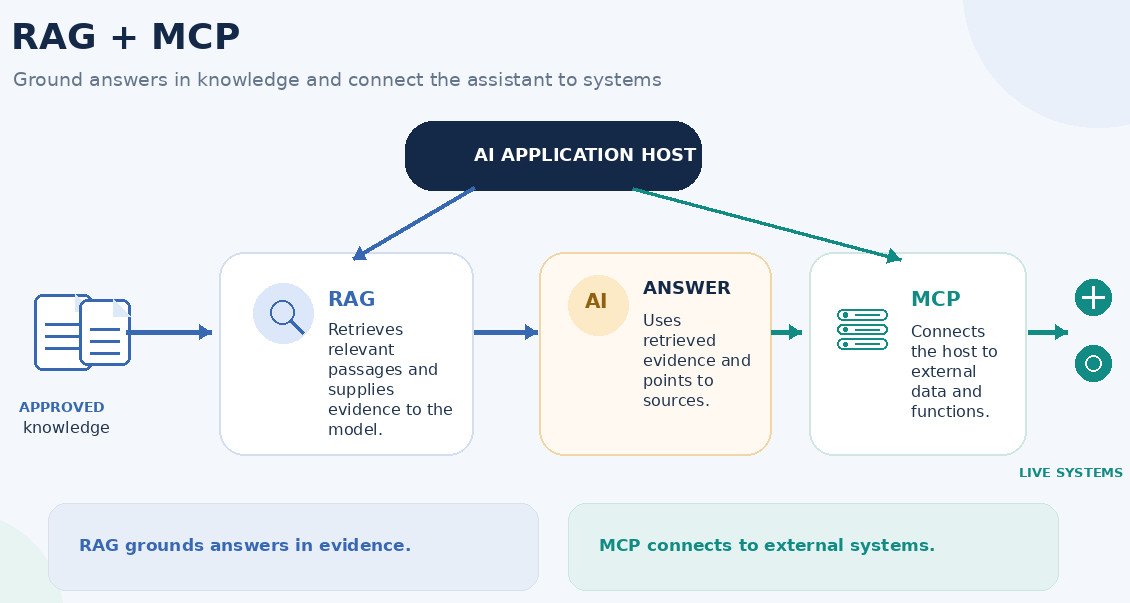
Together, they can support an assistant that finds a current travel policy, checks a live booking, and prepares a change request. RAG grounds the answer in evidence; MCP connects the application to systems and functions. Understanding their boundaries is essential for building useful, maintainable, and safe applications.
| Key Takeaways: |
|---|
|
What is RAG?
Retrieval-augmented generation (RAG) combines information retrieval with language generation. Before answering a question, the system searches an approved knowledge source and provides relevant information to the language model as context. The model then uses that information to generate a response, often with links or citations to the original sources.
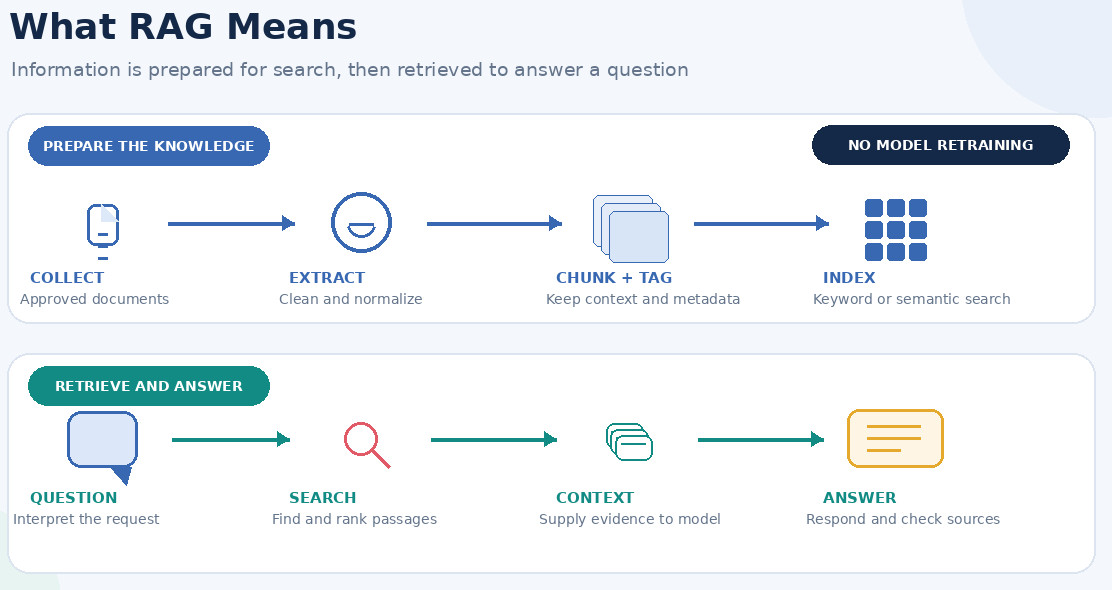
RAG does not retrain the model. Instead, it gives the model access to selected information when a question is asked. A typical RAG system works in two stages: prepare information for search and retrieve relevant information to answer questions.
Preparing Information for Retrieval
- Collect Sources: Gather documents, web pages, product manuals, support tickets, database records, or other approved content.
- Extract and Normalize: Convert files into searchable text, preserve useful structure such as headings and tables, and remove irrelevant navigation or duplicated boilerplate.
- Split into Chunks: Divide long material into smaller passages while retaining enough context to make each passage understandable.
- Add Metadata: Store fields such as document title, date, department, access label, page, or product version.
- Create Searchable Representations: Index words for keyword search, create embeddings for semantic search, or combine the two approaches.
Chunk size affects search quality. Chunks that are too small may separate a statement from the conditions needed to understand it. Chunks that are too large may return broad sections with irrelevant details. A heading, its policy paragraph, and a short definition may belong in one chunk, while an entire handbook usually should not.
Example: A support team indexes product guides by section. Each passage includes the product name, version, heading, and publication date. When someone asks about an installation error, the system can prioritize guidance for the correct product version instead of returning a similar passage from an older guide.
Retrieve Information and Answer the Question
- Interpret the request. Identify what the user wants to know and any relevant details, such as the product, date, or department.
- Search for relevant passages. Use keyword search, semantic search, or both to find likely matches.
- Refine the results. Apply filters, rank the strongest matches, and remove duplicate or outdated content.
- Provide context to the model. Send the question and selected passages to the model, along with instructions for handling missing or conflicting evidence.
- Generate the answer. Ask the model to respond using the supplied information and identify its sources.
- Check the response. Confirm that the retrieved passages are relevant and that they support the answer.
Example: An employee asks, “How many days of parental leave can I take, and does the policy differ for adoption?” The system retrieves the relevant leave-policy sections, including the passage about adoption. The model summarizes the rules and links to the policy. If the system cannot find information about adoption leave, it should say so instead of guessing.
Why RAG is Useful and Where it Falls Short
RAG is useful when answers depend on changing or private information, or need to be traceable to sources. Updating an index can be easier than retraining a model. But retrieval does not guarantee correctness: the system can miss a document, retrieve stale or conflicting passages, misread a table, or answer beyond its evidence. A citation is useful only when its source supports the claim.
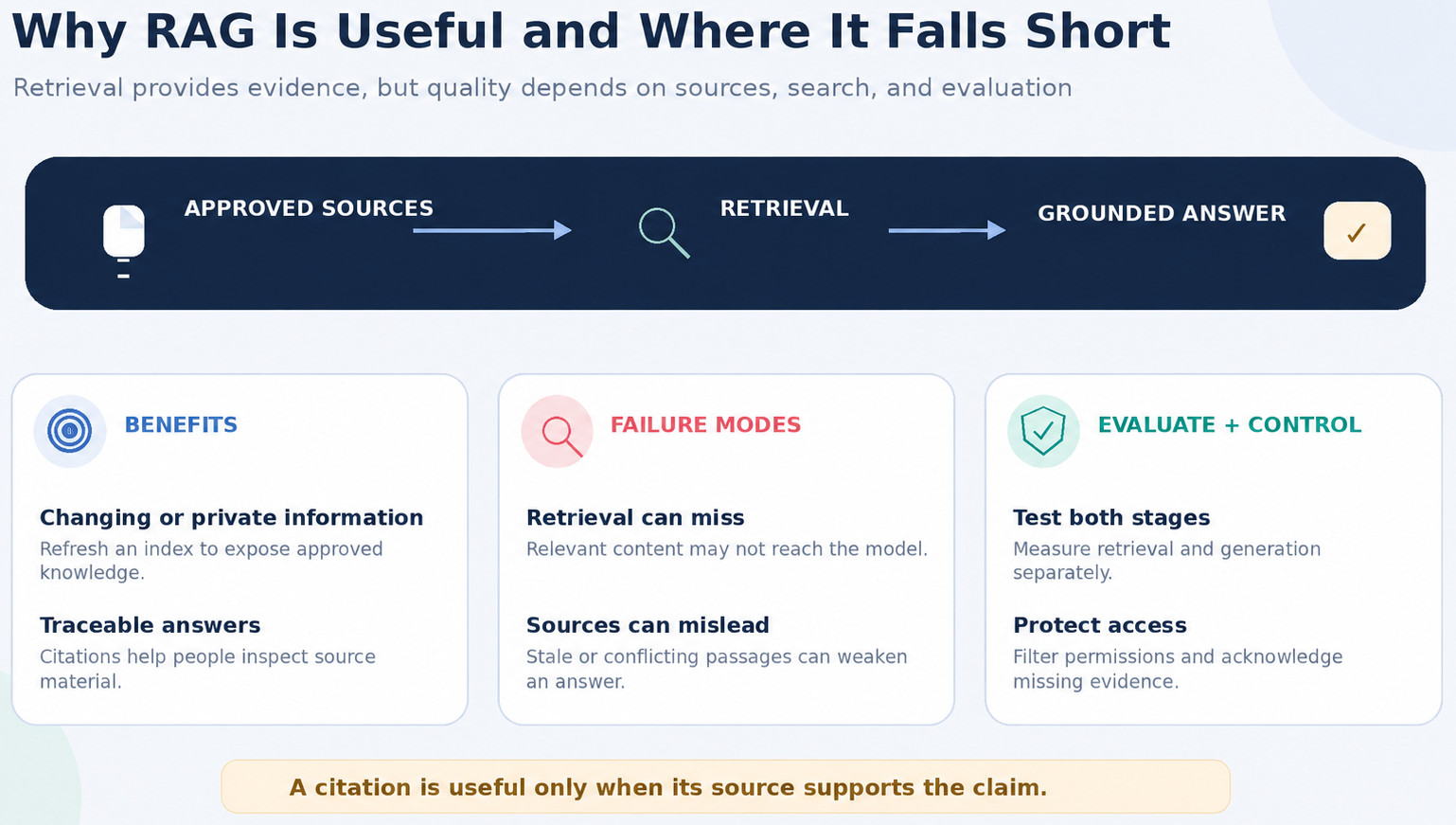
- RAG improves access to evidence; it does not guarantee that evidence is complete or correct.
- A good answer depends on search quality, source quality, prompt design, and evaluation.
- The system should communicate uncertainty when evidence is missing, conflicting, or out of date.
- Document permissions must be applied during retrieval, not merely hidden in the final answer.
Evaluate retrieval and generation separately. Retrieval checks whether the right passages rank highly; generation checks whether the answer is accurate, relevant, and supported. If the right document is missing from the results, changing the answer prompt will not fix the retrieval problem.
What is the MCP?
The Model Context Protocol (MCP) is an open protocol that helps AI applications connect to external information and functions. It gives applications a consistent way to discover and use capabilities offered by connected systems.
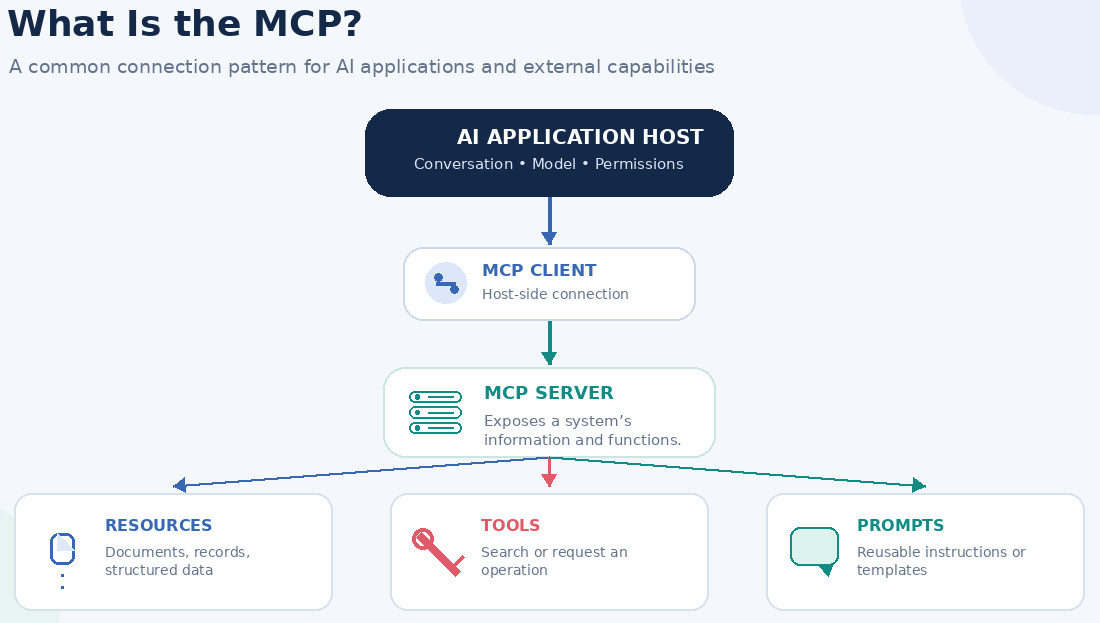
Think of MCP as a common connector. Without a shared protocol, each AI application may need a separate integration for every database, file store, calendar, or business service. MCP provides a standard way for an application to communicate with these systems. An MCP setup has three main participants:
| Participant | Role |
|---|---|
| Host | The AI application that manages the conversation, model, permissions, and connected servers. |
| Client | The component within the host that communicates with an MCP server. |
| Server | A program that makes information or functions available through MCP. |
- Resources provide information, such as a document, record, or structured result.
- Tools let the model request an operation, such as searching for an issue or creating a draft ticket.
- Prompts provide reusable instructions or interaction templates that the host can make available.
MCP standardizes how these capabilities are described and called. It does not determine whether an answer is correct, whether a user is authorized to access specific information, or whether an action should be performed. Those decisions remain the responsibility of the AI application and the systems it connects to.
Example: A project-management MCP server could provide a project-summary resource, a tool for searching open issues, and another tool for creating a draft issue. When the user asks about a project, the host can make relevant information available to the model. If the model requests a tool call, the host and server should apply the required identity, access, and confirmation checks before carrying out any consequential action.
To explore how retrieval-augmented generation differs from AI agents, see Retrieval Augmented Generation (RAG) vs. AI Agents.
RAG and MCP Solve Different Problems
RAG and MCP are complementary, but they serve different roles. RAG is an approach for grounding a model’s answers in retrieved information. MCP is a protocol for connecting an AI application to external information and functions.
RAG vs. MCP
| Aspect | RAG | MCP |
|---|---|---|
| Primary role | Finds relevant information to help ground an answer | Connects an AI application with external systems and capabilities |
| How it works | Retrieves passages from a knowledge source and supplies them to the model | Lets a host discover and use resources, tools, and prompts exposed by a server |
| Example | Finds the current leave policy to answer an employee’s question | Connects to a ticketing system to look up or create a ticket |
| Can it work alone? | Yes. It can use a search API without MCP | Yes. An MCP server can provide tools without using RAG |
| How they can work together | Provides the retrieval and grounding approach | Can expose a RAG search function or connect the host to live systems |
Clearly, “we use MCP” does not mean “we have reliable retrieval“. Similarly, “we use RAG” does not mean “we have a standard tool integration.”
A protocol can make a search service accessible, but relevance, freshness, access control, and answer quality remain system-design responsibilities.
Read more: RAG vs. Agentic RAG vs. MCP.
How RAG and MCP Work Together?
RAG and MCP can work together in one AI application. RAG retrieves relevant knowledge and grounds the model’s answer, while MCP connects the application to search services, live systems, and actions. The host coordinates the process by deciding which capabilities to use, what results to share with the model, and whether an action needs user approval.
Consider an employee who asks, “My laptop cannot connect to the office VPN. Check the current steps, see whether there is a known outage, and open a ticket if needed.”
The host can use an MCP search tool to look up troubleshooting guidance in a RAG index of approved IT documents, then use another MCP capability to check live service status. The model compares the employee’s issue with the guidance and outage information. If there is a known outage, it summarizes the status and cites the relevant sources. If the issue remains unresolved, it prepares a support ticket and shows the draft to the employee for confirmation before submitting it.
In this workflow, RAG supplies the supporting knowledge, MCP connects the assistant to search, service-status, and ticketing capabilities, and the host manages access and approval. Each part has a distinct role, while working together to answer the question and, when appropriate, take the next step.
For a discussion of how MCP is changing and where the protocol may be headed, read Is the MCP Protocol Dying or Evolving?.
Designing an Effective RAG and MCP Solution
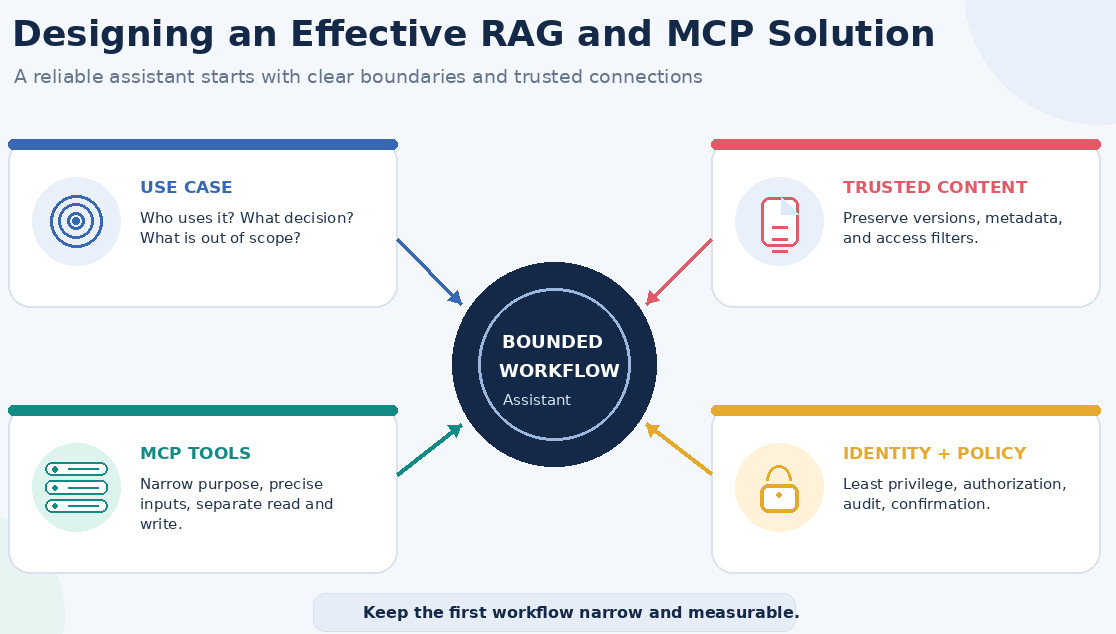
A reliable RAG and MCP solution starts with a clearly defined use case, trusted data, and tools with carefully limited access. These design choices help the assistant retrieve relevant information, respect permissions, and take only the actions it is allowed to perform.
Start With a Bounded Use Case
- Identify the people who will use the assistant and the decisions it should support.
- List the knowledge sources and systems the use case needs.
- Separate questions that need documents from tasks that need live data or actions.
- Define what the assistant must refuse, escalate, or ask the user to clarify.
- Choose a narrow first workflow that can be measured end to end.
A broad goal such as “connect the assistant to company data” is hard to secure and evaluate.
A clearer first objective is “answer expense-policy questions, show the relevant section, and do not submit reimbursements.”
Build Retrieval Around the Content
- Preserve headings, tables, dates, and document versions during ingestion.
- Choose chunk boundaries that reflect the structure of the source.
- Use metadata to filter by user access, product version, geography, or effective date.
- Consider hybrid search when exact identifiers and natural-language questions both matter.
- Rerank results when initial retrieval produces many plausible passages.
- Include enough source information for users to verify important claims.
For a technical knowledge base, semantic search may locate a paragraph that describes a login timeout even if the user says sign-in keeps hanging.
Keyword search may be better for an exact error code such as VPN-1042. Combining both can improve recall, but it also adds tuning and evaluation work.
Design MCP Capabilities Carefully
- Give each tool one clear purpose and a name that describes its function.
- Define input fields, types, allowed values, and error behavior precisely.
- Keep tool permissions narrow; separate read operations from write operations.
- Return useful, bounded results rather than entire databases or huge documents.
- Make actions idempotent where practical, so retries do not create duplicates.
- Log calls with appropriate privacy protections and a traceable request identifier.
A tool called manage_customer is ambiguous. Separate tools such as get_order_status and create_return_request make the model’s choices easier to inspect and restrict. A draft-creation tool can be safer than a tool that immediately sends an email or issues a refund.
Treat Identity and Access as Core Design Elements
- Use least-privilege credentials for each server and tool.
- Scope access to the signed-in user or an approved service role.
- Avoid placing secrets in prompts, logs, resource text, or model-visible errors.
- Require confirmation for actions with financial, legal, privacy, or operational impact.
- Keep an audit trail of who requested an action, what was executed, and what the system returned.
A model may produce a convincing explanation of why it needs access to a record. That explanation is not an access-control decision. Authorization belongs in application and server code, where identity and policy can be checked consistently.
Security and Reliability Risks
- Prompt injection in retrieved content: A document may contain text instructing the model to reveal secrets or call a tool. Keep a strict separation between trusted instructions and untrusted retrieved content.
- Over-broad tool access: A model given a general-purpose write tool may choose an unintended action. Narrow tool scope and permission checks reduce the impact.
- Confused-deputy behavior: A server might use its own broad credentials on behalf of a user who lacks permission. Bind actions to verified identity and enforce authorization at the server.
- Stale or conflicting sources: Old policies may remain searchable beside current ones. Track versions, effective dates, and retirement status, and prefer authoritative current content.
- Sensitive data exposure: Retrieved text or tool output may include personal or confidential information. Minimize what enters the model context and apply retention and logging controls.
- Unsafe action execution: A model may misunderstand an amount, recipient, or requested change. Show a clear action summary and obtain confirmation when required.
- Server supply-chain risk: An MCP server is executable software with access to data or tools. Review its source, dependencies, deployment, network access, and update process.
- Operational failure: A server may time out, return malformed data, or become unavailable. Define timeouts, retries, fallbacks, and user-facing error messages.
Security should be reviewed across the whole chain: user, host, model, MCP client, server, data source, and target system. A protocol standard can improve interoperability, but it cannot replace secure implementation or organizational governance.
Testing and Evaluation
- Retrieval tests: Does the system find the authoritative passages for common, ambiguous, and adversarial queries? Does it filter out unauthorized documents?
- Grounding tests: Are material claims supported by retrieved evidence? Does the answer acknowledge missing or conflicting evidence?
- Tool-selection tests: Does the host choose the right MCP tool, pass valid arguments, and avoid calling tools when they are unnecessary?
- Authorization tests: Can a user access only the records and actions their role allows? Are denied requests handled safely?
- Action tests: Are drafts accurate? Do confirmations work? Are retries safe? Do failures avoid partial or duplicate updates?
- Resilience tests: What happens when a server is slow, unavailable, or returns unexpected output?
- Regression tests: Do changes to the index, prompt, model, tool schema, or server alter established behavior?
A compact evaluation set might include ordinary requests, paraphrases, exact identifiers, incomplete questions, conflicting policy versions, attempts to retrieve restricted data, and requests to perform disallowed actions. Measure more than whether the final answer “sounds right.” Track retrieval quality, citation support, task completion, tool errors, latency, cost, and rates of unsafe or unnecessary actions.
For a deeper look at evaluating AI systems that plan and act through tools, see Agentic AI Testing.
Common Misconceptions about RAG and MCP
- “RAG eliminates hallucinations.” RAG can give the model evidence, but retrieval and interpretation can still fail. Systems need abstention behavior and grounded-answer checks.
- “MCP is a database or an AI model.” MCP is a communication protocol used by AI applications to connect with capabilities exposed by servers.
- “Every MCP tool call should be automatic.” Some operations are low risk; others should require review or confirmation. The application should set policy based on the impact of the action.
- “If a server is connected, the model can safely use it.” Connectivity is not authorization, and tool descriptions alone are not a security boundary.
- “RAG and MCP are competing approaches.” They address different layers and can be combined in one system.
- “More context always improves answers.” Too much irrelevant material can distract the model, increase cost, and make source attribution harder.
A Practical Implementation Roadmap: MCP + RAG
A phased rollout helps teams validate the knowledge sources, retrieval, MCP tools, and safeguards before expanding the assistant’s scope. The roadmap below moves from a measurable first workflow to ongoing monitoring and improvement.
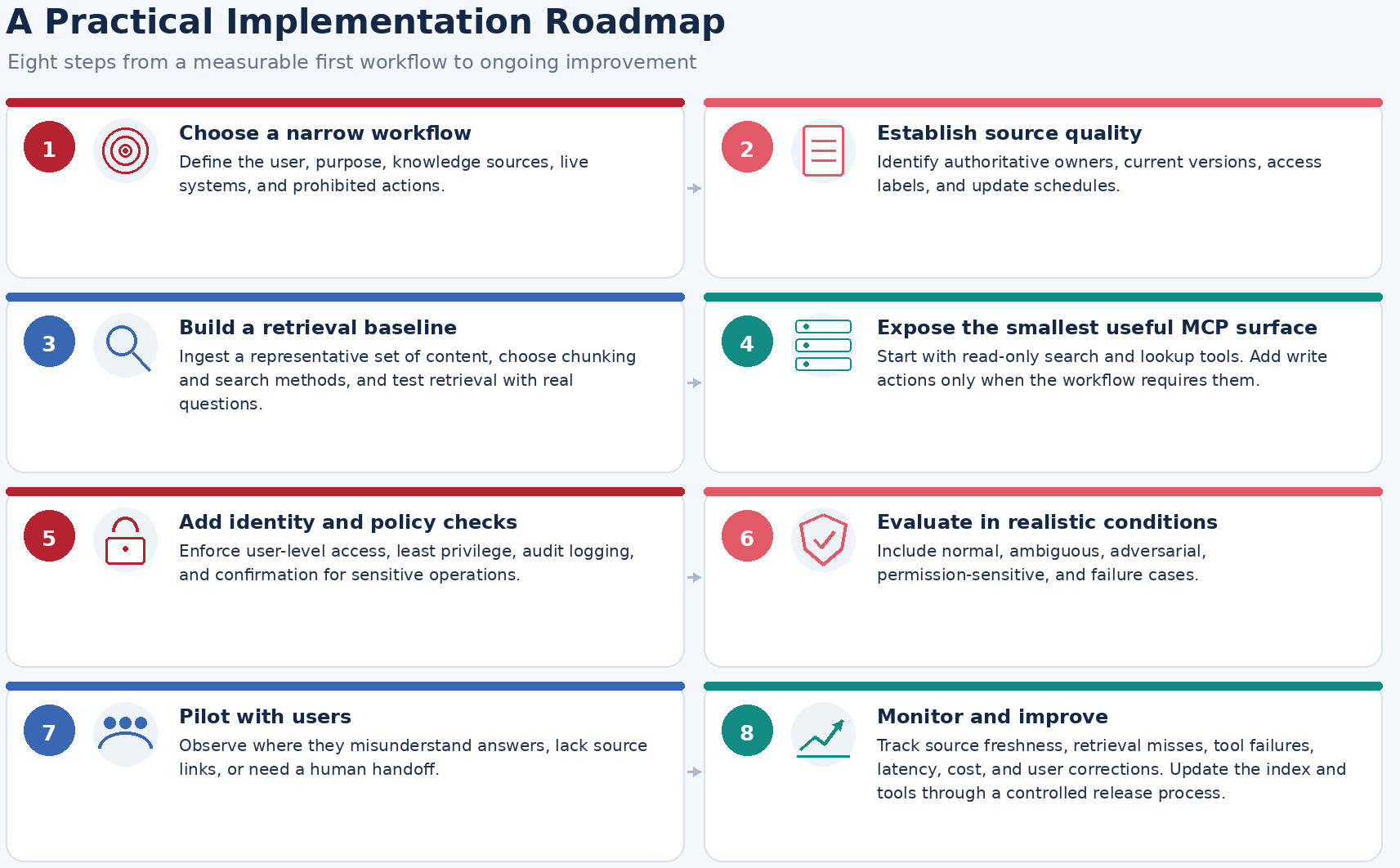
- Choose a narrow workflow: Define the user, purpose, knowledge sources, live systems, and prohibited actions.
- Establish source quality: Identify authoritative owners, current versions, access labels, and update schedules.
- Build a retrieval baseline: Ingest a representative set of content, choose chunking and search methods, and test retrieval with real questions.
- Expose the smallest useful MCP surface: Start with read-only search and lookup tools. Add write actions only when the workflow requires them.
- Add identity and policy checks: Enforce user-level access, least privilege, audit logging, and confirmation for sensitive operations.
- Evaluate in realistic conditions: Include normal, ambiguous, adversarial, permission-sensitive, and failure cases.
- Pilot with users: Observe where they misunderstand answers, lack source links, or need a human handoff.
- Monitor and improve: Track source freshness, retrieval misses, tool failures, latency, cost, and user corrections. Update the index and tools through a controlled release process.
A phased rollout helps locate failures. An old policy citation points to source lifecycle or ranking; a wrong tool choice points to descriptions or orchestration; a missing confirmation points to action policy. Not every failure is a prompt problem.
The strongest implementations begin with a clear use case and treat relevance, permissions, security, evaluation, and user trust as first-class requirements. RAG does not make an answer automatically true, and MCP does not make a tool call automatically safe. Good outcomes come from combining sound retrieval, narrowly designed capabilities, application-level controls, and continuous testing.
The Future of Connected AI Applications
RAG and MCP help move AI applications from text generation toward work with organizational knowledge and services. More integrations expand capability but also increase the need for clear ownership, testing, and monitoring. A maintainable design keeps the content pipeline, retrieval, orchestration, and MCP servers testable and independently updateable. Users should be able to inspect sources, correct mistakes, and see when an action is proposed or completed.
How testRigor Fits into RAG and MCP Testing
Applications that use RAG and MCP need tests for both the answers people see and the actions the system takes. testRigor can help automate end-to-end checks of user-facing AI features, including chatbot interactions and generated summaries. For example, a test can verify that a support assistant returns the correct order information, handles an unsupported question appropriately, or does not expose another customer’s data.
testRigor also provides an MCP server that lets compatible AI assistants work with testRigor test suites and cases. Through natural-language requests, an assistant can create or update test cases, run tests, and retrieve results. This connects AI-assisted workflows with test automation while leaving teams in control of test review and release decisions. Read: How to Utilize testRigor’s MCP Server.
These capabilities complement dedicated checks of retrieval quality, source citations, access controls, and MCP tool behavior. They help teams test the application’s end-to-end behavior without treating one automation tool as a substitute for evaluating every layer of a RAG-and-MCP system.
For a broader overview of how AI is being applied to software testing, see AI in Software Testing.
Frequently Asked Questions (FAQs)
- Is MCP required to build a RAG application?
No. A RAG application can call its retrieval service directly or use another integration method. MCP is useful when an AI host needs a standard way to discover and connect to external context or tools.
- Can an MCP server provide RAG search?
Yes. An MCP server can expose a search capability that queries a RAG pipeline and returns relevant passages or references. The server handles the integration interface; retrieval quality and access enforcement still depend on the implementation.
- Which should a team implement first, RAG or MCP?
Start with the problem. If the main need is grounded answers from internal documents, build and evaluate retrieval first. If the application must connect to multiple external systems through a common interface, MCP may be part of the integration design. Many teams will add the second layer after proving the first use case.
| Achieve More Than 90% Test Automation | |
| Step by Step Walkthroughs and Help | |
| 14 Day Free Trial, Cancel Anytime |