
Agentic AI Testing
 |
Software testing is entering a new era. AI in software testing can support teams across the lifecycle, from understanding requirements and generating tests to executing workflows and analyzing failures. At the same time, products are embedding agents that can interpret requests, select tools, use data, and take action across business systems.
These developments lead to two related responsibilities: using agentic AI to improve software testing, and testing agentic AI products.
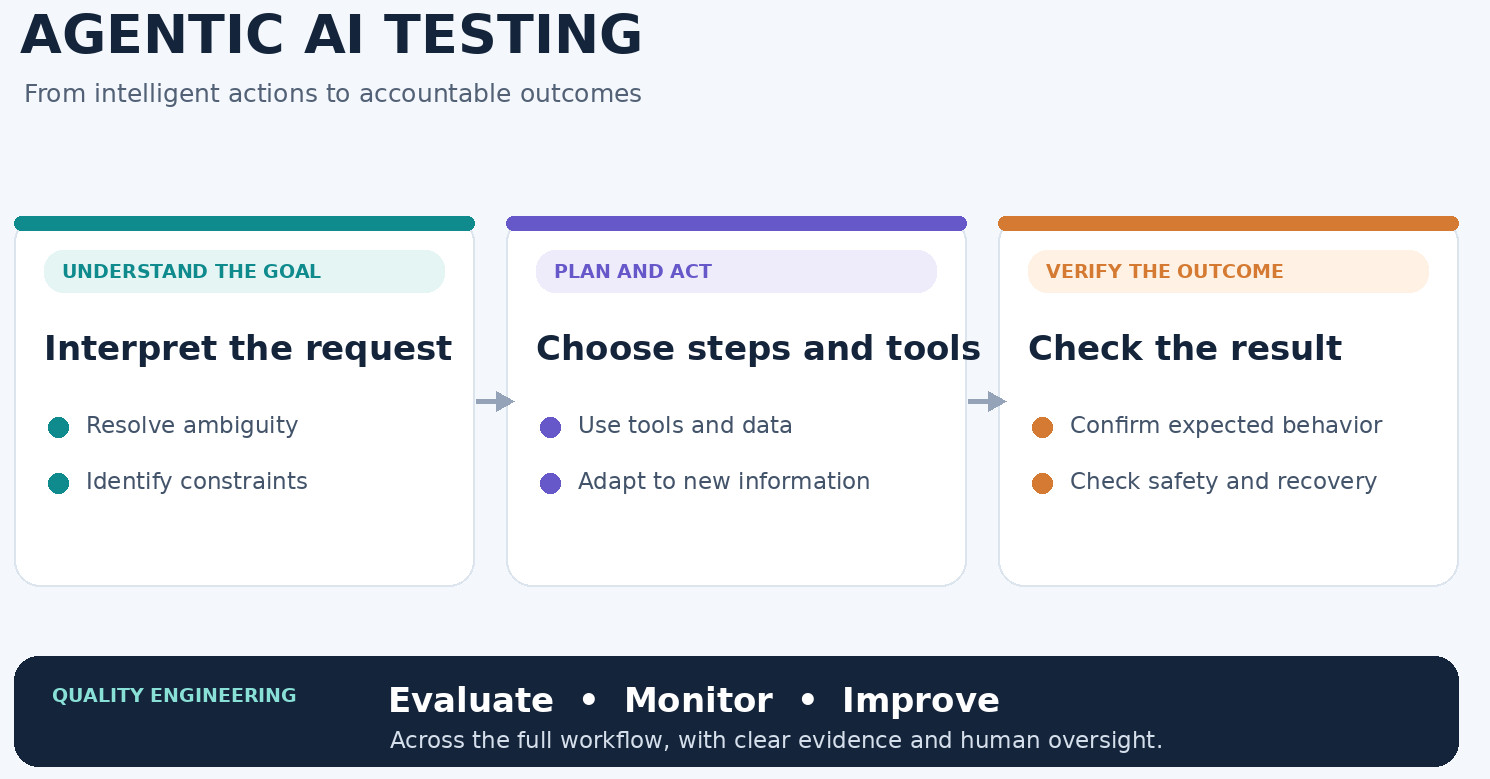
So agentic AI testing is more than just asking a model if an answer sounds correct. It assesses whether an agent knows its goal, selects suitable actions, applies tools safely, handles uncertainty, respects boundaries, and achieves a satisfactory outcome over a series of steps.
The core concept is straightforward: assess the system as a whole, in realistic conditions, and hold people responsible for risk, intent, and release decisions.
| Key Takeaways: |
|---|
|
What Makes an AI System Agentic?
An AI agent is a software system that incorporates a model to understand a goal and determine what to do and how to interact with tools and other systems to take a step forward. Depending on its design, it may search documents, call APIs, update records, run code, browse web pages, or delegate work to another agent. It might look at the result of an action and decide what to do next, rather than just returning a single response straight away. The difference between agentic AI and generative AI is that agentic systems can use model outputs to plan and act through tools.
The word “agentic” describes a range, not a single architecture. At one end, a model proposes actions and a human validates them. The distinctions among agentic AI, AI agents, and autonomous AI help clarify where a system falls on this spectrum. Later, an agent can automatically execute a bounded sequence of low-risk actions.
A multi-agent workflow may have different roles for planning, execution, review, or specialist analysis. More autonomy may speed the flow of work, but also increases the number of paths, decisions, and consequences that testing needs to cover.
A typical automation script has predefined instructions. The agent has a set of possible actions that it can choose from depending on the current context. That flexibility is useful when inputs are ambiguous, or workflows vary, but it means that the same request may produce different intermediate steps. Testing must separate acceptable variation from a failure of meaning. It should focus on the outcome and the constraints the agent must obey, while still examining the path it took when that path impacts safety, policy, cost, or auditability.
Two Sides Of Agentic AI Testing
- Agent-assisted testing: AI agents support quality engineering by analyzing requirements, generating test ideas, running applications, verifying results, and helping maintain test assets.
- Testing AI agents: Quality teams test the product enabled by the agent, including its model, prompts, tools, memory, orchestration, guardrails, interfaces, and human approval steps.
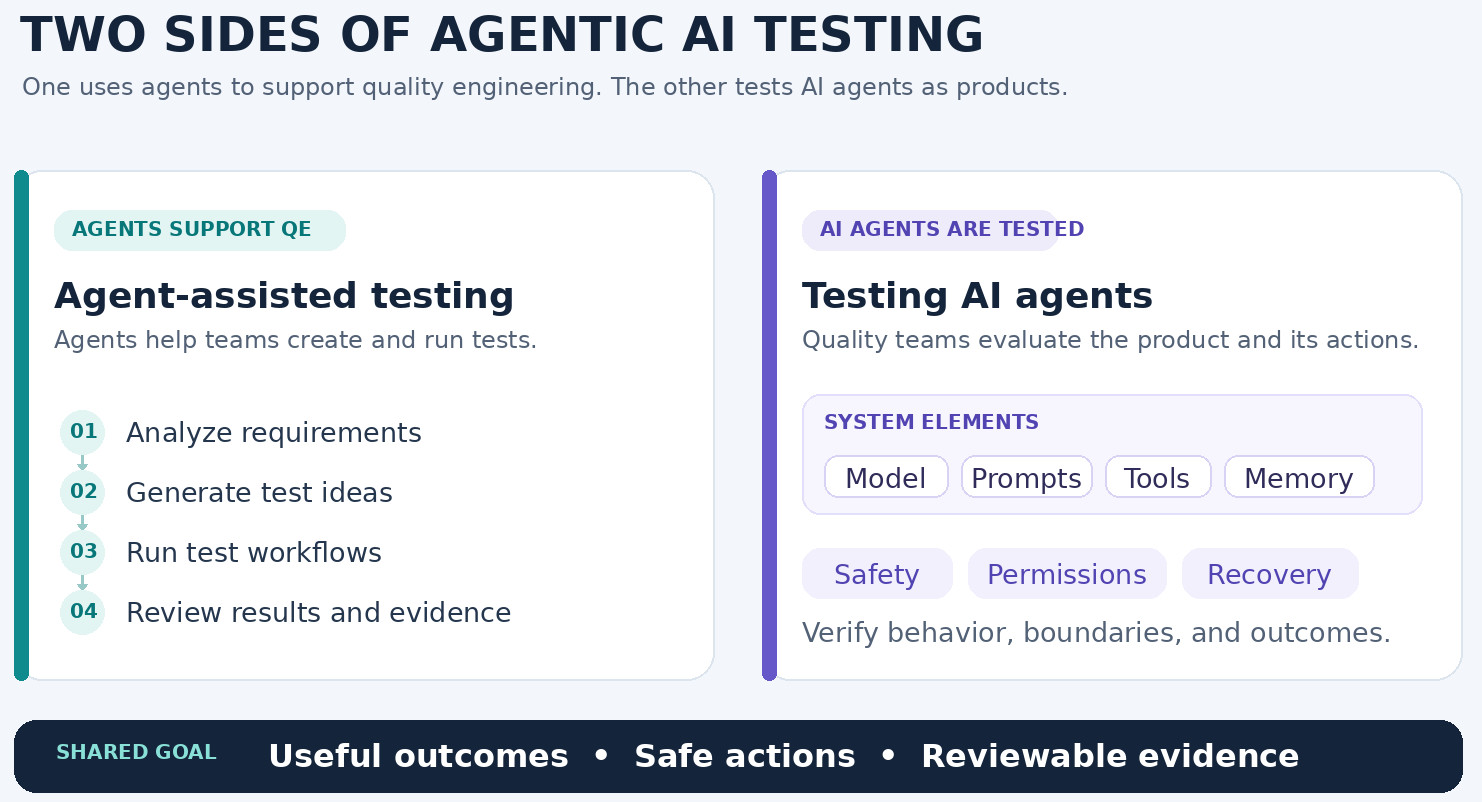
A useful quality strategy clearly defines both scopes. It asks whether the product behaves acceptably for testing agents. For agent-assisted testing, it asks if the testing agent produces useful, repeatable, reviewable evidence. In either case, ownership is with those who know the product risks and acceptance criteria.
For instance, an agent-assisted testing tool could step through a checkout flow and suggest test cases. The team still looks at those cases to see if they follow the intended payment rules. In parallel, if the product has a shopping assistant, testers verify that the assistant picks the right products, stays within the customer’s budget, and places an order only after receiving the required confirmation.
Why Traditional Testing Needs to Expand
Traditional software testing is still important. Agents still rely on working APIs, user interfaces, databases, identity services, and infrastructure. Existing checks for accessibility, performance, compatibility, data integrity, and business rules are still in place. The difference is that agents exhibit behavior that is probabilistic, context-sensitive, and often distributed across several interactions.
For example, one typical test would verify that there is a refund button and that clicking it brings up a confirmation dialog. Also, an agentic refund workflow has to be evaluated for: does the agent understand the customer’s request, check eligibility, select the correct order, calculate the permitted amount, explain any limitation, seek approval when required, and not submit a duplicate refund. The test includes the final state and the decisions that lead to it.
A Layered Model for Agentic Testing
A good test strategy looks at the system on different levels. You cannot replace any one level with any other level. Each level answers a different question. It should look at individual elements such as models, tools, and prompts, but also entire agent workflows. Testing should also cover how the system reacts to failure, unexpected inputs, and situations that require human approval.
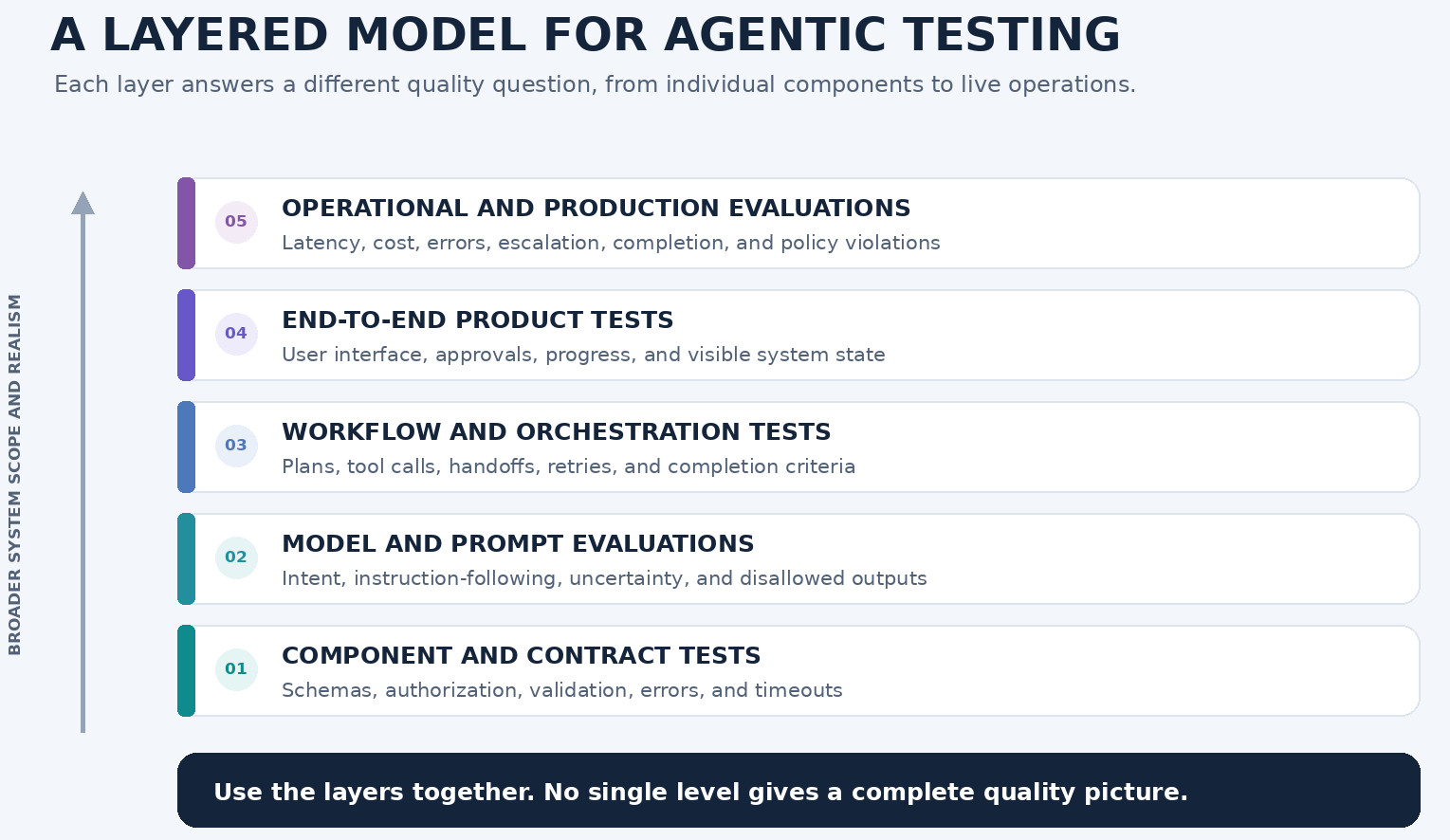
- Component and Contract Tests: Test individual tools and services separately. Check API schemas, auth, authorization, input validation, error handling, idempotency, timeouts, data contracts. The model might pick the wrong tool, but the tool still has to reject invalid or unauthorized requests. Fast, deterministic checks at this level provide a stable foundation for higher-level tests.
- Model and Prompt Evaluations: Evaluate whether the model follows instructions, interprets user intent, asks a clarifying question when needed, expresses uncertainty appropriately, and avoids disallowed outputs. Use a curated set of examples with clear scoring guidance. Some responses can be graded with exact rules; others require semantic review by a trained evaluator or human reviewer. Model-based graders can scale evaluation, but their own agreement with human judgment should be measured.
- Workflow and Orchestration Tests: Test complete tasks across planning, tool calls, handoffs, retries, memory, and final response. Define acceptable paths, required checks, prohibited actions, and completion criteria. Workflows should be tested with successful inputs as well as missing information, contradictory instructions, tool failures, partial results, and interrupted sessions.
- End-To-End Product Tests: Test the agent using the same interface that a real user would use, including chat, voice, or a graphical application. Make sure the interface shows progress and errors clearly, shows approval prompts at the right time, and reflects state accurately after actions. End-to-end tests discover integration problems that can’t be found by testing isolated components.
- Operational and Production Evaluations: Track latency, cost, tool errors, escalation rates, completion rates, policy violations, and user fixes. Utilize privacy-preserving feedback and appropriate retention policies. Production signals can reveal new test cases, but monitoring is not a substitute for pre-release testing. A high-risk failure should be contained and investigated before it becomes a repeated customer problem.
Depending on their access to the system, teams can combine black-box, gray-box, and white-box testing for AI agents.
What Should Be Tested in Agentic AI?
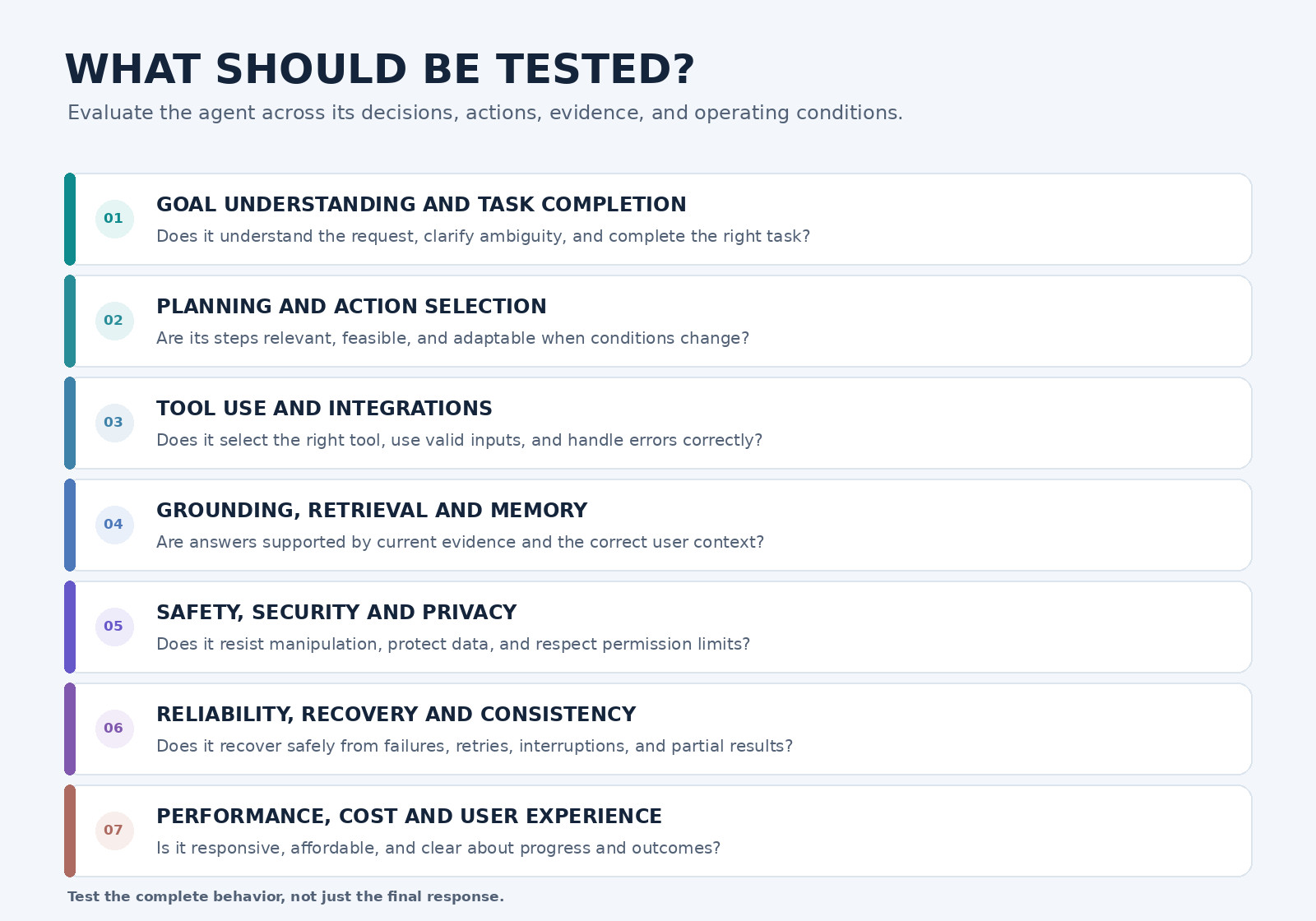
Testing of agentic AI should span the entire path from understanding a request to completing an action. The tests should evaluate the agent’s reasoning, tool use, handling of uncertainty, and response to failure. The areas below offer a useful framework for evaluating these behaviors.
Goal Understanding and Task Completion
Let’s start with realistic user goals, like vague or incomplete requests. Verify that the agent understands the purpose of the answer and can separate the necessary information from the nice-to-know information. When furthering the conversation would entail guessing on an important decision, it should ask for a brief follow-up. Assess successful completion against an explicit rubric rather than a fluent final answer.
For example, a travel assistant asked to “move my meeting and book something close by” must determine which meeting, what date or time constraints exist, and whether booking is authorized. A test should check that it doesn’t choose between multiple meetings without saying anything, or make a purchase based on an unspoken preference. Good evaluation includes both the quality of the clarification and the eventual task result.
Planning and Action Selection
Evaluate whether the agent chooses relevant steps, ignores irrelevant steps, and adjusts to changing circumstances. Check for other ways to get to the same answer, including if a favorite tool isn’t available. If the agent has a plan-and-execute structure, test whether its plan is feasible and whether it revises the plan when a tool returns new information.
Tool Use and Integrations
Check correct selection of each tool, valid arguments, error handling, and result interpretation. Malformed responses, empty results, stale data, rate limits, permission denial, timeout, duplicate submission, etc. Verify that an agent doesn’t think that a tool error is a successful action, or invent information that wasn’t returned. When retrieval and tool access are combined, the roles of RAG, agentic RAG, and MCP should be evaluated separately.
A tool should have the least privileges for its role. Tests should include allowed behavior and denial of out-of-scope requests. Train a support agent to look up an order and issue refunds up to a certain limit. Ensure that the support agent cannot access unrelated customer records or override the refund approval rule. These are model behavior tests as much as application security tests. Similar checks apply to agents that interact with enterprise systems such as ERP; see Testing Agentic AI in ERP.
Grounding, Retrieval, and Memory
Ensure the agent indicates when it lacks evidence, has conflicting or outdated documents, and that its answers are backed by the correct sources when it leverages enterprise documents or search. Evaluate retrieval quality irrespective of response quality. A correct answer to a question based on an irrelevant document is a failure, even if it is correct by coincidence. RAG and AI agents can both use retrieved information, though an agent may also plan and take actions.
- How long is it available?
- Is it linked to the correct user or session?
- How can users correct or delete it?
Test that one user’s private information does not affect the response of another user. Also consider the effect of stale memories and conflicting instructions. A reliable agent should not treat recalled context as gospel truth.
Safety, Security, and Privacy
Test direct and indirect prompt injection, malicious content in retrieved documents, attempts to override system instructions, unsafe tool parameters, sensitive data exposure, and privilege escalation.
- Ask the agent to reveal credentials or private data it should not access.
- Place conflicting instructions in a retrieved page, email, or attachment and check which instructions the agent follows.
- Request an action outside the user’s permissions, such as refunding an ineligible order.
- Simulate a tool response that contains malicious instructions or misleading data.
- Verify that the agent pauses for approval before an irreversible or high-impact action.
- Evaluate whether the agent can be manipulated into taking an action by instructions embedded in an email, webpage, document, or tool output.
- Include attempts to make it reveal secrets, execute unauthorized operations, or bypass human approval.
Security testing should include the entire pipeline from user input through the model and tools to downstream systems. If the API itself allows an unauthorized operation, a prompt-level denial is not sufficient. Conversely, a secure tool may still be a target of abuse or contain sensitive data in its logs.
OWASP’s LLM application guidance lists excessive agency as a risk category; the practical lesson is to constrain tool access and test those constraints under adversarial conditions. The NIST Generative AI Profile offers a risk-management lens for teams to organize their identification, measurement, and response activities. NIST banking systems provide a practical example of how agentic AI guardrails create testing challenges.
Reliability, Recovery, and Consistency
Agents have to deal with incomplete, changing, and failed conditions. Test service outages, retries, duplicate events, interrupted conversations, expired credentials, and partial completion. If an agent modifies an external system, test rollback or compensation behavior; then the system must clearly differentiate between “completed,” “partially completed,” and “unable to complete.”
Since model outputs can vary, run repeated evaluations on important cases and track distributions instead of only one pass/fail result. A task that succeeds 19 out of 20 times might still be unacceptable if the one failure causes a duplicate payment. Set thresholds based on impact and risk, and consider worst-case outcomes along with averages. Reproducibility is improved if teams capture model versions, prompts, tool specifications, test data, and relevant runtime settings.
Performance, Cost, and User Experience
Measure end-to-end latency, response time at each tool boundary, token or compute consumption, and cost per successful task completion. Long agent loops may look correct, but they may be too slow or expensive for production. Test realistic load and concurrency, including contention for shared services. Set reasonable limits on retries, loops, and delegated work.
Designing an Evaluation Set
- User goal: What the person wants to accomplish.
- Starting context: Account state, available data, and relevant conversation history.
- Allowed actions: Tools and records the agent may use.
- Expected outcome: The required business result and explanation.
- Failure conditions: Actions the agent must avoid, or situations that require a pause or escalation.
- Evidence: Outputs, tool calls, state changes, and approvals to inspect.
Keep tuning prompts out of release evaluations. Maintain a regression set, add new cases when failures occur, and use a separate holdout set for release decisions. Have experts review high-risk cases. Use deterministic checks for tool calls and system state, semantic graders for response quality, and human review for ambiguous or high-risk cases. Track grader disagreements; don’t rely on one score alone. Teams can select different evaluation methods for agentic AI based on the behavior and risk being assessed.
For example, for an ineligible refund, verify that the agent selects the right order, explains the policy, and does not issue the refund. For an eligible refund above its approval limit, verify that it requests approval. Capture the request, evidence, tool activity, approvals, and final state. Protect traces and limit retention.
Using Testing Agents to Test Software
Quality teams can use agents at multiple stages of the software testing lifecycle. A requirements agent can identify ambiguity, missing acceptance criteria, and conflicting rules. This use of agents across testing activities is often called agentic QA. A test design agent can propose scenarios from user stories, API contracts, risk models, or production incidents. A test execution agent can interact with a browser or desktop application, capture evidence, and report the observed result. An analysis agent can group failures and suggest likely causes. A maintenance agent can recommend locator or test updates when the interface changes.
These capabilities are most valuable when integrated into a controlled workflow. The agent should receive approved specifications and test environments, use test data safely, and produce artifacts that a human can inspect. Generated tests should be reviewed for meaningful assertions, independence, data cleanup, and coverage of negative paths. Execution results should link to logs, screenshots, traces, and environment details. A test that passes without clear evidence should not be treated as trustworthy.
How testRigor Supports Agent-Assisted Testing
testRigor can support test design and execution in an agent-assisted quality workflow. Teams can describe end-to-end scenarios in plain English or use Generative AI to draft test steps from a requirement. Testers can then review the steps, add checks for business rules, and run them against the application while collecting execution evidence. This keeps tests readable across QA, product, and domain teams while leaving acceptance decisions with the people who own the requirements.
For example, a team testing a customer-support assistant could verify that it returns the correct order status and does not expose another customer’s information. testRigor can help automate checks of user-facing AI features, including chatbot interactions and AI-generated summaries. These tests complement separate evaluations of the agent’s tool permissions, orchestration, and policy enforcement.
Common Failure Patterns
- Scoring only the final answer: inspect tool calls and system state as well as the response.
- Trusting one automated grader: calibrate it against deterministic checks and human-reviewed cases.
- Leaving broad permissions in place: define the agent’s allowed actions and verify denials with negative tests.
- Testing only easy prompts: include incomplete, contradictory, and adversarial requests.
- Launching without clear ownership: assign responsibility for policy, escalation, incidents, and rollback.
A Practical Implementation Roadmap
Start with one bounded workflow that has a clear outcome and manageable risk. Establish the baseline, define safeguards, and expand only after the workflow meets its release criteria.
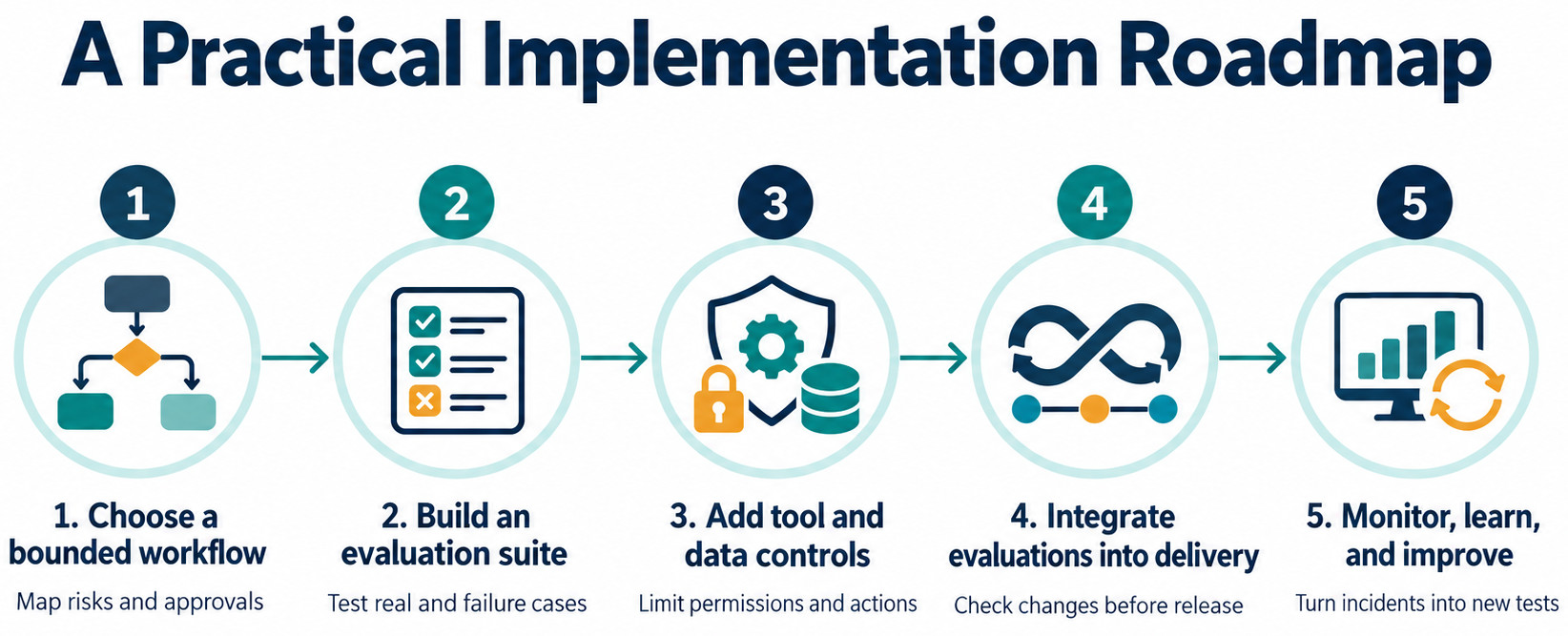
- Choose a pilot: Map the user journey, systems, data, risks, and approval points. Start with read-only support tasks before enabling refunds or account changes.
- Build a small evaluation suite: Cover success, clarification, tool failure, permission denial, adversarial input, and partial completion. Define scoring, evidence, and release thresholds.
- Control tools and data: Apply least-privilege access, input validation, rate limits, bounded retries, audit logs, and approval for high-impact actions. Test these controls.
- Add evaluations to delivery: Run regression checks when prompts, models, tools, data, or orchestration change. Run broader end-to-end and adversarial checks before release.
- Monitor and improve: Track reliability, safety, performance, cost, and user experience. Review incidents, turn verified failures into tests, and reassess when the workflow or system changes.
When defining the agent’s boundaries, consider the distinction between AI agency and autonomy.
Roles and Operating Model
- Product owners: Define acceptable outcomes and user expectations.
- Domain experts: Identify business rules and exceptions.
- Engineering and data teams: Instrument the agent, tools, and data flows.
- Security, legal, and privacy teams: Assess risks, permissions, and data handling.
- Quality engineers: Design evaluations, challenge assumptions, and connect results to release decisions.
- Operations teams: Monitor behavior and coordinate incident response.
Quality engineering also establishes the evaluation framework, keeps evidence traceable, and links technical results to business risk. Teams need skills in prompt and model evaluation, security, data quality, observability, and workflow analysis, alongside established testing skills.
Measuring Success
- Task quality: Completion within defined constraints, correct tool selection, grounded responses, and evaluation coverage for critical workflows.
- Risk: Unauthorized action rate, escalation quality, and recovery from tool failures.
- Efficiency and experience: Latency and cost per completed task.
Interpret measures together. Faster completion is not an improvement if it increases risky errors. Review trends regularly and investigate changes that could affect users or business outcomes.
The Future of Agentic AI Testing
As agents use more tools and coordinate across applications, testing must cover interactions among agents, services, users, and policies. Continuous evaluation, production feedback, deterministic checks, and independent review help teams find failures while maintaining control.
Agentic AI makes disciplined software quality more important. Combining conventional testing with model and workflow evaluations, adversarial testing, monitoring, and human oversight helps teams assess what agents do, which actions they can take, and how they recover from failures.
Frequently Asked Questions (FAQs)
- How can teams test an agent that supports multiple languages?
Evaluate each language for intent recognition, response quality, retrieval accuracy, tool use, and policy compliance. Include fluent speakers in reviews, especially for culturally sensitive or high-impact scenarios.
- How can teams protect customer information in agentic AI test data?
Use synthetic or masked data in controlled test environments, and limit access to test records. Define how long test data and execution traces are retained, and remove sensitive details that are not needed for evaluation.
- How should teams test an agent when a third-party tool provides limited logs?
Add monitoring around the integration boundary to record requests, responses, timing, and resulting system state. Exclude sensitive information that is not needed to diagnose failures.
| Achieve More Than 90% Test Automation | |
| Step by Step Walkthroughs and Help | |
| 14 Day Free Trial, Cancel Anytime |