What is V-Model?
 |
The V-model is a popular and widely adopted structure approach in software engineering. It follows a systematic and well-articulated process for building high-quality software. It offers a holistic view of the software development lifecycle (SDLC), combining requirements gathering, design, implementation, testing, and maintenance.
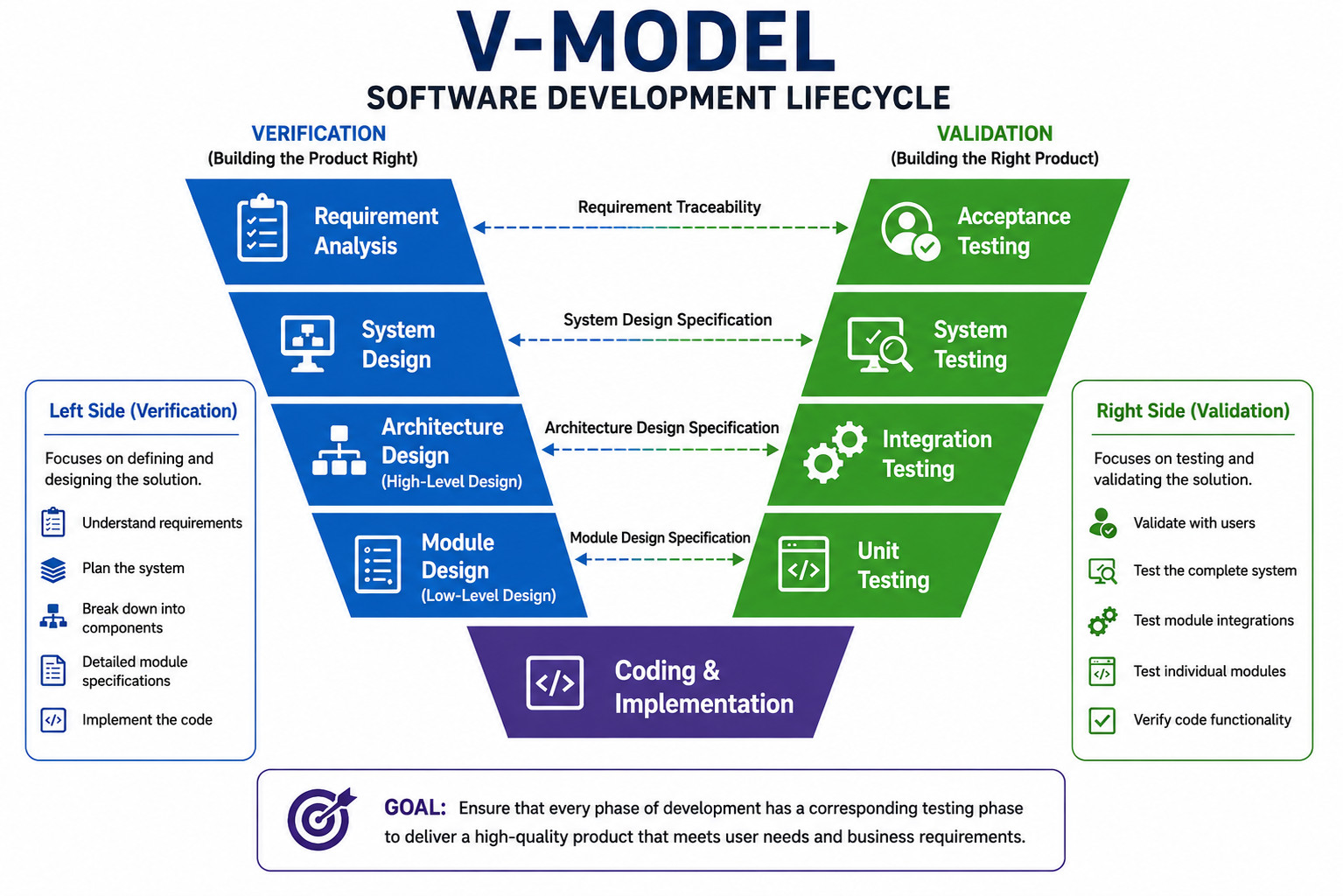
The V-model gets its name from its shape. It resembles the letter “V”. In this model, we segregate the software development life cycle into stages, and each stage is related to a corresponding testing phase.
The left side of the V stands for the verification phase, while the right-hand side stands for the validation phase. Verification checks that the product is developed correctly as per the requirements. Validation checks that the product meets user needs and expectations.
Read: Verification and Validation in Software Testing: Key Differences.
| Key Takeaways: |
|---|
|
When to Use V-Model in Software Engineering
V-models are suitable for scenarios wherein the requirements and the understanding of the software’s features are well-explained from the start. The V-model presumes stable requirements and discourages iteration. Thus, the V-model is good for cases where the project scope is clear, and the development team has a good understanding of the requirements.
The V-model is useful when working with bigger teams where communication and coordination between developers and testers becomes challenging. By clearly specifying the testing requirements for each stage of the development process, the V-model makes sure that all team members are working toward a shared understanding of the project’s goals.
Understanding the V-Model with a Simple Example
Say a company wants to build an online banking application.
Before anyone writes code, several questions need to be answered:
- What should users be able to do?
- How should account information be stored?
- What security rules exist?
- What happens if transactions fail?
These discussions create requirements and designs. The V-Model then makes sure that every one of those decisions eventually gets tested.
If account security requirements are defined during planning, corresponding tests are also prepared early. If the system architecture is designed, system testing eventually validates that architecture.
The result is a process where development and testing stay connected instead of existing as separate activities.
Read: Test Cases for a Banking Web Application.
Left Side of the V-Model and Software Engineering
The left side of the V-Model focuses on requirement definition, system planning, and design activities. The primary objective during this phase is to establish a structured blueprint before implementation begins. Each stage progressively transforms business requirements into technical specifications that developers can implement and testers can later validate.
Unlike iterative development methods, where requirements may change continuously, the V-Model underscores detailed analysis and documentation at the beginning of the project lifecycle. This brings down ambiguity and makes sure of clear traceability between requirements and testing outcomes.
Requirement Analysis
Requirement analysis builds the foundation of the development process. During this phase, stakeholders, business analysts, developers, and project managers work together to identify functional and non-functional requirements.
The activities typically performed include:
- Defining business objectives
- Identifying user requirements
- Gathering system constraints
- Documenting performance and security expectations
- Establishing acceptance criteria
The output of this phase is generally a Software Requirement Specification (SRS) document. This document works as a reference throughout the project lifecycle and becomes the basis for acceptance testing later in the process.
Read: Software Requirements Guide: BRS vs. SRS vs. FRS.
System Design
Once requirements are finalized, the next stage focuses on system-level architecture and design decisions. The goal of system design is to define how different components of the application will interact and operate together.
Typical considerations include:
- Overall system architecture
- Technology stack selection
- Database design
- Infrastructure planning
- External system dependencies
Design decisions made during this stage directly influence future system testing activities.
Architecture Design (High-Level Design)
The architecture design disintegrates the app into logical modules and defines interactions among them. Rather than focusing on implementation details, this phase provides a broader view of the software structure and module relationships.
Common results of this stage include:
- Component diagrams
- Data flow diagrams
- API interaction definitions
- Module communication specifications
This stage works as the base for integration testing because it defines how different modules are expected to communicate.
Module Design (Low-level Design)
Module design converts high-level architectural components into detailed technical specifications that developers can implement directly.
This stage includes information such as:
- Class definitions
- Database schemas
- Algorithms
- Function-level logic
- Data structures
Module design provides developers with implementation-level guidance and establishes the basis for unit testing activities.
Coding and Implementation
Coding represents the implementation stage of the V-Model and forms the bottom point of the V structure. During this phase, developers convert design specifications into executable code while following predefined standards and technical guidelines.
Because requirements and designs have already been documented extensively, development activities become more structured and predictable. The completed source code then progresses to the testing stages on the right side of the V.
Right Side of the V-Model and Software Testing
The right side of the V-Model concentrates on verification and validation activities. Each testing phase is linked directly to a development stage on the left side of the V. The purpose of this relationship is to ensure that every requirement and design decision defined earlier in the lifecycle is validated systematically.
Rather than treating testing as an isolated post-development activity, the V-Model integrates quality assurance into the full software development process.
Unit Testing
Unit testing is the first testing activity performed after implementation. This phase checks individual components or units of source code independently to ensure they work as per the design specifications.
Unit tests commonly verify:
- Function outputs
- Business logic
- Conditional behavior
- Error handling mechanisms
- Boundary conditions
For example, if a function calculates transaction charges, unit testing verifies that valid and invalid inputs produce expected outputs. The main goal is to catch defects at the code level before components are integrated.
Integration Testing
Once individual modules have been validated, integration testing evaluates interactions between system components. Independent modules may perform correctly in isolation but fail when exchanging data or communicating with external services.
Integration testing generally focuses on:
- API communication
- Data transfer validation
- Interface compatibility
- Database interaction
- Service dependencies
The goal is to detect issues that emerge from interactions between connected components.
System Testing
System testing verifies the complete app as an integrated system. Instead of testing individual modules, this phase evaluates whether the software satisfies functional and technical requirements defined during system design.
Areas commonly examined include:
- Functional behavior
- Performance
- Security
- Reliability
- Scalability
- Recovery mechanisms
System testing validates that all components work correctly under expected conditions.
Acceptance Testing
Acceptance testing represents the final validation stage before deployment. This phase confirms whether the delivered system satisfies business objectives and user expectations. Acceptance testing is often executed by stakeholders, clients, or end users and focuses on real-world usage scenarios.
Typical validation areas include:
- Business workflow execution
- User requirements
- Compliance requirements
- Operational readiness
Successful completion of acceptance testing indicates that the software is ready for production deployment and aligns with the original project requirements.
When are Teams Happy with V-Model?
The predictability of the V-Model is one of the main reasons why people appreciate it. Projects with fixed requirements often benefit from having a clearly defined procedure. Everyone is clear on what comes next. Documentation tends to be more robust. Testing is initiated earlier, and risk is easier to manage.
Imagine developing software for an airplane navigation system. You wouldn’t want developers experimenting halfway through the project, and suddenly, requirements start changing every week.
There’s a need for a controlled environment, traceability, and clear verification protocols. This is exactly what the V-Model offers. Defect detection is another major benefit of this model.
Finding a problem during requirement analysis is significantly cheaper than discovering it after deployment. A requirement issue found in week one might take mere minutes to correct. However, the same issue caught after release may need to be redesigned in entire sections of software.
Where the V-Model Starts Struggling
Despite its obvious benefits, the V-Model is not perfect. The biggest con is flexibility. Modern software projects change regularly. Users request new features, market conditions shift, and business priorities evolve. The V-Model does not adapt easily to those situations.
Say, your team is developing a social media application.
A prototype is launched, and users suddenly request new capabilities every week. Under the V-Model, frequent changes can become difficult because so much planning and documentation already exists. Agile methods are more adept at handling such situations.
Feedback timing is another challenge with the V-Model.
In most cases, users interact with the product at a relatively later phase in development. That delay can lead to situations where software may technically meet requirements but still fail user expectations.
Read: What is Agile Software Development?
Comparison Against Popular Models
| Parameter | V-Model | Waterfall Model | Agile Model | Spiral Model | Iterative Model |
|---|---|---|---|---|---|
| Development approach | Sequential with mapped testing phases | Linear sequential process | Incremental and iterative | Risk-driven iterative process | Repetitive development cycles |
| Requirement handling | Requires stable and clearly defined requirements | Assumes fixed requirements | Supports changing requirements | Allows evolving requirements | Supports requirement refinement |
| Testing strategy | Testing activities are planned from the early stages | Testing occurs after the development phases | Continuous testing throughout iterations | Testing is integrated into each cycle | Testing repeated across iterations |
| Customer involvement | Limited after the requirements phase | Minimal involvement | High customer participation | Moderate to high involvement | Moderate involvement |
| Documentation level | High | High | Relatively lighter | Moderate to high | Moderate |
| Change management | Low flexibility | Low flexibility | Highly adaptable | Adaptable based on risk assessment | Moderately adaptable |
| Risk management | Moderate | Limited | Moderate | Strong risk analysis capability | Moderate |
| Delivery pattern | Single release cycle | Single release cycle | Multiple incremental releases | Multiple controlled releases | Incremental releases |
| Defect detection | Early due to planned verification activities | Often discovered later in the lifecycle | Continuous detection during development | Risk-focused detection | Identified during repeated cycles |
| Best suited for | Safety-critical and regulated systems | Small projects with fixed scope | Dynamic products and evolving requirements | Large, high-risk projects | Projects requiring progressive enhancement |
Read: Testing Methodologies Uncovered: Propel Your QA Forward.
Is the V-Model Still Relevant Today?
Some people think that the V-Model disappeared after Agile became popular. That isn’t really true. Many industries continue using it extensively. Healthcare systems often depend on structured testing and documentation requirements. Automotive software follows strict safety standards. Defense and aerospace projects repeatedly need detailed verification processes.
In environments where failure carries serious consequences, structured approaches still have significant value. The V-Model simply serves a different purpose than fast-moving development methodologies.
Conclusion
The V-Model may look inflexible at first, but its core idea is actually simple: think about testing before problems happen. Rather than treating quality assurance as a final step, the V-Model places QA into every stage of development.
That approach may feel slower compared to modern iterative methods, but for many projects, speed is not the primary concern.
Reliability is.
For software engineers, understanding the V-Model is useful not only for interviews or exams but also for understanding how different teams consider quality and risk management.
Even if you finally spend most of your career working with Agile frameworks, the lessons behind the V-Model remain valuable. Good software isn’t just about writing code.
It’s about making sure the right software gets developed in the right way.
FAQs
What is the main purpose of the V-Model in software engineering?
A: The main goal of the V-Model is to establish a direct relationship between development activities and testing activities. It ensures that verification and validation are planned from the beginning of the project lifecycle rather than being treated as separate phases.
Why is testing considered a major strength of the V-Model?
A: Testing is integrated into every stage of development. Since test planning begins early, teams can identify defects and requirement gaps before implementation reaches advanced stages.
What is the difference between verification and validation in the V-Model?
A: Verification checks whether the software is being developed according to defined specifications and design documents. Validation checks whether the delivered software satisfies user expectations and business requirements.
| Achieve More Than 90% Test Automation | |
| Step by Step Walkthroughs and Help | |
| 14 Day Free Trial, Cancel Anytime |