Why AI Testing Tools Fail in Enterprises: Key Challenges
 |
The world of software testing has been swiftly changing with Artificial Intelligence. From self-healing scripts to natural language test creation, AI testing tools offer up a possible future in which manual effort is minimized, maximum coverage is achieved, and quality lowers the burden of reactiveness in favor of predictive metrics. On paper, it sounds like a dream.
But in the real world, especially within large organizations that depend on these tools, the picture is much different.
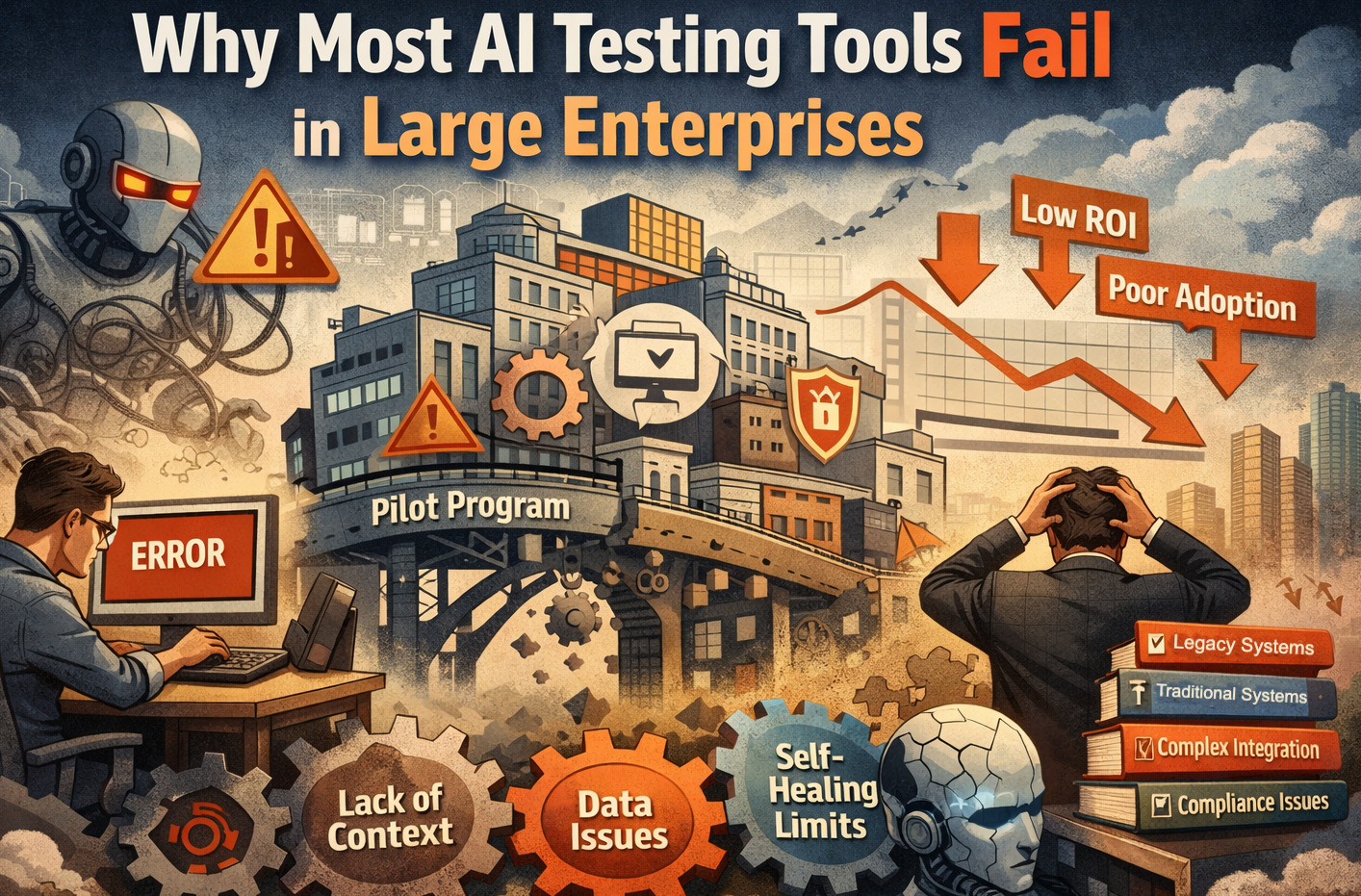
Despite the big investments, companies have a hard time unlocking the promised value from their AI testing tools. Pilot programs stall. Adoption plateaus. ROI becomes questionable. And then teams return to classic ways or hybrid working.
Leaders start asking a tough question: “Why isn’t this working?”
Let’s look at the real reasons why nearly all AI testing tools fail in large enterprises (and we don’t look at this from a theoretical standpoint but rather through practical, organizational, and technical realities). More importantly, it exposes systemic issues that extend beyond the tools themselves.
| Key Takeaways: |
|---|
|
The Promise of AI in Testing
In the software testing space, Artificial Intelligence has been quite a buzzword with great promises to change how quality assurance will be done on a large scale. Organizations recognize that AI is a game-changing technology for enabling testing faster, smarter, and more optimized.
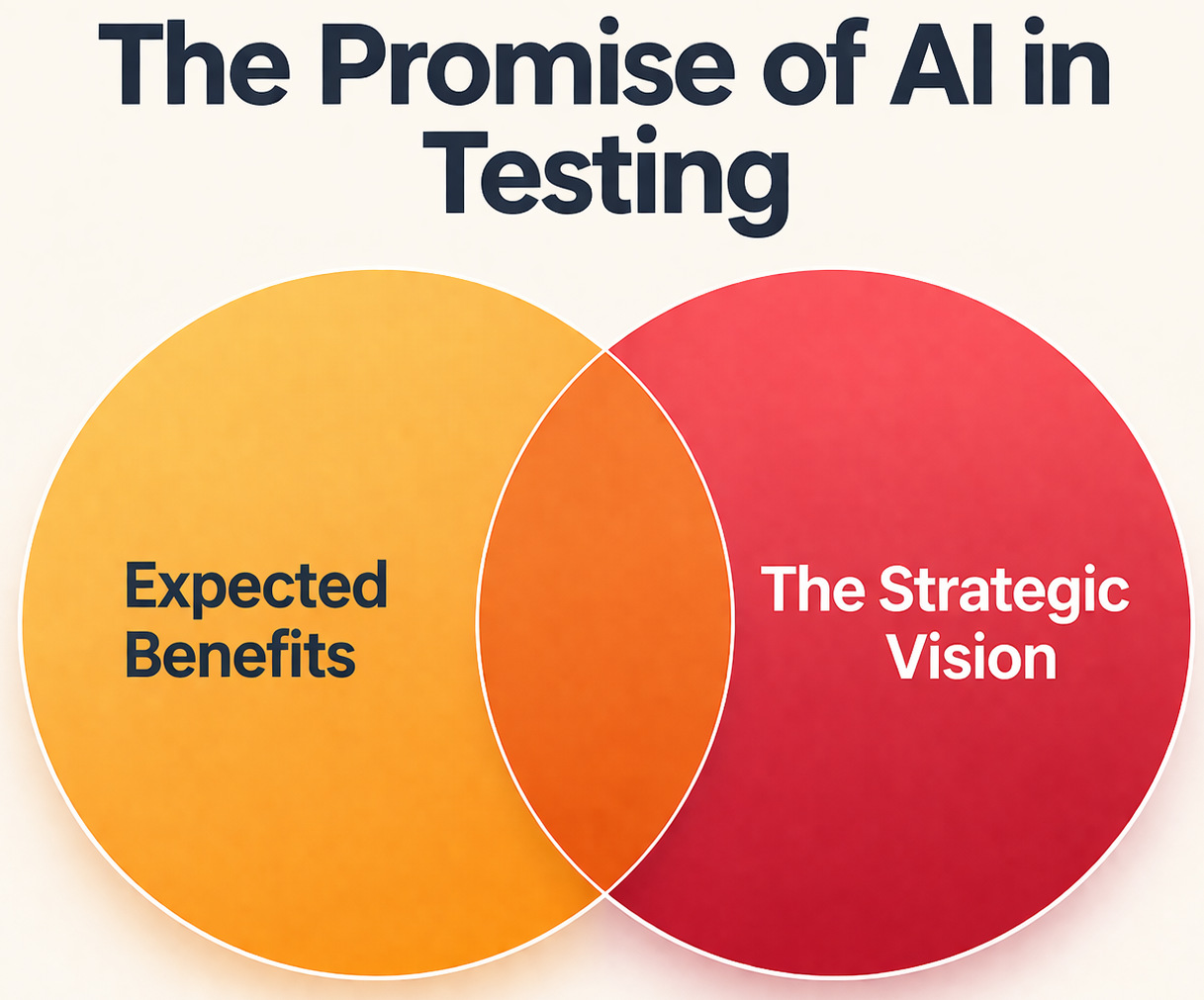
Expected Benefits
There are several expectations that large organizations have with regard to the adoption of AI testing tools. But these expectations are often driven by the need for improved efficiency, containment of costs, and growing software complexity. Moreover, the pressure to increase the speed of release cycles without compromising on quality is making enterprises take a step towards adopting AI.
- AI is going to help drastically cut down on manual testing effort by automating some of the repeatable and time-consuming validation tasks.
- Its goal is to speed up regression cycles by smartly picking and executing only the most relevant test cases.
- Organizations expect intelligent test generation to mean that AI will continue to create meaningful test scenarios from the behavior of the application.
- Building automation with self-healing capabilities should reduce maintenance effort by avoiding test failures due to changes in UI.
- AI models are also expected to optimize defect prediction by utilizing historical data patterns to highlight high-risk areas.
- Another significant expectation is reduced management expenses, since AI tools promise to decrease the effort needed to update and maintain testing scripts.
- Lastly, enterprises await the democratization of testing to empower non-technical users to author and run tests with natural language or simplified interfaces.
Read: All-Inclusive Guide to Test Case Creation in testRigor.
The Strategic Vision
- AI is viewed as a means to scale QA capabilities without proportionally scaling headcount, allowing teams to do more with less.
- This is seen as a fix for flaky automation and to make tests more reliable and restore confidence in what is automated.
- For leaders, AI can also be a means to match up with fast development cycles, particularly in Agile and DevOps environments.
- Furthermore, the way companies perceive AI testing is as a competitive advantage that allows them to ship better software at faster speeds than their competitors.
Read: Testing Prompt Robustness Against User Variations.
The Enterprise Reality Check
- Multiple legacy systems (often decades old)
- Highly customized workflows
- Complex integrations across dozens of services
- Strict compliance and regulatory requirements
- Distributed teams across geographies
- Massive data volumes and variability
- Frequent UI and backend changes
Read: Can You Trust an AI That Can’t Explain Its Decisions? A Guide to Explainable AI Testing.
Enterprise Test Automation Challenges
The reality is that while AI testing tools offer huge ROI, their value (other than being effective) decreases rapidly when heading into the complex world of enterprise. What works in controlled or mid-size systems tends to fail under the scale, diversity, and constraints of large organizations. Consequently, there is a growing chasm between the perceived state and reality.
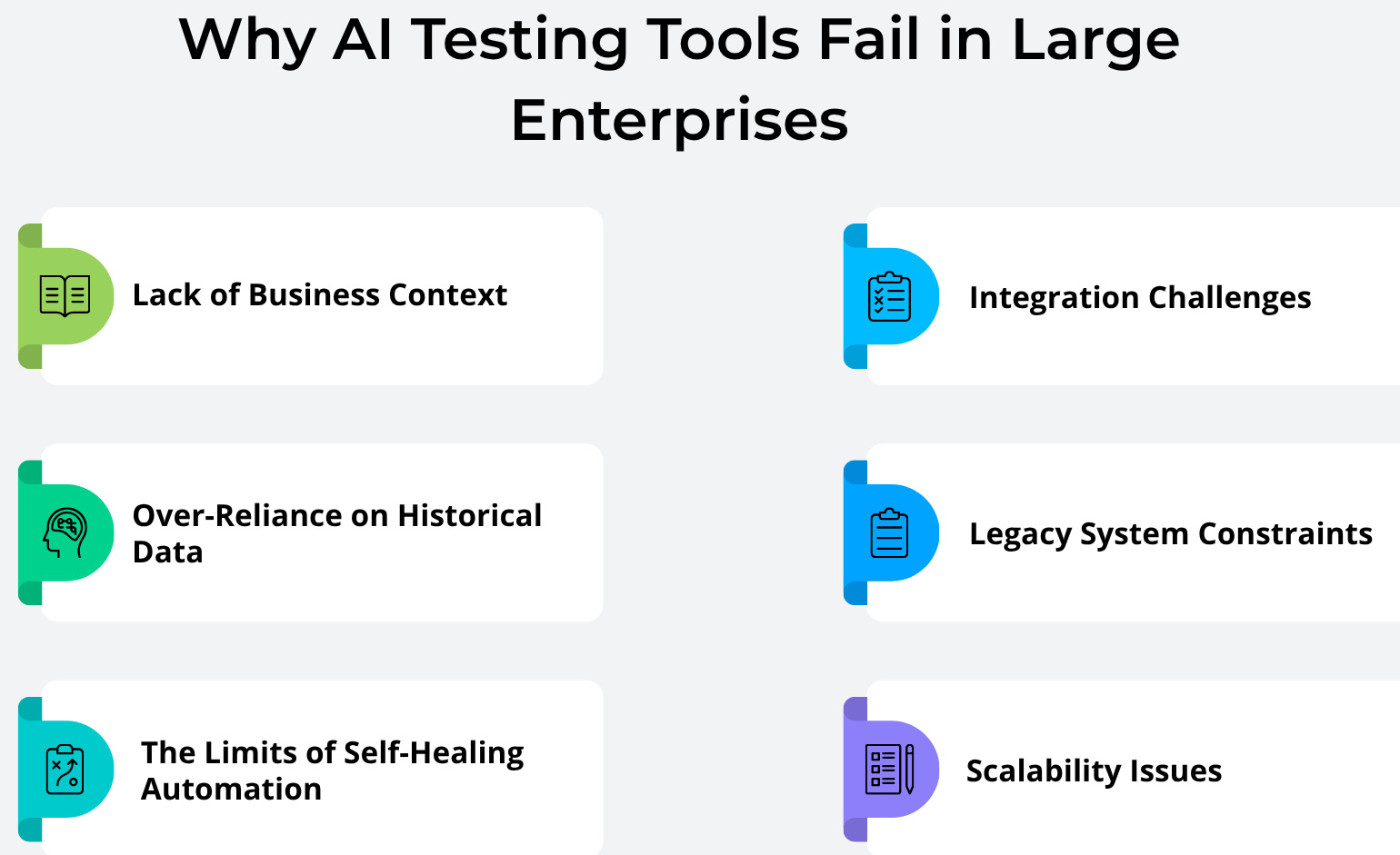
Lack of Business Context
The AI tools are very good at recognizing patterns and confirming workflows, but they have little idea of what the company’s intent is, nor the domain-specific logic. In enterprise systems, correctness is based not simply on execution but also on compliance with complicated business rules and policies.
Example: In a banking application, an AI tool may confirm that a loan application process completes successfully, but fails to verify whether credit risk rules or regulatory compliance checks were correctly applied.
Read: Trusting AI Test Automation: Where to Draw the Line
Over-Reliance on Historical Data
The AI models rely significantly on historical data, which might not depict the real-time scenario of fast-paced, dynamic enterprise systems. This dependence can result in stale insights, which means AI focuses more on redundant scenarios while missing out on newer threats.
Example: If a new payment feature is introduced, the AI might continue focusing on older transaction flows, missing critical defects in the newly added functionality.
Read: Garbage In, Disaster Out: Data Validation for AI Models.
The Limits of Self-Healing Automation
In enterprise settings, self-healing automation can be implemented to automatically adapt tests when changes take place. However, this may prevent real defects from being identified. The solution is that AI may enable humans to find disguised errors.
Example: If a critical “Submit” button is unintentionally renamed due to a bug, the AI might update the locator and pass the test, even though the change was not intended.
Read: Self-healing Tests.
Integration Challenges
Even with multiple tools and pipelines at your disposal, integrating enterprise testing ecosystems remains a challenge. Many AI testing solutions struggle to fit within these complicated environments. If the integration capabilities are limited, it only takes more time and creates disruptions instead of making things easier.
Example: A team using a custom CI/CD pipeline may find that the AI testing tool requires manual triggers or workarounds, breaking the automation flow and slowing down releases.
Legacy System Constraints
Legacy technologies often found in enterprise systems are not compatible with AI testing tools, which have largely been designed for web and API-based applications. This leads to gaps in automation, and teams are forced to get back to hybrid testing models.
Example: A company using a mainframe-based order processing system may not be able to automate tests effectively with AI tools that only support modern web interfaces.
Read: Mainframe Testing.
Scalability Issues
Most AI testing tools work fine in sandbox mode, but when an attempt is made to move to production level, they fall flat on their faces. Complexity increases, potentially degrading performance, accuracy, and cost efficiency.
Example: A test suite that runs smoothly with 100 test cases may become slow and generate irrelevant insights when expanded to thousands of interconnected scenarios across multiple environments.
Read more: Test Scalability.
A Realistic Approach to Enterprise AI Testing
When appropriately applied, AI testing tools can provide significant value in an enterprise setting, even if they face heavy criticism for a variety of reasons. The solution is to take a layer of realism instead of hoping that the AI is programmed optimally in every world situation.
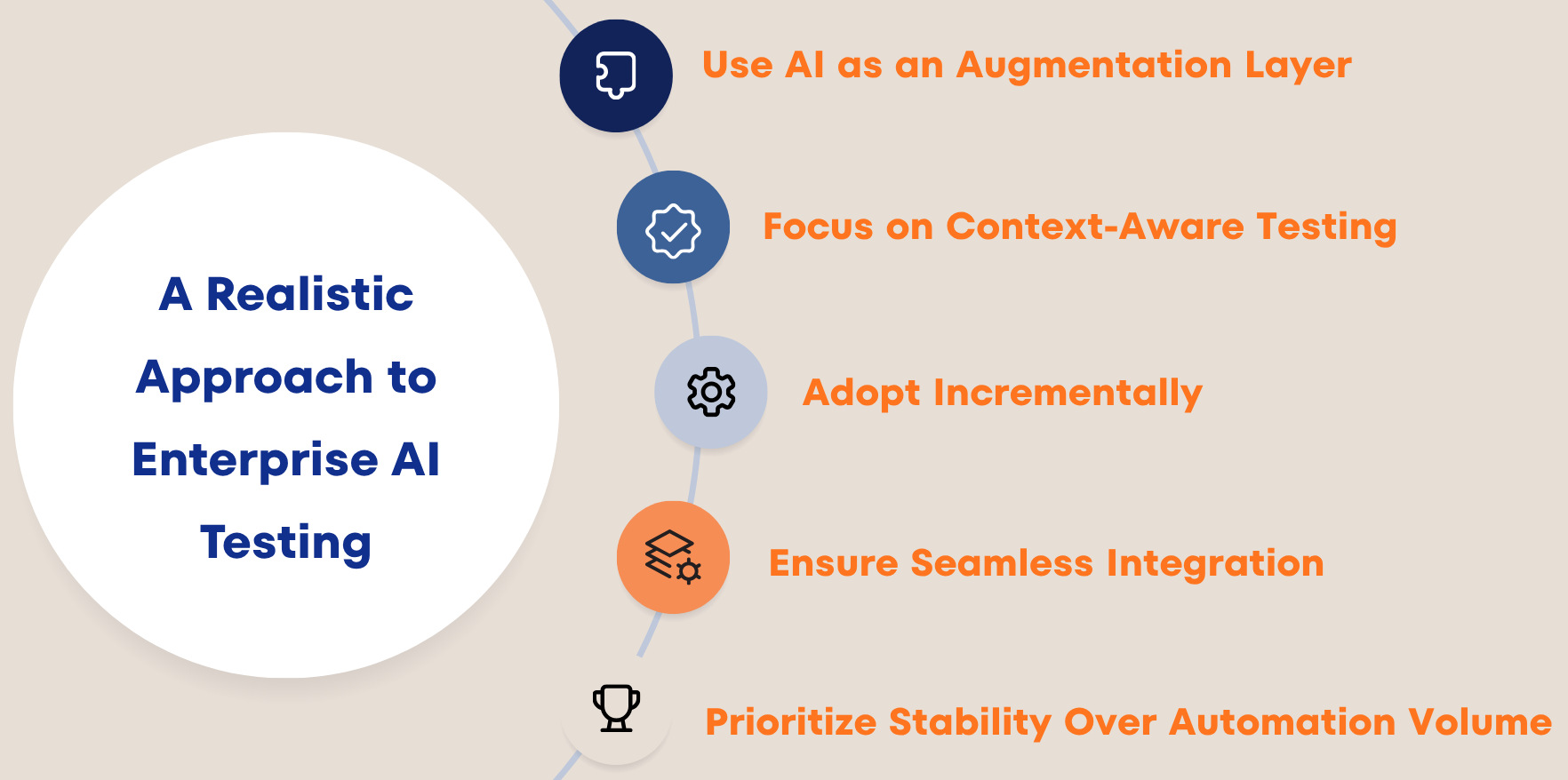
- Use AI as an Augmentation Layer: AI needed to be framed as a supplement to, rather than a replacement for, human testers. Human intervention is still required for interpreting results, validating business logic, and deciding what to test. Read: How to Keep Human In The Loop (HITL) During Gen AI Testing?
- Focus on Context-Aware Testing: Creative and practical test implementations for AI combine business rules, domain knowledge, and contextual understanding to design and run the tests. Without this context, even the most advanced AI models can generate technically correct results, but functionally irrelevant ones. Read: Testing AI Tone, Empathy, and Context Awareness.
- Adopt Incrementally: When organizations begin with targeted use cases and avoid going for all-in AI adoption, they’re able to make better progress. An incremental approach gives teams the opportunity to learn, react, and improve as they develop based on real feedback and actual results.
- Ensure Seamless Integration: AI testing tools must integrate seamlessly with existing enterprise systems, such as CI/CD pipelines, test management platforms, and monitoring tools. Weak integration can break workflows and introduce frictions back, diminishing the very purpose of bringing in that solution.
- Prioritize Stability Over Automation Volume: The goal of AI-based testing should be to produce stable, reliable, and maintainable test suites rather than to maximize the number of automated tests. It can undermine trust and create additional overhead with the maintenance of your AI solution, completely subverting the intention of bringing in expanded AI automation to begin with.
The Future of AI Testing in Enterprise Environments
Enterprise AI testing is not a failed concept, but one that’s been slow to mature as organizations have valuable work experience in the real world. The latest iteration of these tools is merely the beginning of an evolution that will change how quality engineering works at scale.
This is a paradigm shift from legacy test automation to intelligent systems. Rather than simply running scripts, AI allows systems to discern patterns, detect anomalies, and focus validation activities where risk is greatest.
Simultaneously, enterprises are expecting more contextual, transparent, and integrated solutions that fit into their multifaceted ecosystems. The future of AI testing will thus be filled with humans and machines working together and supported by adaptive learning systems.
Key Directions for the Future of AI Testing
- Shift from Automation to Intelligence: AI will focus on identifying risks and guiding smarter validation instead of just executing test scripts.
- Context-aware AI Systems: Future tools will incorporate business logic and domain knowledge to ensure tests reflect real-world scenarios.
- Explainable AI: AI systems will provide transparent reasoning behind results to improve trust, debugging, and compliance.
- Deep Enterprise Integration: AI testing will seamlessly integrate with CI/CD, DevOps, and observability systems to enable continuous quality engineering.
- Human-AI collaboration: AI will augment testers by handling repetitive tasks while humans drive strategy and decision-making.
- Continuous Learning Systems: AI will evolve by learning from production data and user behavior to enable proactive and adaptive testing.
Conclusion
AI testing tools have a probability to fail in large enterprises, not because the technology lacks potential, but because the complexity of enterprise environments and expectations around AI are often misunderstood. Success depends on treating AI as an augmentation layer, not a replacement, and aligning it with real-world constraints such as data, systems, and governance.
Organizations that approach AI testing with realistic strategies, incremental adoption, and strong human oversight are far more likely to unlock its true value. Ultimately, the future of enterprise testing lies not in automation alone, but in intelligent collaboration between humans and AI.
Frequently Asked Questions (FAQs)
- What is the biggest misconception about AI testing tools in enterprises?
The biggest misconception is that AI testing tools can fully replace human testers. In reality, they still lack domain understanding, strategic thinking, and contextual judgment, making human oversight essential for meaningful validation.
- Why do AI models struggle with rapidly evolving enterprise systems?
Because most AI models depend on historical patterns, they often fail to adapt quickly to new features, changing business rules, and evolving user behaviors in dynamic environments.
- Can AI testing tools handle compliance-heavy industries effectively?
Only partially. AI can assist in automation, but regulatory validation, audit requirements, and compliance checks still require human expertise and strict governance.
| Achieve More Than 90% Test Automation | |
| Step by Step Walkthroughs and Help | |
| 14 Day Free Trial, Cancel Anytime |