Databricks Test Automation for Apps & AI | testRigor
 |
Databricks is a unified platform for building, deploying, and managing enterprise-grade data, analytics, and AI solutions. It is trusted by OpenAI, Block, Comcast, Condé Nast, Rivian, Shell, and more than 60% of Fortune 500 companies.
This powerful partnership between Databricks and testRigor helps you bring plain-English intelligent test automation into your data and AI application development process, with ease.
With testRigor, test user workflows and AI features, and connect coding assistants through testRigor MCP. Easily let product managers and manual QA contribute directly to test automation. Your acceptance tests become the shared definition of what developers and AI coding agents need to build through ATDD.
You have less automation code to generate, and more people contributing to quality. Therefore, you have clearer requirements before actual development begins, leading to excellent quality of the product.
Test Databricks Apps as Business Workflows
Databricks apps support interactive dashboards, AI chat applications, data-entry tools, and operational interfaces. These applications need testing beyond whether a model returns an answer or a query completes successfully.
These are the questions that need answers during Databricks testing:
Does the dashboard show the right information?
Can a manager approve a request?
Does an AI assistant follow the relevant policy?
When an agent says it updated a record, did the update actually happen?
testRigor supports testing across web interfaces, APIs, AI features, chatbots, and other connected systems, helping you validate the experience around your Databricks-powered application, not just an isolated component.
testRigor works on the user intent and not on the implementation of the app, and this is what makes it actually an intelligent and powerful test automation tool.
For example, your acceptance suite could follow a purchase request from submission through approval, check the resulting status, and confirm that a user without approval permissions cannot complete the same action. Even if some of the responses are from chatbots or AI tools, testRigor helps you test them using its AI context and Vision AI. Here is an example:
check that page "contains a positive message in the chat response" using ai
The goal is to test the actual business outcome, not simply the presence of a button or a plausible AI response.
Connect AI Coding Agents and Test Results with testRigor MCP
How do we check an AI coding agent’s work?
testRigor MCP (Model Context Protocol), which is a customer-facing MCP server, provides a seamless integration with agentic AI tools such as Claude, ChatGPT, and more. This integration allows interaction with testRigor using natural language. So, you can create and update test cases, execute them, retrieve results, and inspect failures directly through AI assistants.
That lets your team move from a loosely defined request such as “build an approval application” to a more useful development instruction:
"Implement the approval workflow, run the approved acceptance tests, and use the failures to correct the application. Do not change the agreed business requirements."
The coding agent handles implementation. testRigor executes the tests and returns evidence about what passed and what failed. Your team remains in control of the acceptance criteria and uses execution results to guide debugging and further changes.
Databricks supports external MCP services. So, it provides a route for bringing third-party tools into agent workflows. You need connections to be configured for the relevant authentication, permissions, and network requirements.
Note: Give your agent an executable target, not just a description of what “done” might look like.
Reduce AI Token Usage with Concise Test Language
When you use AI to generate tests, the representation of the test matters.
A test written as framework-specific code may include imports, locator expressions, function calls, and supporting workflows that can be difficult to understand and manage. testRigor lets your agent describe supported actions directly in plain English. It is as good as a human describing the application as they see it.
For example, here is a login scenario:
enter stored value "username" into "Email"
enter stored value "password" into "Password"
click "Log in"
check that page contains "Dashboard"
click "email icon" using AI
This example assumes the application URL, execution settings, and stored credentials are configured separately. The commands use testRigor’s supported language for entering values, interacting with controls, and checking results. The last command instructs the test to click on the email icon, without defining its location or other implementation details. It is mentioned just as a human would see it on screen.
Reusable rules can make frequently repeated workflows even more concise. Once your team defines and validates a workflow, other tests can invoke it by the reusable rule’s name instead of repeating every underlying step.
For AI-assisted development, that creates an opportunity to spend fewer tokens generating test definitions, supplying them as context, and revising them during subsequent iterations. The savings come from concise language and reuse; MCP provides the connection.
Actual savings depend on the model’s tokenizer, the scenario, and the amount of shared setup and reusable code in the comparison. Test-definition tokens are also only part of total agent usage; prompts, tool results, screenshots, and retries still matter.
The practical objective is straightforward: spend less of your AI budget expressing the test, and more of it building the application.
Test AI Features, NOT Exact String Matching
AI-generated responses are non-deterministic. They do not always use the same words.
Your tests should be able to check whether a response satisfies the requirement without demanding one fixed sentence string.
testRigor includes built-in AI assertions for evaluating meaning, intent, and other complex conditions. You can use them to test AI-generated text, summaries, chat experiences, and visual content without writing a custom model-calling implementation for every assertion.
For example, imagine a controlled test record where ticket 1042 describes a damaged item and a request for a replacement. A test for your AI support assistant could look like this:
enter "Summarize ticket 1042" into "Ask AI"
click "Send"
check that page "contains the item arrived damaged and the customer wants a replacement in the chat response" using ai
Here, the test describes the required meaning rather than insisting on one exact phrasing. The field names and expected facts would be adapted to your application and test data.
You can also build scenarios around follow-up questions, missing information, unsupported requests, prompt variations, and attempts to obtain restricted information. testRigor supports combining these checks with the surrounding user journey, AI features, and API-level validation.
For important amounts, identifiers, permissions, and stored records, pair semantic checks with explicit assertions against known expected results. An answer that sounds right is not sufficient evidence that a business action was performed correctly.
Test what the AI says, and what the application actually does, with testRigor.
Empowers Product Managers and Manual QA to Build Automation
Your product managers understand the intended behavior. Your manual testers know the workflows, exceptions, and failure cases.
They need not have to hand all that knowledge to someone else just to turn it into an automated test.
With testRigor, product managers, manual QA, business analysts, and developers can read and contribute to the same plain-English tests. Manual testers can create and maintain automation without first becoming specialists in a programming-based test framework.
That changes the whole conversation.
Instead of asking a product manager to review a test script, you can ask them to review the business scenario. Instead of leaving manual QA waiting for automation capacity, you can let them help build the regression coverage themselves in plain English.
Existing manual test cases can also provide a starting point: import or bring them into testRigor from test management tools, then review and adapt their steps into executable tests.
testRigor lets you keep the people who understand your customers and involve these experts in defining and validating application behavior.
Build Databricks Apps Test-First with ATDD
Acceptance Test-Driven Development, or ATDD, means agreeing on acceptance tests before implementing the corresponding functionality. Developers, testers, and business stakeholders collaborate on concrete examples of the required behavior.
For a Databricks-powered application, that might mean defining who can access a forecast, how an adjustment should be approved, and what an AI explanation must include before anyone starts building the feature.
testRigor makes those examples accessible as plain-English tests. Because the tests can describe user-visible behavior rather than implementation-specific selectors, your team can draft them before the underlying application code exists.
A Test-First Workflow for Your Team (Databricks + testRigor)
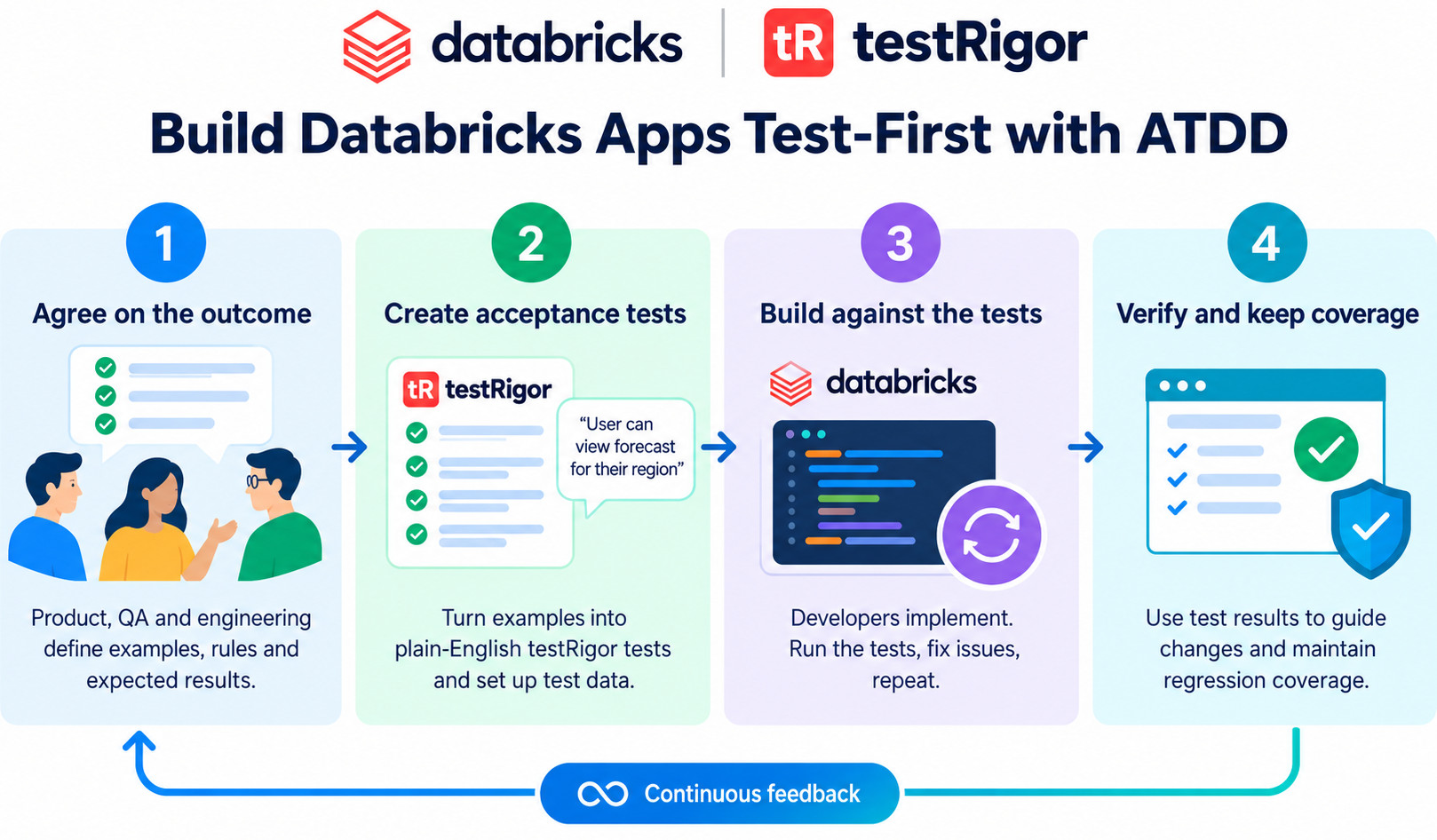
- First, agree on the outcome. Product, QA, and engineering define representative examples, business rules, expected results, and important exceptions.
- Create and review the acceptance tests. Turn those examples into plain-English testRigor tests. Establish the intended interface behavior and controlled test data before implementation details take over the discussion.
- Build against the tests. Developers or coding agents implement the application. As a testable environment becomes available, run the acceptance suite and use the failures to identify missing or incorrect behavior, and rebuild.
- Correct, verify, and retain the coverage. Use testRigor results to guide implementation changes, rerun the tests, and keep the approved scenarios as regression coverage for later releases.
This is the same test-first feedback pattern supported by testRigor’s documented agentic development approach: reviewed acceptance criteria guide implementation, and execution results reveal the remaining gaps.
Keep changes to the acceptance criteria under review. An agent should not make a failing requirement disappear by weakening its test.
The aim is not merely to generate code faster. It is to reduce the work of discovering, explaining, and rebuilding the wrong behavior.
Reduce Costs from Prototype to Production
The potential savings extend beyond AI tokens.
Reduce translation work. Plain-English tests let business stakeholders and technical teams work from the same scenarios instead of maintaining separate descriptions of what should happen.
Reduce duplicated test logic. Reusable rules let common workflows be maintained centrally rather than copied across individual tests.
Move clarification earlier. ATDD gives the team a chance to resolve conflicting expectations before investing in implementation.
Make verification repeatable. testRigor’s command-line capabilities support automated execution and JUnit reporting, allowing acceptance tests to become part of a delivery pipeline rather than a separate end-of-project exercise.
Together, these approaches give your team a practical way to deliver faster: reduce avoidable handoffs and rework while keeping an explicit check on the business outcome.
Build Databricks Apps with Acceptance Tests from Day One
With Databricks and testRigor, bring product, QA, engineering, and AI coding agents together around a shared definition of success.
Use concise, plain-English tests to describe the behavior. Use testRigor MCP to connect your agent to execution results. Make verification part of building the application, from day one, not something you have to catch up on afterward.
Ship reliable Databricks apps and AI workflows faster with testRigor → Request a demo
Frequently Asked Questions (FAQs)
- Can testRigor test Databricks Apps?
testRigor’s web and API testing capabilities can be applied to accessible Databricks-powered application interfaces and services. Tests require the appropriate environment access, test accounts, authentication, and configuration. Databricks Apps supports browser-based experiences such as dashboards, chat applications, and operational tools.
- Does testRigor replace MLflow evaluation?
No. MLflow provides evaluation capabilities such as LLM judges and code-based scorers for models, agents, and applications. testRigor adds business-readable acceptance tests around user interactions and connected workflows. Use them alongside each other to evaluate both AI quality and the wider application experience.
- Can product managers and manual testers create automated tests?
Yes. testRigor lets team members author, review, and update supported test steps in plain English. Existing manual cases can be adapted into automation, while technical team members help with environment setup and integration requirements where needed.
- Can an AI coding assistant run tests and inspect failures through MCP?
Yes. testRigor’s MCP server exposes operations for test execution, results retrieval, and failure inspection, as well as creating and updating test cases. A compatible assistant needs a configured connection and appropriate credentials.
| Achieve More Than 90% Test Automation | |
| Step by Step Walkthroughs and Help | |
| 14 Day Free Trial, Cancel Anytime |