Agentic AI Security and Guardrails: The Complete Guide
 |
When AI was just a text box on a screen, a jailbreak meant getting a chatbot to say something it wasn’t supposed to. Now, we are hooking LLMs up to shell terminals, SQL databases, Slack workspaces, and payment APIs. Today, an agent doesn’t just generate text; it takes action. And because models fundamentally struggle to separate trusted system instructions from untrusted external data, indirect prompt injection and over-permissioned tool calling have turned routine workflows into wide-open attack surfaces.
While this autonomy helps automate complex tasks, it also raises an important question: How do you make sure an AI agent stays within its boundaries?
In an October 2026 study of more than 3,700 senior security and technology decision-makers, ServiceNow reported that 90% of surveyed organizations had experienced an agentic AI security incident in the preceding year.
And we know a chain of security incidents happened in October 2026; it was called “Black October” for cybersecurity. We saw PHP2Shell, HTTP2Shell, autonomous agents hacking websites on their own, the eMudhra incident, and many more.
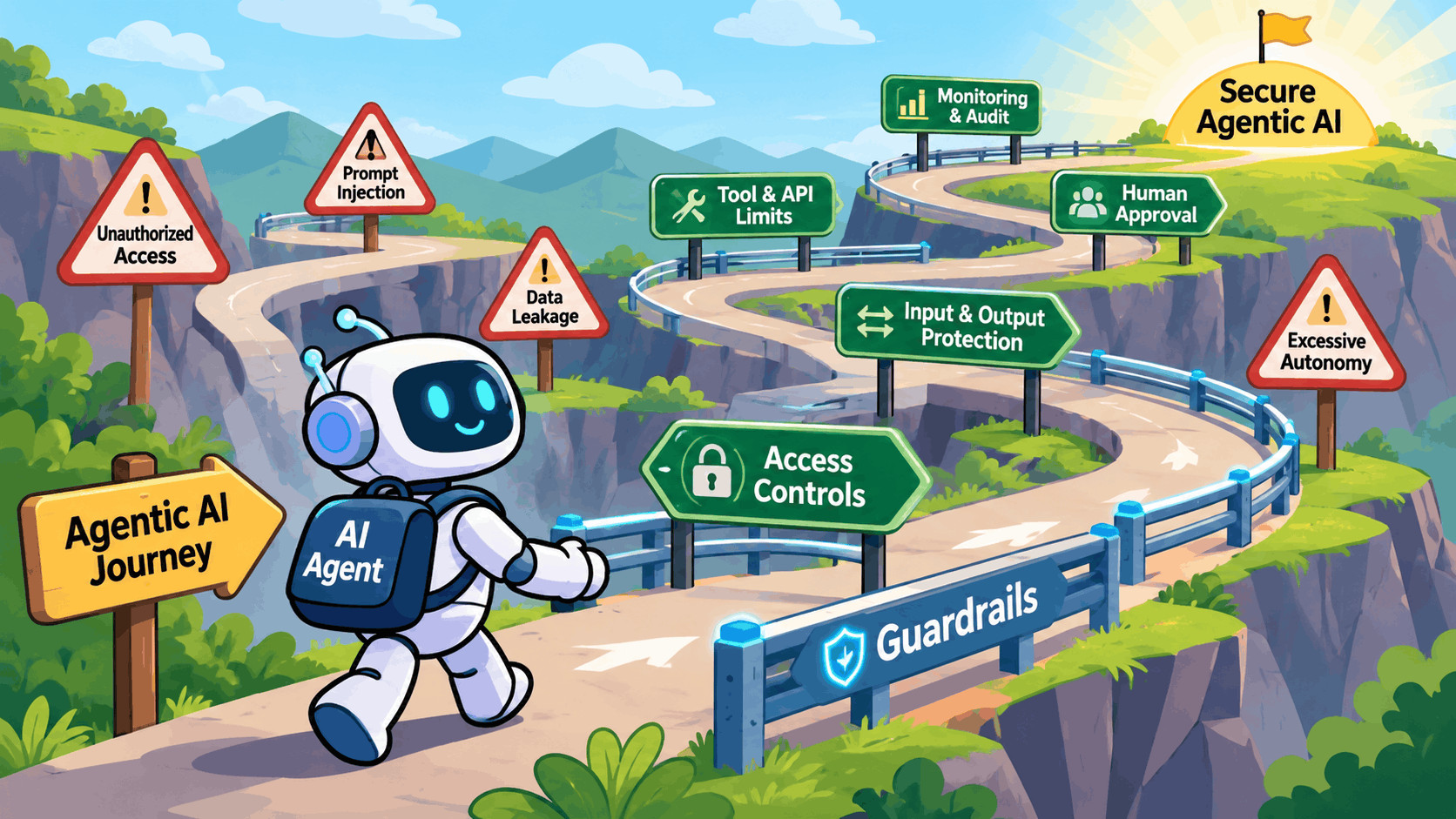
That’s where agentic AI security and guardrails come in. Security controls protect agents and the systems they interact with. Guardrails help define and enforce acceptable behavior.
Together, they help organizations manage risks.
| Key Takeaways: |
|---|
|
Why is Agentic AI at a Greater Security Risk?
Traditional AI systems and agentic AI systems face many of the same security threats, including data leakage, adversarial attacks, and manipulated inputs. The difference lies in what happens when something goes wrong.
A traditional AI application, such as a chatbot that only answers questions, may generate an incorrect response or reveal information it shouldn’t. An AI agent, however, may have permission to access databases, call APIs, execute code, or modify files. If compromised or misdirected, it could use those capabilities to perform unauthorized actions. Also, attackers can take control of such weaknesses and cause Remote Code Execution (RCE), which can prove to be catastrophic.
The concern is no longer limited to what the AI generates, but also what it can do.
Greater Autonomy Means Less Direct Human Oversight
Traditional AI applications often follow a relatively simple workflow: a user provides an input, the model processes it, and the application returns an output.
Agentic AI can go further. An agent may break a goal into smaller tasks, select tools, evaluate results, and decide its next action without requiring approval at every step.
For example, consider an AI agent responsible for managing cloud resources. It might identify unused resources and initiate cleanup operations. If it incorrectly identifies an active resource as unnecessary, it could disrupt a running service.
The risk comes from allowing the system to act on its decisions. Without appropriate permissions, authorization checks, approval checkpoints, and safeguards, an incorrect decision can become an unwanted change to a production environment.
Access to External Tools Expands the Attack Surface
Traditional AI security often focuses on protecting model inputs, outputs, training data, and the applications serving the model.
Agentic AI introduces additional security considerations because agents frequently connect to external tools and services, such as databases, file systems, cloud platforms, and APIs.
Every integration creates another potential point of attack. For instance, an agent with access to a customer database might be tricked into retrieving sensitive records through malicious instructions embedded in a document it processes.
This is concerning when agents receive broader permissions than they need. A compromised agent with read-only access has fewer opportunities to cause damage than one authorized to modify or delete records.
Prompt Injection Can Lead to Real-World Actions
Prompt injection is a security risk for both traditional LLM applications and agentic AI systems. It occurs when malicious instructions are introduced through inputs or external content (docs, webpages, emails, etc.) in an attempt to influence the model’s behavior.
In a conventional chatbot, a successful prompt injection might cause the model to ignore instructions or produce an inappropriate response.
In an agentic workflow, the consequences can extend further.
Imagine an AI agent reviewing customer support emails. An attacker includes instructions in an email telling the agent to export customer information to an external address. If the agent treats that email content as an authorized instruction and has access to the necessary tools, it could attempt to carry out the request.
The underlying vulnerability is a failure to distinguish untrusted content from legitimate instructions. Agentic AI makes this especially dangerous because the model’s interpretation can influence tool execution.
Multi-Step Workflows Make Errors Harder to Contain
An AI agent may perform several connected actions to complete a single task. The output of one step can become the input for the next.
Consider an agent that analyzes a software defect, modifies code, runs tests, and prepares a pull request. If it misinterprets the original issue, that misunderstanding could influence the code changes and subsequent testing decisions.
The challenge is that errors can propagate through the workflow before anyone reviews the results.
Security controls must therefore consider the entire sequence of actions, not just individual prompts and responses. This includes validating tool inputs, monitoring execution, and introducing approval requirements for high-impact operations.
Sensitive Data Can Move Across Multiple Systems
AI agents often need information from different sources to complete a task. They may retrieve customer records, summarize internal documents, and send results to another application.
This creates additional opportunities for sensitive information to be exposed, particularly when agents interact with systems that have different access permissions.
For example, an agent authorized to read an internal financial report should not automatically be allowed to share its contents through an external messaging service.
Traditional AI applications can also leak sensitive data. However, agents with access to multiple connected systems introduce additional paths through which information can move.
Organizations need to control not only which data an agent can access, but also where that data can be sent and which actions are permitted.
Agent Actions Can Be Difficult to Trace
When an AI agent performs a multi-step task, it may make several tool calls, retrieve information from different sources, and adjust its approach based on intermediate results.
If an unexpected action occurs, security teams need to understand which instructions, retrieved content, tool responses, and permissions contributed to it.
A basic record of the user’s original request and the agent’s final response may not provide enough information.
Without detailed audit logs and monitoring, investigating security incidents becomes more difficult. Organizations also need a way to interrupt or stop an agent when its actions violate security policies.
What is Agentic AI Security?
Thus, you can look at agentic AI security as practices, policies, and technical controls used to protect autonomous AI agents, their workflows, and the systems they interact with. The aim is to make sure that AI agents operate within authorized boundaries, access only permitted resources, and do not perform unsafe or unauthorized actions.
Traditional AI Security vs. Agentic AI Security
| Security aspect | Traditional AI applications | Agentic AI systems |
|---|---|---|
| Primary concern | Protecting models, data, inputs, and outputs | Protecting models, data, tools, workflows, and agent actions |
| Autonomy | Often limited to generating outputs | Can independently select and execute actions |
| External access | Depends on application integrations | Frequently involves multiple tools and APIs |
| Prompt injection | May manipulate responses or connected functions | May also trigger unauthorized tool actions |
| Permissions | Usually managed at the application level | Requires controls over agent identities, tools, and individual actions |
| Error impact | May produce incorrect or unsafe outputs | May propagate errors across multiple operations |
| Monitoring | Model requests, responses, and application activity | Model activity, tool calls, permissions, and execution history |
| Security controls | Input validation, access controls, output filtering, and monitoring | All applicable traditional controls, plus tool authorization, execution limits, action approvals, and runtime monitoring |
Read more on this topic: Why Traditional Security Testing Fails for AI Systems.
OWASP Top 10 for Agentic Applications
Since AI agents interact with many interfaces, they are prone to security threats. According to OWASP, here are some of the important security risks you should consider.
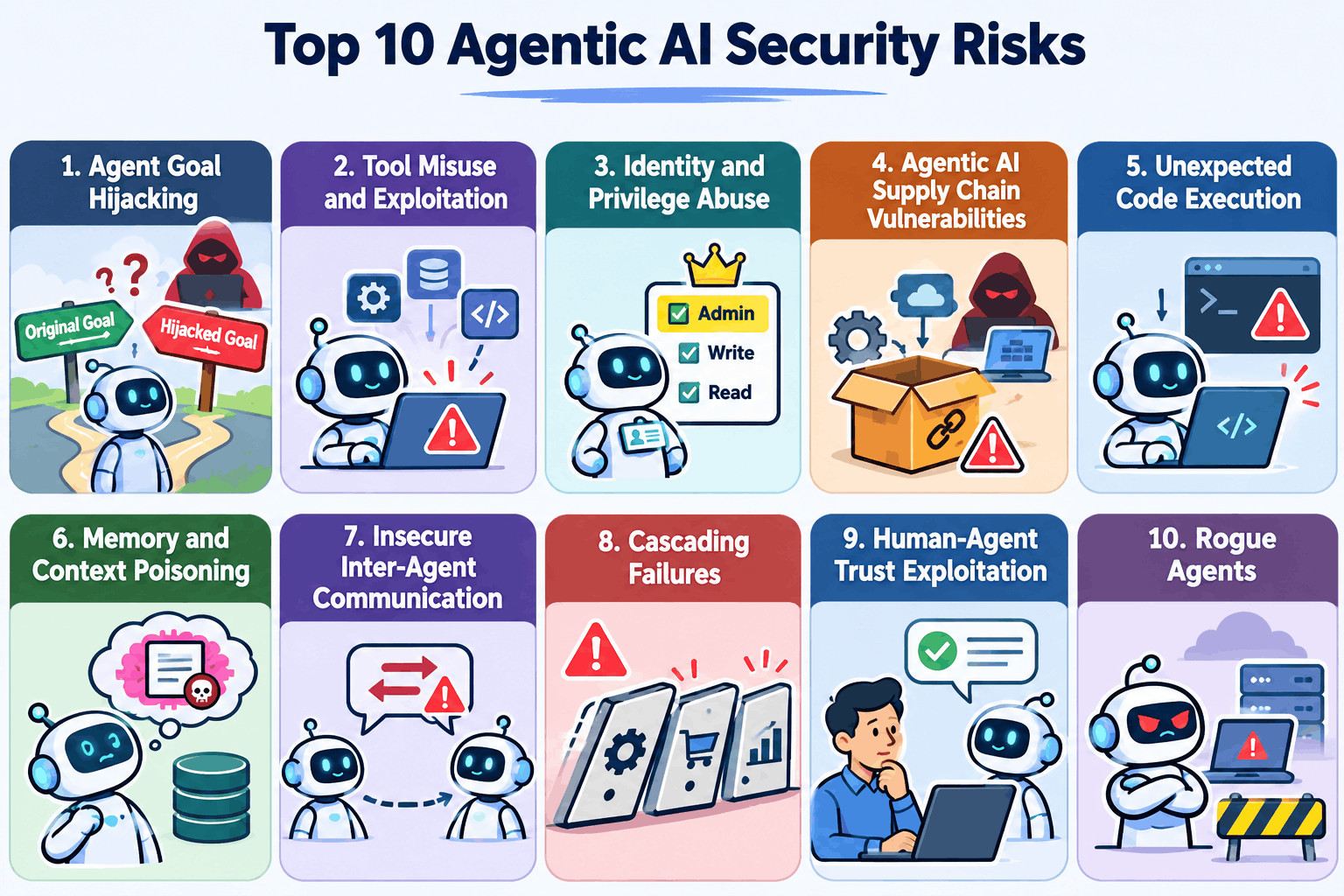
Agent Goal Hijacking
Agent goal hijacking happens when an attacker manipulates an AI agent into pursuing a different objective from the one originally assigned.
Security risk: Unauthorized actions, sensitive data exposure, and manipulation of business workflows.
Tool Misuse and Exploitation
AI agents often use tools such as APIs, databases, browsers, and command-line interfaces to complete tasks. Tool misuse occurs when an agent uses an authorized tool in an unsafe or unintended way. The tool itself may be legitimate, but the agent’s decision to use it can create security problems.
Security risk: Unintended transactions, data modification, service disruption, and misuse of connected applications.
Identity and Privilege Abuse
AI agents need permissions to access files, applications, and services. This becomes especially risky when one agent delegates tasks to another. A lower-privileged agent should not automatically gain access to everything available to a more privileged agent.
Security risk: Privilege escalation, unauthorized data access, and misuse of trusted identities.
Agentic AI Supply Chain Vulnerabilities
AI agents rely on different external components. If one of these components is compromised or malicious, it can introduce security risks into the agent’s workflow.
Security risk: Compromised integrations, unauthorized tool behavior, data theft, and supply chain attacks.
Unexpected Code Execution
Some AI agents can generate and execute code to complete tasks. This becomes dangerous when untrusted inputs influence the commands or scripts the agent runs.
Security risk: Remote Code Execution (RCE), malware installation, unauthorized file access, and system compromise.
Memory and Context Poisoning
AI agents may store information from previous interactions, retrieved documents, or completed tasks to help with future decisions. Memory poisoning occurs when an attacker inserts false or malicious information into that stored context.
Security risk: Persistent manipulation, incorrect decisions, unauthorized actions, and long-term data integrity problems.
Insecure Inter-Agent Communication
In multi-agent AI systems, different agents communicate and exchange information to complete tasks. If these communications are not properly authenticated and validated, an attacker may impersonate an agent, alter messages, or introduce unauthorized instructions.
Security risk: Agent impersonation, manipulated instructions, unauthorized data access, and compromised multi-agent workflows.
Cascading Failures
A cascading failure occurs when a problem in one part of an agentic AI workflow spreads to other connected agents, tools, or systems.
Security risk: Widespread operational disruption, incorrect transactions, resource exhaustion, and loss of data integrity.
Human-Agent Trust Exploitation
People may trust AI-generated recommendations, especially when an agent appears knowledgeable or has access to internal business systems. Attackers can exploit this trust by influencing an agent to produce misleading instructions, false approvals, or deceptive recommendations that encourage users to take unsafe actions.
Security risk: Social engineering, credential theft, unauthorized approvals, and unsafe human decisions.
Rogue Agents
A rogue agent is an AI agent that operates outside its intended goals, permissions, or organizational controls.
Security risk: Uncontrolled actions, service disruption, unauthorized resource changes, and difficulty identifying or stopping unsafe agent behavior.
What are Agentic AI Guardrails?
Agentic AI guardrails are meant to keep AI agents within authorized boundaries by restricting access to sensitive data, controlling tool usage, validating actions, and preventing violations of security policies. You might see them as rules, policies, and technical controls.
What Role do Agentic AI Guardrails Play in Agentic AI Security?
- Preventing unauthorized actions
- Controlling tool and API access
- Protecting sensitive information
- Reducing prompt injection risks
- Enforcing human oversight
- Monitoring agent behavior
However, guardrails alone do not guarantee agentic AI security. They must work alongside authentication, authorization, least-privilege access, secure tool integrations, and runtime monitoring.
Here’s an interesting read: Is Having Good Model Guardrails Enough? Testing for a Safer Product.
Agentic AI Guardrails to Consider
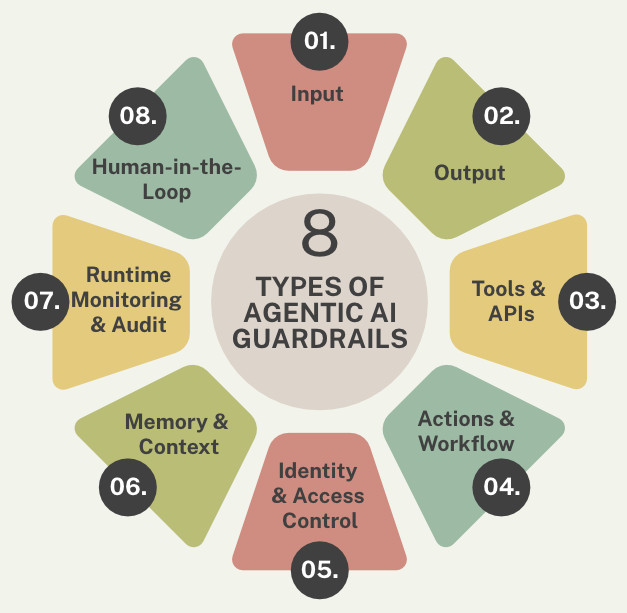
Input Guardrails
Their purpose is to identify potentially harmful inputs, enforce data-handling policies, and reduce the risk of malicious instructions influencing the agent.
- Prompt injection detection: Identifying attempts to manipulate an agent through malicious instructions in user inputs or external content.
- Input validation: Checking whether incoming data follows expected formats, structures, and size limits.
- Sensitive data protection: Detecting and masking personal or confidential information when it is not needed for the task.
- Trust boundary enforcement: Preventing untrusted content, such as a retrieved webpage, from being treated as a system instruction.
- Goal and intent validation: Define the agent’s authorized objectives and check whether incoming instructions attempt to change them. Unexpected changes to the original task should require additional validation or approval.
- Prompt Testing: A Complete Guide to Testing AI Prompts
- What are System Prompts and How to Test Them?
- Testing Prompt Robustness Against User Variations
- What is Prompt Versioning and Why do We Need it?
Output Guardrails
These controls help prevent sensitive data exposure, policy violations, and responses that do not meet the application’s requirements.
- Sensitive information filtering: Detecting and blocking or redacting confidential information, credentials, and personal data.
- Content safety checks: Filtering responses that violate defined safety or organizational policies.
- Response validation: Checking generated output against required formats, schemas, or business rules.
- Grounding checks: Evaluating whether factual claims are supported by approved sources when the application requires source-grounded responses.
- Agent-to-agent message validation: Verify the structure, integrity, and authorized purpose of messages exchanged between agents. Use authenticated communication and message integrity checks to prevent unauthorized changes.
Tool and API Guardrails
Tool guardrails determine which tools an agent can use and what operations are permitted.
- Tool allowlisting: Making only approved tools available to an agent.
- Least-privilege permissions: Granting access only to the resources and operations required for the task.
- Tool-call validation: Checking arguments, target resources, and requested operations before execution.
- Execution restrictions: Limiting access to dangerous commands or sensitive environments.
- API usage limits: Apply rate limits, cost ceilings, and restrictions on repeated tool calls to prevent excessive resource consumption.
- Third-party component verification: Maintain an inventory of tools and dependencies, verify their sources, and use approved versions. Scan integrations for vulnerabilities and unexpected changes.
Action and Workflow Guardrails
Even when individual tool calls are valid, the overall sequence of actions may create security or operational risks.
- Approval checkpoints: Requiring human authorization before sensitive or irreversible actions.
- Transaction limits: Restricting the value, volume, or scope of operations an agent can perform.
- Workflow validation: Checking whether actions follow approved business processes.
- Execution limits: Setting limits on tool calls, retries, execution time, and resource consumption.
- Failure isolation: Prevent errors in one agent or workflow from automatically affecting other systems. Use isolated execution environments, bounded retries, and circuit breakers where appropriate.
- Recovery mechanisms: Provide ways to stop workflows, revoke access, and roll back changes when operations fail, or an agent behaves unexpectedly.
Identity and Access Control Guardrails
Identity and access controls establish which resources an agent can access and under what conditions.
- Agent identity: Assigning identifiable credentials or service identities to agents where supported.
- Role-based or attribute-based access control: Restricting operations according to assigned roles, policies, and context.
- Credential management: Using secure storage and short-lived credentials where practical.
- Per-action authorization: Recheck permissions before sensitive operations instead of relying only on authorization granted at the beginning of a workflow.
- Delegation restrictions: When one agent assigns work to another, pass only the permissions needed for that task. Do not automatically transfer the original agent’s full access rights.
- Secure inter-agent authentication: Verify the identity of communicating agents and protect their messages against impersonation, tampering, and replay attacks.
Memory and Context Guardrails
- Restricting who can read or modify stored agent memory.
- Separating sensitive context between users, tasks, or tenants.
- Validating information before adding it to persistent memory.
- Applying retention limits and removing information that is no longer needed.
- Maintaining appropriate version histories or snapshots so suspicious changes can be investigated and reversed.
- AI Context Explained: Why Context Matters in Artificial Intelligence
- Testing AI Tone, Empathy, and Context Awareness
Runtime Monitoring and Audit Guardrails
Runtime monitoring helps identify suspicious behavior, while audit logs provide information needed to investigate incidents.
- Tool-call logging: Recording which tools were invoked, with what parameters, and whether the operations succeeded.
- Anomaly detection: Flagging unusual access patterns, repeated failures, or unexpected sequences of actions.
- Policy violation alerts: Notifying security teams when agents attempt restricted operations.
- Execution interruption: Providing mechanisms to pause or terminate workflows when unsafe behavior is detected.
- Behavioral baselines: Define expected agent capabilities and activity patterns so unusual behavior can be investigated.
- Continuous security testing: Test agents against prompt injection, tool misuse, privilege escalation, memory poisoning, and other relevant threats. Repeat these tests after changes to tools, models, permissions, or workflows.
Human-in-the-Loop Guardrails
Human-in-the-loop guardrails introduce approval or review requirements at critical points. This is valuable for high-impact actions, although it should complement rather than replace technical authorization controls.
How an Agentic AI Guardrail Framework Works
These guardrails work best as connected security layers throughout an agent’s execution lifecycle.
A typical framework follows this sequence:
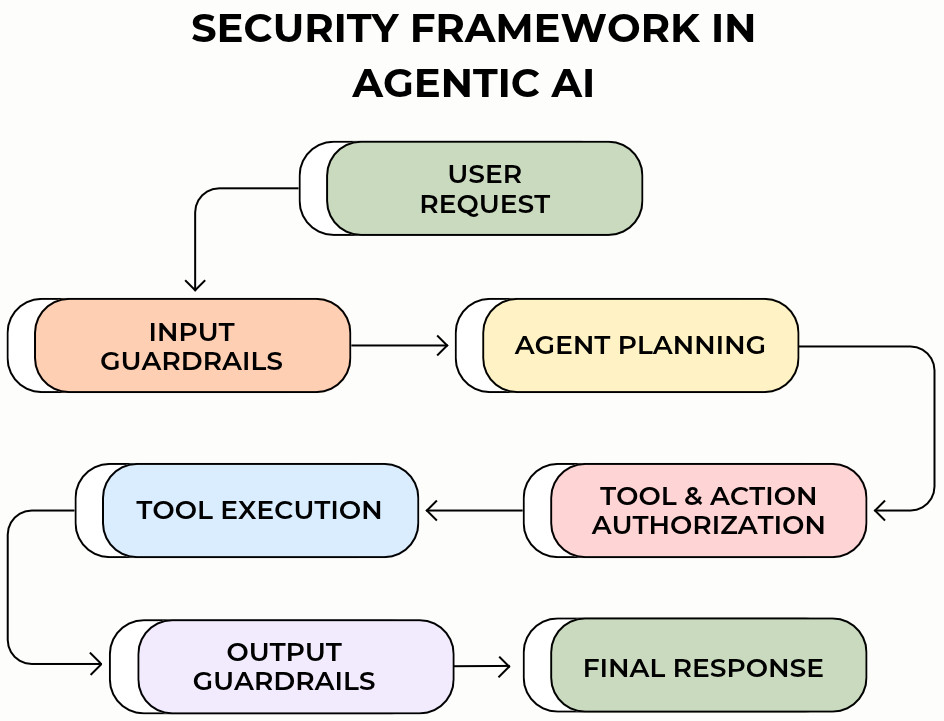
Human approval is introduced wherever the risk of an action warrants additional oversight. This layered approach is important because no single guardrail can address every agentic AI security risk.
- Input guardrails check the customer’s request and any supporting information.
- Identity and access controls verify which customer records the agent is authorized to retrieve.
- Tool guardrails restrict the agent to approved order-management and payment APIs.
- Action guardrails check refund eligibility and enforce transaction limits.
- Human approval is required if the refund exceeds the permitted threshold.
- Output guardrails check the customer-facing confirmation for sensitive information.
- Runtime monitoring records the agent’s actions and flags policy violations.
Common Mistakes to Avoid When Implementing Agentic AI Security and Guardrails
Relying Only on Input and Output Guardrails
Input and output filters can help detect malicious prompts, sensitive information, and unsafe responses. However, they cannot replace authorization checks on the actions an AI agent performs. For this, apply security checks at the tool and action levels. Validate permissions before executing sensitive operations rather than relying solely on prompt filtering.
Giving AI Agents Excessive Permissions
Granting agents broad access to databases, APIs, or cloud resources increases the potential damage from mistakes or malicious instructions. Follow the principle of least privilege. Assign only the permissions required for each task and review them regularly. Enforce these restrictions through the underlying access control systems.
Treating External Content as Trusted Instructions
AI agents frequently process emails, documents, webpages, and tool responses. These sources may contain malicious instructions designed to manipulate the agent’s behavior. Maintain clear trust boundaries between system instructions and external content. Treat retrieved information as untrusted data, and independently authorize sensitive actions.
Skipping Human Approval for High-Risk Actions
Autonomy is useful for routine tasks. But allowing agents to perform irreversible or high-impact operations without oversight can create unnecessary risks. Have human approval for sensitive operations, such as production changes, financial transactions, or deletion of critical data. Use technical controls to ensure an agent cannot bypass these checkpoints.
Failing to Test Guardrails Against Realistic Threats
A guardrail that blocks a few obvious malicious prompts may still fail when an attacker changes the wording, hides instructions in a document, or attempts to misuse an authorized tool. Test agentic AI guardrails against prompt injection, unauthorized tool calls, sensitive data exposure, permission violations, and multi-step workflow failures. Include both normal and adversarial test cases, and repeat testing whenever agents, tools, or permissions change.
Ignoring Runtime Monitoring and Audit Logs
An AI agent may execute multiple actions before producing its final response. Without sufficient logging, it can be difficult to determine what happened when an unexpected action occurs. Monitor tool calls, authorization decisions, policy violations, and execution outcomes. Maintain appropriate audit trails and establish mechanisms to pause or terminate unsafe workflows.
Assuming Guardrails Guarantee Complete Security
No single guardrail can detect every prompt injection attempt, prevent every incorrect decision, or eliminate all security vulnerabilities. Adopt a layered security approach that combines guardrails with authentication, authorization, secure tool integrations, sandboxing where appropriate, monitoring, and regular security testing.
Final Thought
As AI agents become more capable of making decisions, accessing data, and executing tasks independently, security can no longer stop at protecting AI-generated responses. Organizations also need to consider what their agents can access, which actions they can perform, and what happens when something goes wrong.
This is why agentic AI security and guardrails should be part of an AI system’s design from the beginning, rather than added after deployment.
The goal isn’t to restrict AI agents to the point where they lose their usefulness. It’s to give them enough freedom to complete their tasks without exposing critical systems and data to unnecessary risks.
Additional Resources
- Explainability Techniques for LLMs & AI Agents: Methods, Tools & Best Practices
- What Is Agentic QA?
- Testing Agentic AI in ERP: Enterprise Guide
- Agentic AI Guardrails Create New Testing Challenges for Banks’ Digital Systems
- How to Test a Multi-agent Ecosystem Effectively?
- AI Agents in Software Testing
- Agentic AI vs. AI Agents vs. Autonomous AI: Key Differences
Frequently Asked Questions (FAQs)
- What is the difference between AI guardrails and agentic AI guardrails?
AI guardrails are controls designed to keep AI systems operating within defined safety, security, and policy boundaries. Agentic AI guardrails extend these protections to autonomous agents that can use tools, access external systems, and execute multi-step workflows. They focus not only on what AI generates but also on the actions it performs.
- Are input and output guardrails enough to secure AI agents?
No. Input and output guardrails primarily examine information entering and leaving an AI system. AI agents also require controls over tool execution, API access, permissions, and workflow decisions. A layered security approach is necessary because an agent can perform an unsafe action even when its final response appears acceptable.
- How can organizations test agentic AI guardrails?
Organizations can test guardrails by simulating both expected behavior and security threats. Test scenarios may include malicious prompts, unauthorized API requests, attempts to access restricted data, excessive tool usage, and actions requiring human approval. Testing should verify that unsafe operations are blocked while legitimate tasks continue to work as expected.
- Do agentic AI guardrails reduce the autonomy of AI agents?
Guardrails introduce boundaries around an agent’s autonomy, but they do not necessarily prevent it from working independently. For example, an agent may be allowed to retrieve information, analyze data, and prepare reports without supervision while requiring approval before modifying production records. Well-designed guardrails balance autonomy with appropriate security controls.
| Achieve More Than 90% Test Automation | |
| Step by Step Walkthroughs and Help | |
| 14 Day Free Trial, Cancel Anytime |